| Author |
 Replies: 14 / Views: 3,531 Replies: 14 / Views: 3,531 |
|
|
Valued Member
Bulgaria
474 Posts |
Hi, all :) Anyone with information about similar variety? I found this coin in low grade, but inverted "D" as seen? I can not find similar one coin on the Internet. Thank you. 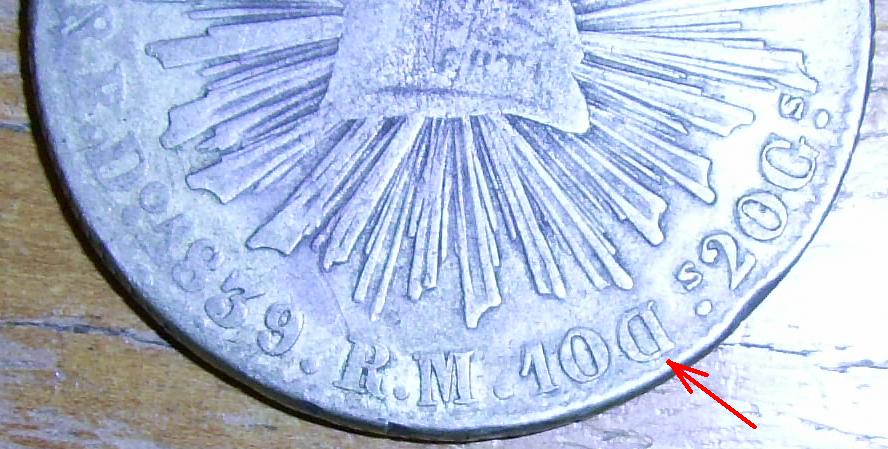 |
|
|
|
Pillar of the Community
United States
4883 Posts |
It certainly does appear to be inverted, but I don't see it as a documented variation. Ostensibly from the Durango mint, although you're probably aware of that already. Have you weighed this example with an eye to determining if it might not be a contemporary counterfeit? Very interesting in any event.
Colligo ergo sum
|
|
Valued Member
 Bulgaria
474 Posts |
Hi, I think it is 100% authentic 19th century coin, it has secure edge and weighs 25.5 grams (quite worn), 38.5 mm diameter. But this is my first coin of this type. Looks uncleaned and authentic silver coin. 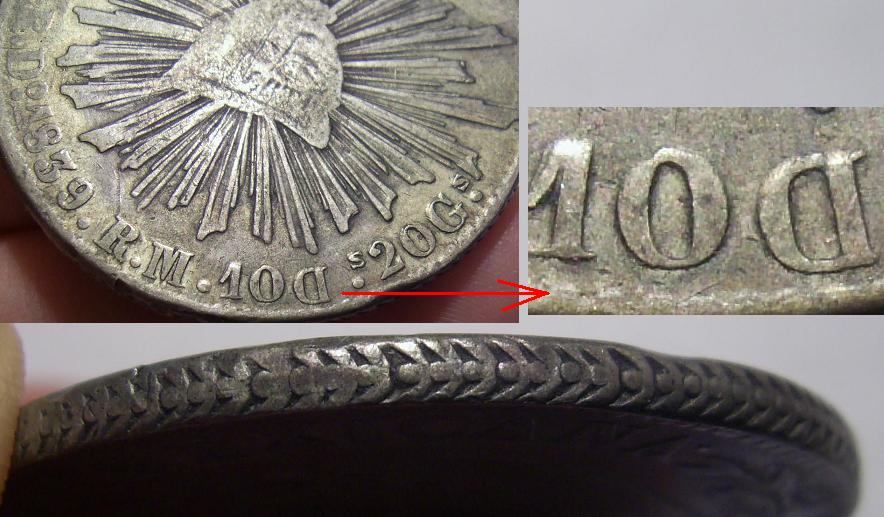 |
|
Valued Member
United States
426 Posts |
Wow, that is a interesting coin! Can you by any chance post full pictures of the obverse and reverse? I am going to try to get swamperbob in here, I am sure he will be interested in this.
|
|
Pillar of the Community
United States
4883 Posts |
Well, that looks like a drill hole on the obverse. That might've been done to see if the metal composition was uniform because it was suspected the piece wasn't genuine. Also, sometimes a hole was drilled to "cancel" a coin, that is, to mark it as a counterfeit, but in that case the coin was usually drilled all the way through. The weight's a bit light, but as you say, there's wear to consider. I'm not crazy about the appearance of the edge. But I'm not trying to run it down - whether it's authentic or not, it's still highly intriguing.
Colligo ergo sum
|
|
Valued Member
Bulgaria
474 Posts |
I think it's an authentic coin, minted in the 19th century.
Edited by bobo13
02/27/2014 4:34 pm
|
|
New Member
Mexico
7 Posts |
Hi everyone! I´m just a little nervous because is my first post in this forum but I will try to do my best. I´m not an expert but my opinnion is that this coin is a forgery, the weight is very low and the caracters are different to the original coins in Durango die style 1832 - 1842. Certainly there are people really expert in this group and I will be very interested in their review. I don´t have any in this date but compare this from 1833. Regards. 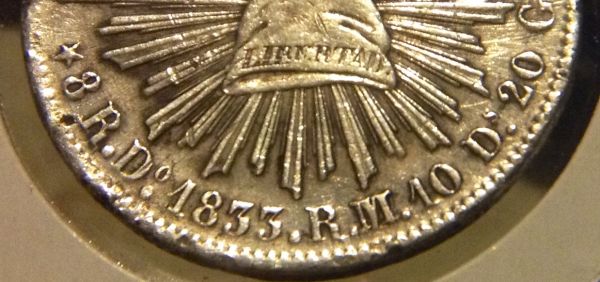 |
|
Pillar of the Community
United States
4883 Posts |
AxelLidenbrock1864, I think my previous comments imply that I'm inclined to agree with you.
Glad to have another aficionado of the ocho reales on this forum!
Colligo ergo sum
|
|
Pillar of the Community
United States
1962 Posts |
Considering the engraving error, the suggestive patina or skin, and the low weight (though not shockingly low - there was some variation even with genuine Cap & Rays of most mints, especially early on), almost certainly a contemporary counterfeit... For those who aren't familiar with them, this is a rather frequent phenomenon in this series (Cap & Ray 8R). As mentioned, SwamperBob, who has to be THE most dedicated accumulator of these, will surely comment when he gets a chance.
EDIT - Decided to not be TOO lazy... it's Riddell 376.
|
|
Pillar of the Community
United States
4883 Posts |
Thank you, realeswatcher, that would seem to be a definitive identification. Does Riddell #376 exhibit that inverted "D"? Still a cool coin. I think these early counterfeits are not to be necessarily spurned, they're an integral part of the "cap and rays" ocho reales' history. A pretty interesting collection could be made up of just all the fakes.
Colligo ergo sum
|
|
Pillar of the Community
United States
4883 Posts |
Oh, I forgot to add - one reason I wsn't too workred up over the coin's weight was that I know I read somewhere that up into at least the 1840's, the Durango mint was notorious for inaccurate assays. So 25.5 grams, while off, wasn't enough off to be a reliable diagnostic in this case.
Colligo ergo sum
|
|
Valued Member
Bulgaria
474 Posts |
Thanks for the help!
It seems really Riddell 376, my coin fits in perfectly with the pictures on the internet.
|
|
New Member
Mexico
7 Posts |
Thanks realeswatcher! I have been lookin' at Ridell's and you're correct. Same inverted D, same die style. But the weight is still to low, in Ridell's book the weight of contemporary counterfeit was very nearly 416 grains, 27 grams actually. The fineness must be 450 so, let's melt it!!  Just kidding! |
|
Valued Member
Bulgaria
474 Posts |
Today I gave this coin as a gift to a my client who bought a lot of coins from my store, along with two another coins gift. He is happy though fake, and I also, as I can not sell it on ebay because it is fake.  Thanks All for the help, good luck! |
|
Pillar of the Community
United States
5362 Posts |
Someone just called my attention to this thread.
The coin is one of the myriad of contemporary counterfeits of the French die style that flooded the US about the time Riddell wrote his book. There are reversed D types like this and a badly tilted D. These forgeries were European in origin (or at least the dies were) and they were made from at least two master hub sets.
This particular counterfeit the 1839 with the reversed D is NOT as common as it's cousins and I would definitely buy it.
|
| |
Replies: 14 / Views: 3,531 |
|









 Posted 02/26/2014 7:40 pm


