| Author |
 Replies: 19 / Views: 7,858 Replies: 19 / Views: 7,858 |
|
Pillar of the Community
Canada
2531 Posts |
Out of a coin roll I hunted, I found a US Jefferson nickel that seems to match some of the criteria for a mercury dipped coin. I immediately put it in a ziploc bag. Description: -feels greasy/oily when rubbed (other Jefferson nickels feel rough compared to this one) -has a greyish/silverish colour -darker coloured than normal Jefferson nickels-is dull under normal lighting, dullness reminds me of how lead appears in a photograph, but this coin is much lighter coloured than lead -when shined on with a very bright white light, it looks silverish, somewhat like an aluminium coin -colour does not match the tarnish colour of any other cupronickel coins (I compared them with both American and Canadian nickels) -is a 1974D (heard that the '70s is when mercury dipped coins are common) Will upload photos soon. Once I can get a good one when the coin is under plastic. How do you accurately test if the coin was actually containing mercury? |
|
|
|
Pillar of the Community
United States
6370 Posts |
You could probably contact a local Hazardous Materials company a get guidance from there. Seperating the coin and putting it in a plastic bag was a responsible step in this matter, so I commend you for that. I have no knowledge about these "mercury-dipped" 1970's nickels, but if they are as common as you advertize, then that may be what you have. You seem to have done your research, which can help in identifying the substance covering the coin.
It's still an interesting, but dangerous, novelty coin if it turns out to be what you think it is.
By the way, are you sure that the nickel is covered in oil? That would seem more likely than mercury, especially one from circulation.
Edited by TypeCoin971793
03/29/2014 08:24 am
|
|
Pillar of the Community
United States
5825 Posts |
Even before I finished reading your post I thought "mercury".
And it appears that you know the dangers of handling mercury; absorption through the skin is one way of poisoning yourself.
You can heat the coin and vaporize the mercury BUT breathing mercury vapors is worse than absorption through the skin.
If you are close to a college you could go to their chemistry department and ask for a favor.
"Please decontaminate this coin for me."
|
|
Valued Member
United States
259 Posts |
Why the heck would someone dip a Jeff in mercury?
|
|
Pillar of the Community
 Canada
2531 Posts |
I'm pretty sure it's Mercury. I'm quite familiar with how Mercury looks like. Oil looks different. I've had a couple of coins covered in oil and it doesn't make it look this dull. I guess that's what you actually get from spending the first 15 years of your life growing up in an LEDC. Regulations aren't that tight (yet). You could just pop to the nearby medical supply store and get a Mercury thermometer well into the 2000s (alchohol ones weren't common back then). And I used to break them too just so I could roll them around...  ...at least I'm not mad. Or at least I think I'm not mad. In the 80s students are given a sample of Mercury to put on their hands and swish them around just to know what it feels like, as my previous math teacher told me (here people use Gallium, which sucks because I can't get it to melt). Even primary schools have samples of elemental Mercury in their labs stored between two petri dishes held together by masking tape so the students can see what it looks like (I handled this one in person). Mercury thermometers are still very common nowdays, even in school labs. I used one when I did my IGCSEs on Dec 2012. One thing I still remember before I left to come here, pretty recent, less than a year ago. My brother broke an old Mercury thermometer by accident, and we all (dad, me, 3 younger siblings) were rolling the thing on the floor to get all of them together while mom is looking for something to scoop the thing up with. And I'm quite familiar with aluminium coinage too, it's just too bad I don't have a full coin now to compare it with. Just the edge of my Kelapa Sawit coin. Should've brought some when I went home last Christmas. They're ridiculously light. Since I had to do a project on the Minamata Bay disease in 5th grade I learnt quite a bit about Mercury, and remained quite fascinated with it. I read an older thread in the Canadian forum and found out about Mercury dipped coins and searched the forum for more since I found it quite interesting. Never thought I'd own one myself, though. Some photos. Sorry for the glare on the plastic, I don't know how to get rid of them. But it just shows how dull-looking this coin is. 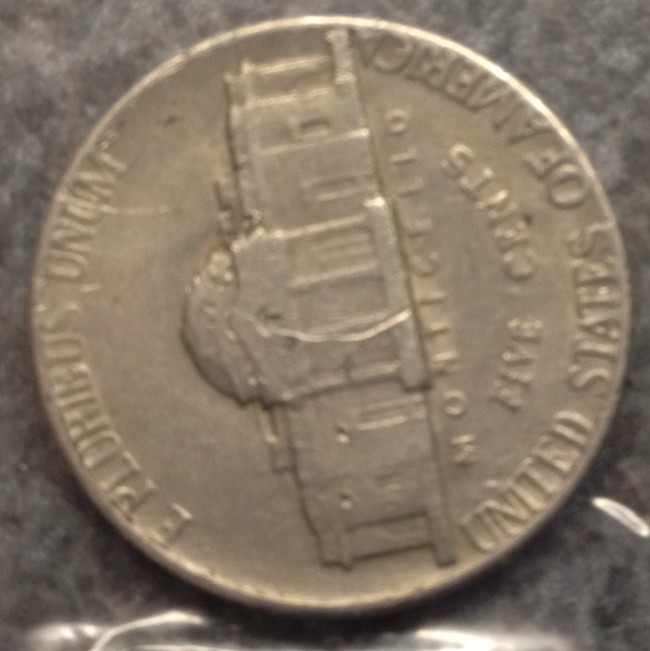 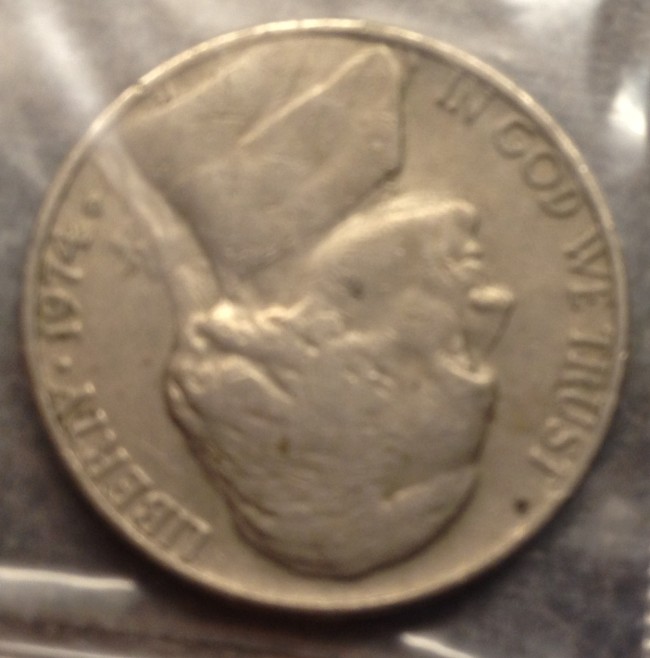 With other Jefferson nickels. Light source from top of pic, sorry. All the glare is from the plastic. There's no white spots (showing reflected light) on the coin, unlike the others. 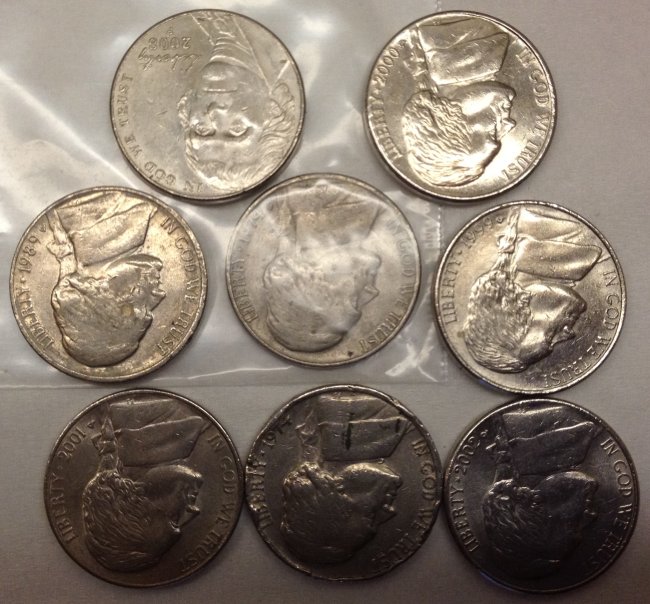 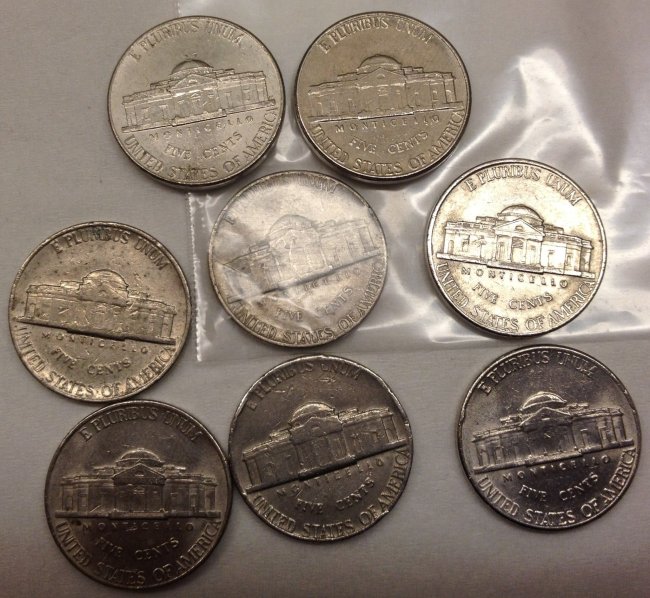 Side by side with the most tarnished Jefferson nickel I have (you find quite a few CRHing here). I have a 1938 one (which I sort of forgot to put in the pic on top) but it's not this tarnished (quite oddly). You can see white spots on the one on the right but not the suspect coin. The second photo had added light coming from the left and still no white spots. 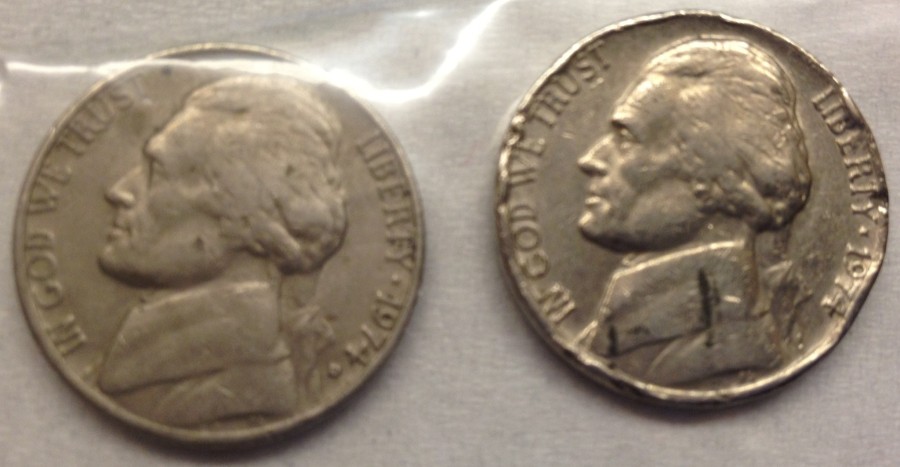 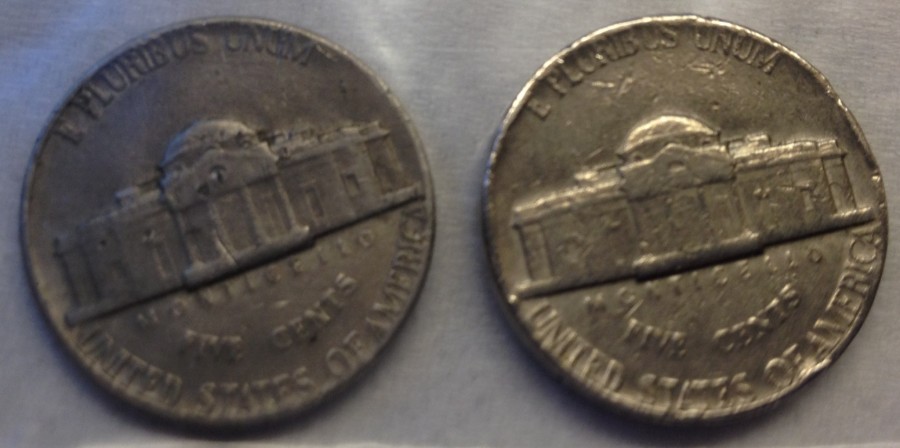 If anyone wants higher resolution pics I will upload them in a host and link them. All photos will be taken with the coin inside the plastic because I don't want to take it out again. I have put a label on the plastic with a warning (in case some person tries to because they think it's just some boring old money): 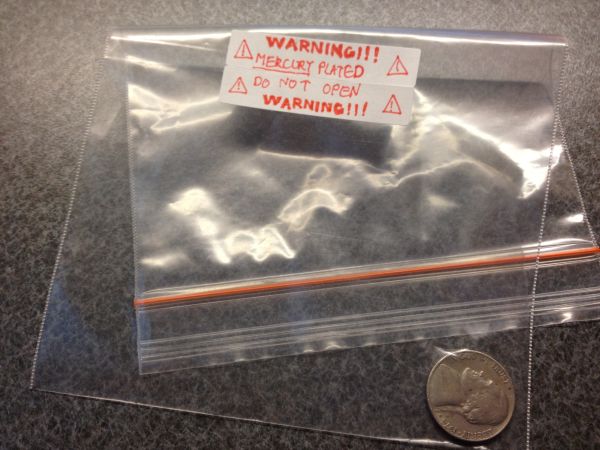 I'll probably keep this coin, though, I find it rather too dangerous to release it back into circulation if it is Mercury. Who knows how many more people are going to handle this coin. And why would someone dip a Jeff in mercury? Some people do anything... Is there a definitive test (without ruining the coin, so no 'take a hacksaw and chop it in half' please) instead of just observation by sight? Edited by Altaira
03/29/2014 2:30 pm
|
|
Pillar of the Community
United States
7730 Posts |
If your city/county has an annual Spring cleanup you can turn in hazardous materials for proper disposal. Most will accept anything like car batteries, paints, chemicals, old medicines, old appliances, tv's, computers etc. The only things most won't take are ammunition and nuclear materials (duh?). Your best bet is to call your city's solid waste department and talk to them. As hazardous as Mercury is I wouldn't want it around my house. It still is out gassing through the plastic bag. The only place I'd store it would be in a sealed glass jar clearly labeled as to what it is. Although the risk of contamination is low in this instance why take the risk?
|
|
Valued Member
United States
337 Posts |
I doubt the plastic bag is a real barrier. But mercury does combine with other metals, such as in old tooth fillings. You could check to see if it is a real hazard. Buy really, it is worth 5 cents. Any cure would cost more, so I would take it in to a hazardous materials collection point and say I lost five cents. Where can that be done? Call your waste management for your area. If they do not want it see if a local university can take it for disposal with other materials from the chemistry department.
|
|
Pillar of the Community
Canada
2531 Posts |
I will turn the coin in as soon as I can. And if if they won't take it I'll bring it to a local university. The only one I know the way to is you of T St. George, which is not too close. I'll be searching if there's a nearer chemistry lab place I can take it to if the hazardous materials won't see it. I didn't know that mercury vapour can pass through plastic. First time I heard of it. I have typed something about mercury dipped coins, please see it and tell me if I made mistakes. Thanks! https://www.dropbox.com/s/tpm7nu9kp...Y%20THEM.pdf |
|
Bedrock of the Community
United States
20753 Posts |
There are so many things that could cause that effect. For one thing there are numerous variations in oils. Also, many people use cleaner waxes on coins. Might be just someone using different cleaning materials. So many people use Olive Oils, cooking oils, etc. on coins or just on their hands and that gets on coins. Not sure if in your case Mercury but you may be just getting a bit carried away with all the hype about Mercury on coins. Just drop it off at a coin store, police station, fire station, etc. and tell them of your opinion. If you do, don't bother to ask for another Nickel in exchange.  |
|
Pillar of the Community
Canada
2531 Posts |
Perhaps. But I actually got a headache the day after having the coin in the same room where I slept for one night. I didn't know mercury vapour passes through plastic. I've moved it out of my room already.
Earlier today I took a pair of scissors and scratched the coin. A layer came off and revealed shiny metal underneath. If it is mercury dipped, it would only just be on the surface (like other things) right?
And if something did get on it, wouldn't its colour match some of the tarnish colour of the cupronickel coins? I have taken out some of my dingiest, dirtiest, dullest cupronickel coins (I have a huge pile of them) and still no match for the colours. The other coins are always a lighter and shinier colour no matter what.
Police and fire stations take hazardous materials?
|
|
Bedrock of the Community
United States
20753 Posts |
Quote:
Police and fire stations take hazardous materials? Here in the USA many cities tell residents to contact the fire, police, etc for such things. IF not sure, try it anyway. Regardless, they should take it and better them doing something with it than you. As to your headach. When I was in Chem classes in high school and college, I handled Mercury all the time. I've also been a Chem lab teacher in college. I also have made lots of toy soldiers with Lead. I've used Mercury for all sorts of things and Lead too. I'm still alive, hopefully well, nothing wrong with me that I know of YET. I really think your headach is from worrying about the Mercury, not the Mercury itself. Of course there is one thing you could do. Simply hand that Nickel to someone you hate.  |
|
Rest in Peace
United States
7075 Posts |
Mercury vapors are visible in UV(black) light. There's a demo on YouTube.
|
|
Pillar of the Community
Canada
2531 Posts |
I'm sort of new to the West culture so forgive me if I sound kind of dumb sometimes.  I come from Indonesia where things are very different. First 15 years of my life there before coming to Canada to study abroad. Tell you what, I'll bring the coin to the school chemistry lab tomorrow and see if the teacher can do something about it. There's something wrong with my connection now I think. I can't seem to load YT videos. The page opens, everything else is there, but all I see is a black box where the video should be. |
|
Bedrock of the Community
United States
20753 Posts |
Quote:
Mercury vapors are visible in UV(black) light. There's a demo on YouTube. Great place for scientific information. Probably also some imfo on big foot. |
|
Bedrock of the Community
United States
17884 Posts |
It looks to me like a normal nickel. And even if it was rubbed with mercury the mercury would have amalgamized with the nickel so and outgassing would be fairly close to zero. And mercury really isn't anywhere near as dangerous as people make it out to be. Amalgams even less so. I've had mercury amalgam fillings in my mouth for over 40 years and as far as I can tell they haven't hurt me at all. And they aren't just subject to outgassing but also leaching from eating acid rich foods and the acids produced by saliva and mouth bacteria.
|
|
Pillar of the Community
United States
1554 Posts |
I agree with Conder101. I find this topic kind of silly. No offence intended SlurExe97. Just think of all the stuff that's on money. I don't worry.
|
| |
Replies: 19 / Views: 7,858 |










 Posted 03/29/2014 08:29 am


