



Coin Community Family of Web Sites Join Thousands of Coin, Bullion, & Money Collectors
Vancouvers #1 Coin and Paper Money Dealer Specializing in Modern Numismatics Coin, Banknote and Medal Collectors's Online Mall Royal Canadian Mint products, Canadian, Polish, American, and world coins and banknotes. Join Thousands of Coin, Bullion, & Money Collectors 300,000 items to help build your collection! Royal Estate Auctions - $1 Coin Auctions


Username:
Password:
Save Password
Forgot your Password?


This page may contain links that result in small commissions to keep this free site up and running.

Welcome Guest! Registering and/or logging in will remove the anchor (bottom) ads. It's Free!

Mint Peculiarity Or Plain Fake? 1805 Carolus IIIi 8R Mexico

To participate in the forum you must log in or register.
Author Previous TopicReplies: 2 / Views: 3,256Next Topic  
Valued Member
NewSpainLearner's Avatar
United States
55 Posts
 Posted 04/03/2014  03:13 am Show Profile   Bookmark this topic Add NewSpainLearner to your friends list Get a Link to this Message Number of Subscribers
Hi guys.
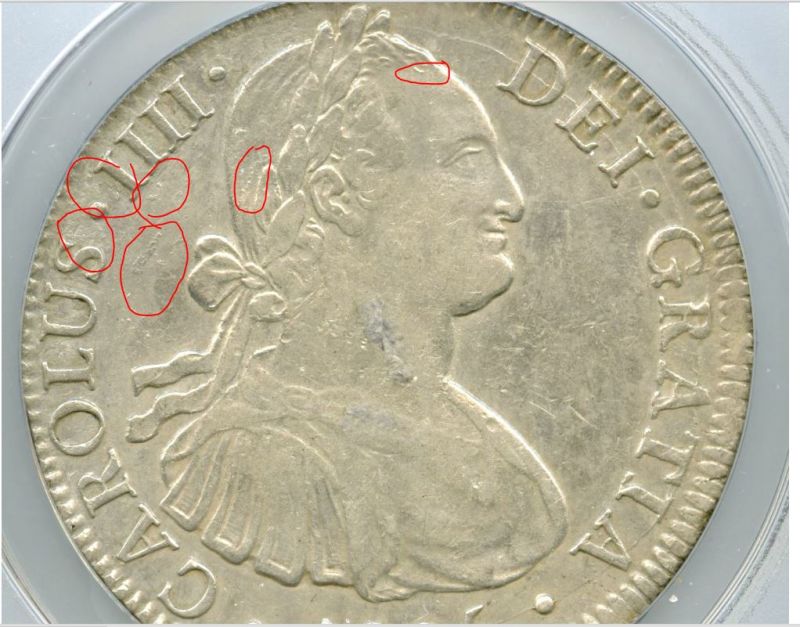
What do you think of this coin?
Have two questions:
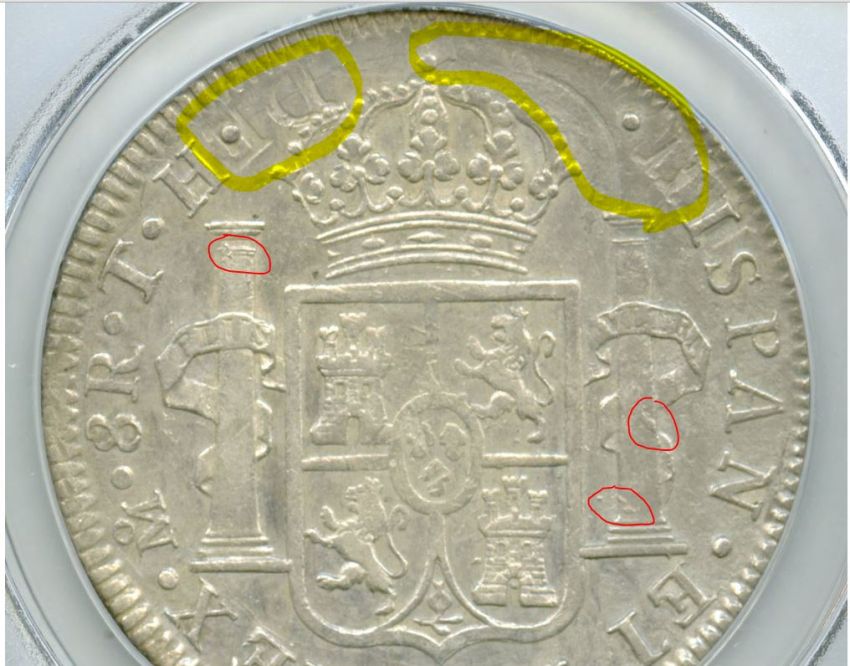
One, there is small flat islands of metal on the surface. Seems there are multiples but I'm highlighting some of the more noticeable (Please see images). These dont seem right to me, but I'm no expert. Are this in general normal in original coins or a strong suggestion of cast reproductions? It seems to me these could be product of molds use for duplication/forgery, but I'd like your experienced opinion.

Two, on this specific coin there is a partial imprint of the bust side of the coin on the crown side (see pic), particularly on the top portion where the silhouette of Charles IV head can be seen as well as the "DE" from DEI GRATIA to the left and a "II" from a partial "IIII" on the right, where the "H" for "HISPAN" would be. These are sunk, like if another coin (not a die) would have pressed over it there. Dentils also show this.
Is this possible? Do you think its original? Or are we seeing just a plain mistake in the manufacture of a "replica"?

The curious thing in this case is that this coin is supposedly ANACS certified (#4901726) and within a case.
Searching online the anacs # matches the coin type, but would that necessarily mean the coin inside is the one from the certification? How easy is it to open these ANACS cases and replace the coin inside making no damage to the anacs case?
Do you think its possible ANACS would inadvertently grade a fake coin in case this is one?

Thanks again for your comments !

Mint-Peculiarity-Or-Plain-Fake?-1805-Carolus-IIIi-8R-Mexico

Mint-Peculiarity-Or-Plain-Fake?-1805-Carolus-IIIi-8R-Mexico
Edited by NewSpainLearner
04/03/2014 04:18 am
Pillar of the Community
colonialjohn's Avatar
United States
1757 Posts
 Posted 04/03/2014  11:09 am  Show Profile   Bookmark this reply Add colonialjohn to your friends list Get a Link to this Reply
The fact this coin is in an ANACS holder to me makes it genuine - with the understanding of these points as well - this is die clashing in which images of the opposite die are transferred - with die clashing as is sometimes seen coin fragments get caught in the striking chamber and these may be the bits of coin fragments seen throughout that you highlighted ... there is a term used by the error specialists on Federal Coinages Diamond/Weinberg & Co ... die clash - floater ... A floating die clash is generated in the aftermath of a die break. After it breaks off, the die fragment remains behind in the striking chamber and is struck by the dies. Usually one of the dies is protected by a planchet. If the other die strikes the working face of the die fragment, the incuse, mirror-image design elements on the fragment are transferred to the intact die (or the intact portion of the broken die). Those transferred elements are raised and normally-oriented on the die face. Every coin that is struck afterward has incuse, mirror-image design elements in an unpredictable location. Most floating die clashes are restricted to the field, as this is the portion of the die face that is most vulnerable to damage ... could be ... if the clash lettering do not orientate properly - you also need to learn to supply weights and ask for weights ... normally use 26.5 grams. In our new GNL Book we have shown that a Good-4 coin weighs around 25.2 grams after measuring low grade coins - so anything even if well worn below 25.2 grams is vurtually an automatic fake ... I could write till tomorrow ... but as suggested buy slab or from reputable dealer ... I think this is why Swamperbob's book will be so great ... its not REALLY a book about just attributing CC8Rs so advanced collectors can add a few GNL Class 1's to their cabinets with a GNL # ... but learning to become a smarter buyer and avoiding ounterfeits and MODERN FAKES if all you want are regals ... big difference ... BUY THIS ONE ... besides errors on Portaits are RARE ... after you own check for die clash floating errors ... where the images don't match up! <VVBG>.

John Lorenzo
United States
Edited by colonialjohn
04/03/2014 11:15 am
Valued Member
NewSpainLearner's Avatar
United States
55 Posts
 Posted 04/03/2014  8:43 pm  Show Profile   Bookmark this reply Add NewSpainLearner to your friends list Get a Link to this Reply
John, thanks a lot for the insight on die clashes. New to me.
Have this coin already and what worries me most is not the inverted potential die clash lettering on top, but the small "debris" areas we discussed. In the picture they dont show too much or that clearly, but these are pretty much everywhere and through a good magnifier, they dont look like loose pieces that were caught in the die and marked it. It looks more like when you are playing with plaster and trying to make a surface even but several layers were put and tried to make those flat with very poor results. They are all over, which concerns me could be potentially an indication of coin image transferring for duplication.
Look at the center of the coat of arms too. the three flowers are pretty weak and the top left flower has a missing portion. that missing portion seems too one of those copy-transfer errors, just not raised.

I'd love to look at the edge of this coin and verify how it looks overall and check the overlaps. Same thing with weighting. But the slab seems to be sealed. Not sure if its meant to allow opening or if it has to be destroyed to open, as a security measure.
Do you know if ANACS keeps images of the coins graded?
I noticed they keep descriptions based on the serial number, but that doesn't help much, as the coin inside could be any other matching the description but sneaked into a certified slab by a clever dealer.
If they at least added more identifying features in the tag, specific to the coin graded, like weight, diameter or even distinctive marks, it would be a much helpful service, beyond grading, for help fighting all this counterfeiting that takes place in the industry.
Thanks again !
  Previous TopicReplies: 2 / Views: 3,256Next Topic  

To participate in the forum you must log in or register.


Disclaimer: While a tremendous amount of effort goes into ensuring the accuracy of the information contained in this site, Coin Community assumes no liability for errors. Copyright 2005 - 2026 Coin Community Family- all rights reserved worldwide. Use of any images or content on this website without prior written permission of Coin Community or the original lender is strictly prohibited.
Contact Us  |  Advertise Here  |  Privacy Policy / Terms of Use

Coin Community Forum © 2005 - 2026 Coin Community Forums
It took 0.22 seconds to rattle this change. Forums