| Author |
 Replies: 68 / Views: 6,944 Replies: 68 / Views: 6,944 |
|
|
|
Pillar of the Community
 Canada
2533 Posts |
I wasn't able to get permission today, Tuesday maybe the teacher says.
Oh well, I guess I'll have the next 4 days to plan out stuff.
I'm on a trip though, so no being able to prepare things.
|
|
Pillar of the Community
Canada
2533 Posts |
I got permission today, but I doubt I can finish it now. I'll tell you back what I find when I do. Edit: Here's a quarter that I de-plated by put in vinegar and salt solution for 30 minutes with 3 AA batteries. Sorry for the blurry pics. I'm under the stairwell now, bad lighting and my magnifying glass is upstairs. 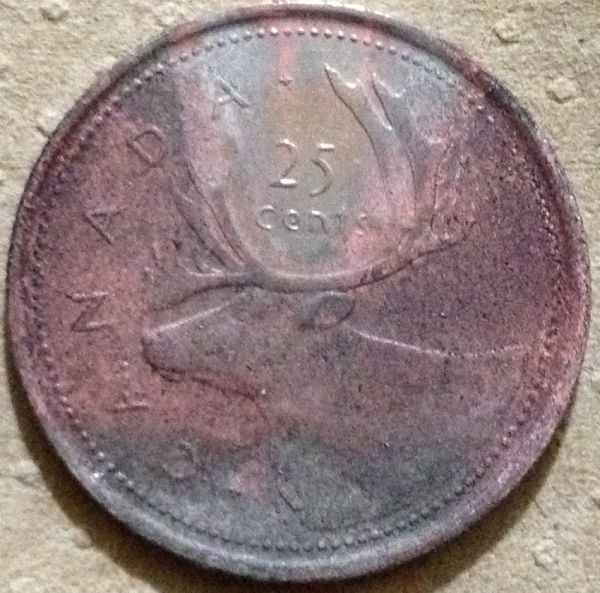 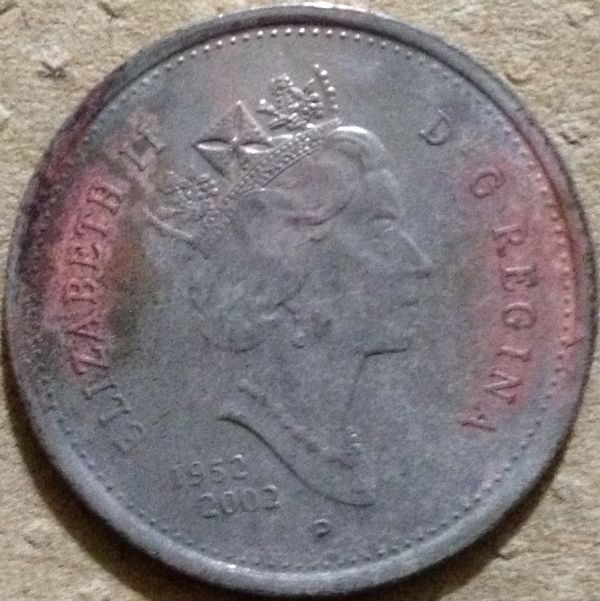 The change is slow enough that I could see the original silvery finish turn grey, then pink, then grey, then pink. The top part isn't dull because it was clipped there and the bottom part isn't showing pink because I put too much salt and the coin is sitting in the salt. Now they have a class in the chemistry lab. I've left a 2012 quarter in there and I will take it later. Edited by Altaira
05/20/2014 2:41 pm
|
|
Pillar of the Community
Canada
2533 Posts |
Sorry no pics yet now, but I found out a difference in a 2012 quarter.
The old one had multiple layers of copper and nickel plating and I haven't reached the core yet.
The 2012 one looks like it's got one nickel outer plating, a copper plating under that, and some black metal under it which gets "sucked out" of the coin faster than the copper or nickel. The letters and date is sunken after the plating on that area was electrolysed off.
Note that this is only 1 set. I will do more to compare more. Now I'm letting one run overnight. I forgot the date but it's the old one.
Anyone wants to experiment too is welcome!
|
|
Valued Member
Canada
372 Posts |
Did you make the nickel acetate first? The quarter should strip in no time.
|
|
Pillar of the Community
Canada
2533 Posts |
No I didn't, and now I see why this thing is going very slow. Do I just need to add nickel to the vinegar to make nickel acetate? If yes I'll drop a nickel nickel in there and hope it dissolves.
|
|
Valued Member
Canada
372 Posts |
You make me laugh, most kids hide under the stairwell to smoke cigarettes, not preform science experiments. I used a nickel on both positive and negative to get the solution to a nice bright green. More salt should speed up the reaction since you are using low voltage. The closer the anode and the electrode are in the solution, the less resistance there is so it will speed up the reaction. NICKEL ACETATE IS POISONOUS Edited by wolfman-11
05/22/2014 11:31 am
|
|
Pillar of the Community
Canada
2533 Posts |
The stairwell is MY territory now, anyone who dares even put their stuff there I will put away somewhere else, usially the ideal place is somewhere in the middle of the stairs  I'm doing the exeriment in the Chemistry lab since I'm not allowed to take materials out. But under the stairwell is where I analyse my coins during school time. Concrete floor, not carpeted or hardwood like all the other places! Plus the acoustics is good, there used to be a really old piano there (which they threw out already) and that piano only sounds good under the stairwell, not anywhere else. I have an idea already, I'll borrow a hot plate to supersaturate the salt, then I dissolve the nickel. Then I begin the deplating. Not sure if I can do it today, but if I don't by tomorrow, I'll have to wait until next week again. Don't know if I should tell the teacher I'm making Nickel acetate, if I do I may not be allowed, if I don't I might get in trouble making something poisonous. She's not here today, maybe I'll do it quietly today and throw it out before tomorrow. |
|
Valued Member
Canada
372 Posts |
I'm sure that if you deactivate it with a base, you can dump it without a problem.
I grabbed a 5v dc power adapter from a D-link router and cut the end off. I had some alligator clips I used for the ends. with this lower voltage.
I nickel plated a copper clamp I needed to be corrosion resistant and it turned out well. Also there was very little fuming compared to the 12 volt battery I used in the first test. I am using hydrochloric acid because that is what I had, but the vinegar should produce the same results.
|
|
Pillar of the Community
Canada
2533 Posts |
I've placed the nickels in the vinegar and waiting now if it will turn green. The teacher did come in, I think for whatever reason she had to leave is done. I'm not sure if it will turn green because I'm still using the same batteries since the start. I'm waiting for the people in the class to come out when they're done so I can continue.
Also a friend wants to plate some quarters with copper and she wants me to help her. So I'll update you when I'm done in the lab.
|
|
Valued Member
Canada
372 Posts |
What you are doing should remove the nickel and leave the copper unless you let it sit too long.
If you want to copper plate something you need copper acetate which is a mix of acid and peroxide that you dissolve copper in. I have not done this yet since I had no need to. I plan to mix some up to remove some gold plating.
|
|
Pillar of the Community
Canada
2533 Posts |
We were using Copper sulphate, and for the anode either a pencil lead, zinc core penny, or a zincoln with signs of zinc rot. Why use the nice copper ones when I can get rid of zincolns that I hate which I got so many in the States? Or I can try uncladding an American dime or quarter to get the copper core. The plating came out mostly pink instead of red though. Also had some fun plating a penny with a nickel make a silver penny heh heh  There was some chrome in the lab, I tried plating a penny with it but it came out grey instead of blue like the block of chrome. Weird. I've prepared around 140mL of Nickel acetate solution. I think I may have accidentally contaminated it with some Copper, since I used the same wires, but I don't think it matters too much in this case. The lab is closed for the day, so I'll continue tomorrow. These things heat up quite a lot don't they. Connections become too hot to touch quite fast. Who knew electroplating stuff is so much fun?  |
|
Valued Member
Canada
372 Posts |
Mine got contaminated when I stripped that dime, also do not let the wire on the cathode get into the solution. the positive can be immersed to completely cover the coin. It should not be that hot. Is it really bubbling?
|
|
Pillar of the Community
Canada
2533 Posts |
I used 5 batteries to speed up making the solution and it did bubble a lot. There was smoke coming out of it, not sure if it's boiling or fuming.
|
|
Valued Member
Canada
372 Posts |
If your school has a tech department, ask the electronics teacher for some scraps of copper wire, they are high quality copper ideal for plating, and free.
|
|
Pillar of the Community
Canada
2533 Posts |
Unfortunately I don't know anyone from the tech department. The lab has some copper sheets or whatever you call it, but my friend wanted to use Copper sulphate and a graphite anode. Plating by other coin was my suggestion, since I'm unplating coins anyway. I'll ask tomorrow if they could spare some copper sheets for an anode. By the way, the result of using copper from a zincoln results in a brighter plating result than using graphite, but you can produce interesting patterns on the coin plating when using graphite because it bubbles and the bubbles are quite "solid" and they stick on the coin. Except when it got left for too long and the quarter was zinc plated instead. Edit: So far I've removed these layers from a 2012: nickel, copper, nickel, copper. There must be something wrong that I did in the first time because the penny was coated with a black substance, maybe it was Carbon, I don't know where that came from. There's another silvery metal under it but I don't know what it is yet. And I've left the coin in the lab. I can't continue it until Monday, because students aren't allowed to be alone in the lab. The teacher had to go home just when it starts getting interesting  Edited by Altaira
05/23/2014 5:32 pm
|
| |
Replies: 68 / Views: 6,944 |






 First Page
 Previous Page


 Posted 05/20/2014 1:37 pm


