| Author |
 Replies: 68 / Views: 6,928 Replies: 68 / Views: 6,928 |
|
Pillar of the Community
Canada
2533 Posts |
I don't know about 2000 quarters since I don't have any at the moment. I tapped (the sound test where you balance a coin on a knuckle and tap it with another coin) quarters from 2001, 2002, and 2003 (I only have the new effigy types). The 2001, 2002, and some of 2003 sound like the main composition is copper. The rest of the 2003 sound like newer year quarters.
Has anyone ever tried this before, and does anyone know why they sound different?
|
|
|
|
Rest in Peace
1988 Posts |
|
|
Pillar of the Community
 Canada
2533 Posts |
Thanks wert. I'll download it and try it out. Edit: I followed the instructions but couldn't get it to work. I don't know what I'm doing wrong. I suck at doing stuff with computers  Here is the result for a 1963 quarter, I used that one because of its characteristic silver ring. 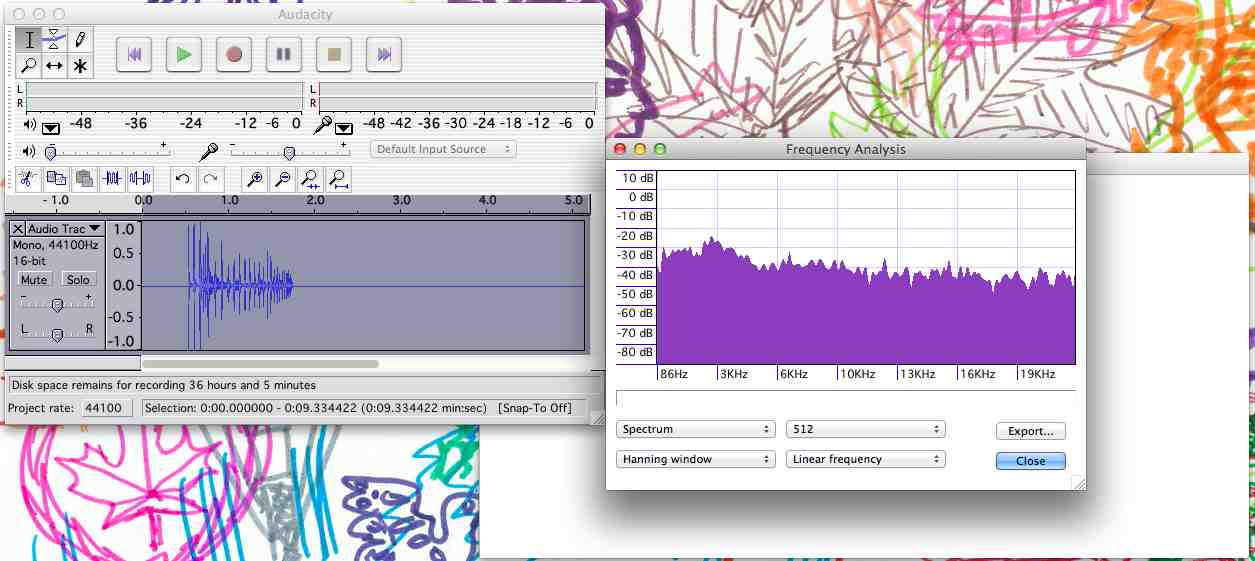 Edited by Altaira
04/12/2014 11:49 pm
|
|
Valued Member
Canada
372 Posts |
This is right from the Canadian mint. Quote:
2000 - date
Composition: 94% steel, 3.8% copper, 2.2% nickel plating
Weight (g): 4.4
Diameter (mm): 23.88
Thickness (mm): 1.58 What are you trying to determine? By the way, the audacity ring test is very accurate in my opinion. I have used it on 1967 quarters and dimes with effective results. I can hear the difference after a few times, the 50% have a higher ring to me which is not as pleasing to the ear, or the value. Edited by wolfman-11
04/13/2014 4:25 pm
|
|
Pillar of the Community
Canada
2533 Posts |
I couldn't get the Audacity to work. I don't know what I'm doing wrong, but any coin I tested came out with that kind of graph when I clicked analyse. They are all mostly level graphs and not a high-to-low graph like the one wert did.
I'm just curious why my 2001-some of 2003 quarters have a more "coppery" sound to the ear when tapped.
|
|
Valued Member
Canada
372 Posts |
I will check some out and report back.
|
|
Pillar of the Community
Canada
2533 Posts |
Thanks wolfman-11. Compare it to a 2004 onwards quarter, the newer ones have a lower sound.
|
|
Valued Member
Canada
372 Posts |
Here is something interesting from http://www.crustymetaldetecting.com...content.html 1965 to 1967 .800 silver, .200 copper. 1967 to 1968 .500 silver, .500 copper 1968 to 1998 1.00 nickel. 1999 to 2003, .940 steel, .038 copper, .022 nickel. 2003 to date, multi-ply steel plated.Edited by wolfman-11
04/13/2014 4:56 pm
|
|
Pillar of the Community
Canada
2533 Posts |
That's quite interesting! I wonder why coinsandcanada.com does not make a distinction between them, the composition they listed is the same. Or are they the same? From a brochure from the mint: Quote:
for white coins, nickel is layered first, followed by copper and then another layer of nickel. Here is the brochure, it's on page 4 under the heading "sm&rt technology". http://www.mint.ca/store/dyn/PDFs/M...n_Client.pdfBut they sound different? I'm confused.  What did your Audacity tell you? |
|
Valued Member
Canada
372 Posts |
I did find a difference in some 2003. year peaks
1999 11090 18269
2000 11175 18524
2001 11462 18224
2002 11186 18517
2002 11048 18181 Canada day
2003 11286 18610 old effigy
2003 11434 19026 new effigy A
2003 11091 18604 new effigy B
2004 11251 18749 BOAT
2004 11330 18847 A
2004 11325 19230 B
2005 11281 18886 vets, alberta sask. It barely shows on the graph. 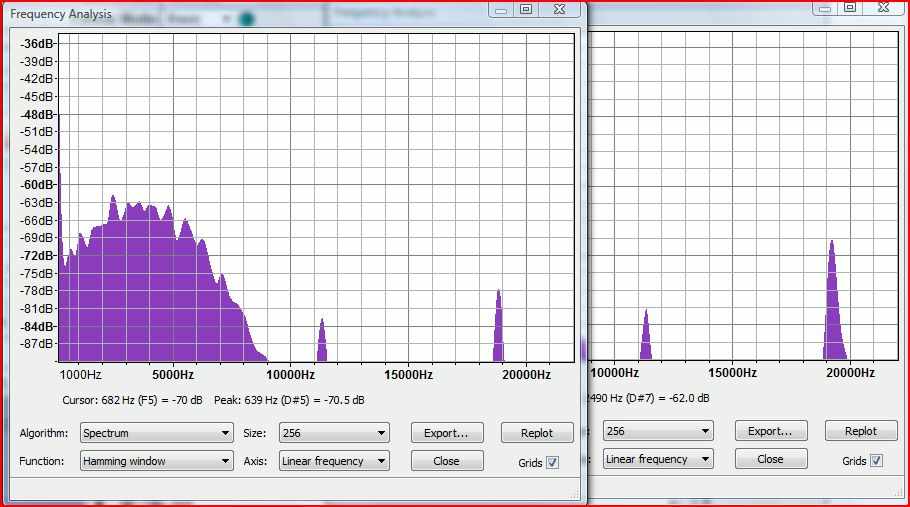 I rang the odd ones a number of times and got the same results. |
|
Valued Member
Canada
372 Posts |
And if you search rolls you should be able to find lots of 1999 2000 quarters, but if you need some for your collection I have plenty, as well as a nice 1985 Voyageur dollar for your new set.
|
|
Pillar of the Community
Canada
2533 Posts |
They're quite similar on Audacity, aren't they? I wonder why they sound so different when tapped. I'll might do some more digging and put it up if I find anything interesting that can explain why it sounds different.
Thanks for the offer, wolfman-11, but I'll not accept it. I'm sure I have 1999 and 2000 quarters tucked away somewhere, I just don't have them on me now. And I've been asking banks I go to to hold on to Voyageurs for me if they do get them, so I'm certain that I'll be able to find more. Again, thanks :)
|
|
Valued Member
Canada
372 Posts |
They do sound different too, even though the frequency is very close. I'm not sure that it will prove copper content though.
|
|
Pillar of the Community
Canada
2533 Posts |
I agree that it doesn't prove content. It only sound different when you actually listen, you'll miss it when not paying attention.
Maybe I'll find something that I can use to chop a coin in two and see what is inside it that way. Maybe have some tests run on it. I've always wanted to chop a coin just to see what they look like inside, but no way I can do that now...
|
|
Valued Member
Canada
372 Posts |
A hacksaw will cut a coin, but if you are comfortable using chemicals you could probably remove the nickel plating with an acid mixture or electrolysis.
Look up nickel etching fluid.
|
|
Pillar of the Community
Canada
2533 Posts |
I'm not sure about using chemicals. I live in a dorm, so I don't know if I'm allowed chemicals.
As of now, I'm allowed acetone, but not xylene.
Maybe I can ask in the lab (earliest Tuesday), but so far xylene is the strongest chemical they'll allow me to use. No harm in asking.
I looked up the etching fluid, and most etching fluids contain HNO3, nitric acid. Also used for pickling metals. Do you know if it fumes as it reacts? If it doesn't, I'll try it.
|
| |
Replies: 68 / Views: 6,928 |










 Posted 04/12/2014 11:29 pm


