You guys know how I love old toned crusty gold. Well, I have been wanting some nice branch mint material for a while in the background, though type was my primary focus. I have also been selling off lower value coins in order to chase higher quality ones. When this piece came into focus, I did some research on Dahlonega gold, and I think I may have found a major rarity....though I need you folks to help me with it. I purchased this from David Lawrence, don't have it in hand yet....but he assures me that the luster is abundant in the fields. My research led me to Doug Winter's commentary on the 1848-D gold coin....and although this purchase ranks 4th as my most valuable coin, I believe it is actually the rarest coin I own.
Here is Doug's commentary off of coinfacts:
"The 1848-D is often regarded as one of the more common Dahlonega half eagles. This is most definitely not the case as it is actually quite scarce in any grade and very rare in high grades.
The 1848-D half eagle is a scarce and undervalued issue. Most grade Very Fine to Extremely Fine.
Any coin grading About Uncirculated is rare and any About Uncirculated example with good eye appeal is very rare. In Mint State, the 1848-D half eagle is extremely rare.
STRIKE: The quality of strike depends on which die variety a specific coin is. Many examples are very poorly struck and show pronounced flatness at the obverse center and heavy die swelling. Others have clashmarks at the mouth of Liberty and behind the head and weakness on the neck feathers of the eagle. The reverse is generally better struck, even on the coins which show extreme weakness on the obverse.
Any example with a sharp overall strike is very rare. For more information on strike, refer to Die Varieties below.
SURFACES: Most 1848-D half eagles have numerous abrasions on the surfaces. This is one of the most difficult Dahlonega half eagles to locate with clean fields. Examples exist with matte-like surfaces from exposure to seawater. These coins have Mint State sharpness but are generally accorded the same value as an Extremely Fine coin with original surfaces.
LUSTER: This date shows below average quality luster. On the few original, higher grade coins that exist, the luster is usually frosty in its texture. On the typical piece the luster is impaired and has a slightly grainy texture.
COLORATION:
Due to the fact that so many have been cleaned, it is very difficult to find an 1848-D half eagle with pleasing natural coloration. The few original pieces which exist have darker green-gold or orange-gold hues.EYE APPEAL:
The 1848-D is one of the most difficult Dahlonega half eagles to locate with good eye appeal. Many are very poorly struck and most show serious, detracting abrasions. A piece with good eye appeal is legitimately rare and it deserves to sell for a significant premium over a typical example.PERSONAL OBSERVATIONS: The 1848-D half eagle is actually one of the hardest Dahlonega issues of any denomination to locate with good eye appeal. Most are either poorly struck or have been cleaned at one time. I cannot recall having seen more than two or three pieces that I felt were genuinely attractive and have seen only one (the Duke's Creek coin) that I felt was unquestionably Uncirculated.
So with all that said:
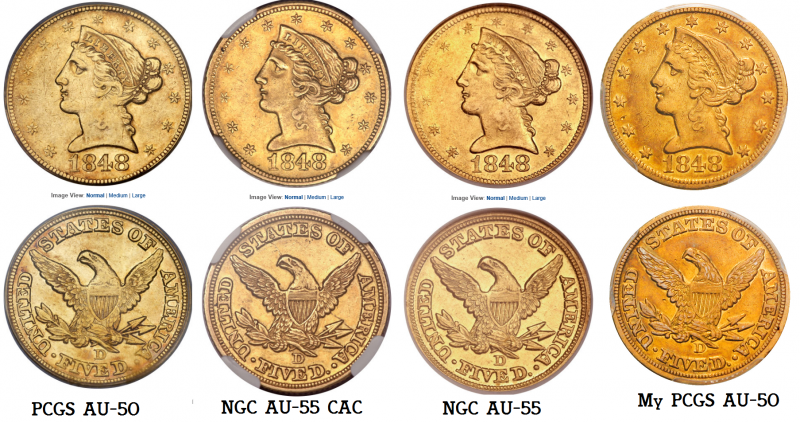
How does this rank in original surfaces compared to other 48-Ds?
How does it rank in strike quality?
How does it rank in overall eye appeal department?
According to Doug, all of these issues add or detract to the rarity of the piece. I personally think it ranks pretty high, but I must admit, I am completely utterly biased....

Looking at AU examples that sold on heritage, almost all of them had severe strike/die swelling issues that this one doesn't appear to have, though I don't really know if it is a STRONG strike, its at least decent.
I will get some more pics take when she arrives, as these pics don't really show off the luster. but what do you all say?
http://s44.photobucket.com/user/joh...b-1.png.html]

[/URL]









 Posted 04/15/2014 9:00 pm


 [/URL]


