| Author |
 Replies: 9 / Views: 3,352 Replies: 9 / Views: 3,352 |
|
|
Valued Member
United States
67 Posts |
I'm still a coin photographer novice. Getting a little better but I'm having problems photographing toned coins and having the nice toning colors come through in the pictures. Do you guys photograph toned coins differently than brilliant coins? Different lighting, exposures? This is a proof Jefferson nickel. In hand the coin has very nice light steel blue and gold toning. As you can seen that didn't come over in the picture. 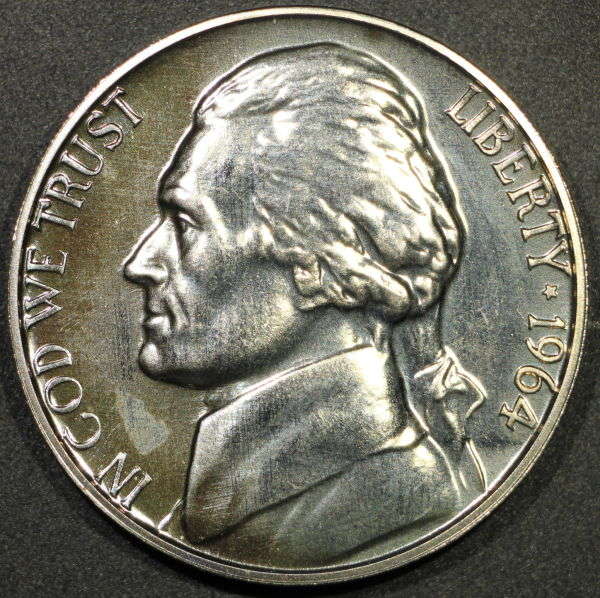 This is my set up built for me by Ray. I have a Canon EOS Rebel T2i camera. 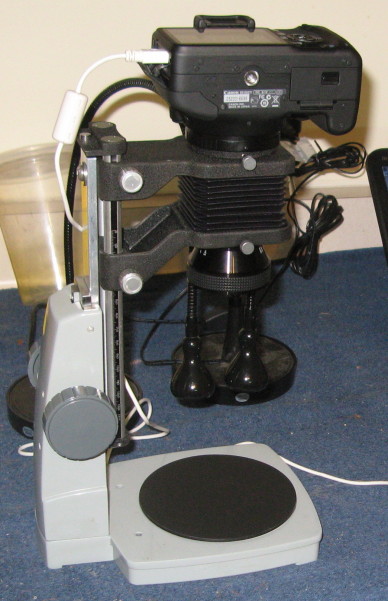 THANKS for any help/suggestions. |
|
|
|
Moderator
 United States
23522 Posts |
|
|
Valued Member
440 Posts |
You can also use the "kinda/sorta" axial light attempt which is a combination of axial lighting & diffused lighting discussed here. https://goccf.com/t/172628 |
|
Valued Member
 United States
67 Posts |
Axial lighting............OK, thanks. I'll get working on making one of those boxes  |
|
Pillar of the Community
United States
4051 Posts |
Gary...axial is best, but the method I use is with my "smile directors". They move lighting as close to axial as possible without creating direct axial glare, so they are good for both raw and encapsulated coins. I also have created diffusers that mount to the front of the lens and do a similar thing. Do a search for "smile director" and you'll get a few refs...Ray
Contact me for photographic equipment or visit my home page at: http://macrocoins.com |
|
Valued Member
United States
67 Posts |
Does the thickness of the glass used in the axial setup matter? Is 1/8" glass just as good as 1/4"?
|
|
Pillar of the Community
United States
2669 Posts |
I use 1/8" (it's a photo frame). You need the glass to reflect the light, so as long as it's clear and reflects down on the coin, any thickness *should* be fine. I'm not 100% sure on that, however, so maybe someone else will chime in. I was able to capture the toning on this one quite handily with an axial setup. Sometimes it's the only way you can.   Edited to add: I wasn't talking about the quality of the glass, just the thickness. |
|
Moderator
United States
23522 Posts |
The quality of the glass plays a far larger role than the thickness. Cheap glass, subjected to commercial-speed casting and cooling processes, can vary dimensionally in thickness and flatness, sometimes enough to affect its' use as an axial reflector. That's a process which requires exacting tolerances, since fractions of a degree in reflective angle can have a bearing on transmitted color.
So if you're getting unsatisfactory results from a well-set-up axial installation, look to the glass itself.
It's like a pool cue - I can walk into a bar, grab the most-bent cue in the place, and still win. You can adapt to curvature in a cue. What you can't fix is inconsistency in the tip. If that heavily-curved cue has a nicely rounded and consistently-shaped tip, you can kick butt with it. And so it is with glass - if it's consistent in its' formulation, even if it isn't flat, you can correct for the variation. But if it isn't consistently thick, you're in trouble. Cheap glass can be wavy, and that's no bueno.
|
|
Valued Member
United States
67 Posts |
OK.........thanks Dave.
I'm hoping to get something set up by this weekend. I'll take a few shots of the same coin and post the results here.
Anybody have a recommendation for a good light for this type of axial setup? I did some searching online but couldn't really find what I was looking for. I'm looking for an adjustable gooseneck type of desk light for a regular type of light bulb with a nice reflector head to reflect a lot of the light forward. I'm finding gooseneck desk lights but not with a nice reflector.
|
|
Moderator
United States
23522 Posts |
Tough call, and honestly your best bet is to probably just hit the Walmarts/Targets in your area looking for the lamp.
Don't be afraid to take that T2i into ISO1600 territory, or exposures slower than 1/4sec, to achieve a well-lit axial shot. You're making that shot to show a full-face image, and if you're filling the sensor with the coin, the resulting image is going to be so huge you'll downsize it 75% to post. That downsizing process will mask/cure a whole_lot of slight noise caused by high ISO.
This gives you a lot of latitude in terms of how much light you have to throw at the coin. It's probably less than you think. With your equipment, I'll bet a single Jansjo is up to the task. With beamsplitter glass, there's no doubt in my mind that a single Jansjo would be enough.
|
| |
Replies: 9 / Views: 3,352 |
|







 Posted 05/03/2014 4:32 pm





