| Author |
 Replies: 9 / Views: 6,711 Replies: 9 / Views: 6,711 |
|
|
Pillar of the Community
United Kingdom
2217 Posts |
Banknotes produced during the Spanish Civil War seem to be another interesting area of numismatics to me, has anyone collected them and are they expensive? Thanks, Matt  |
|
|
|
Pillar of the Community
United States
597 Posts |
I have collected the ones issued by the Republican Government:  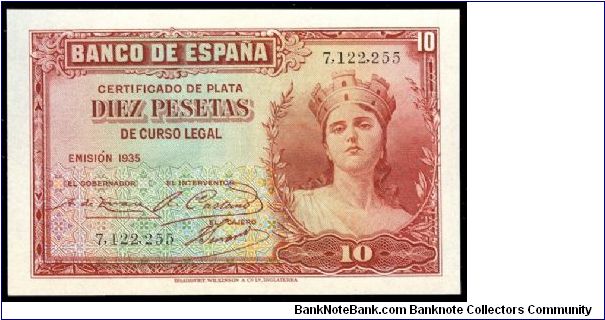  Mainly because of the allegorical feminine portraits on them. They are not expensive, but hard to find at a price that is not ridiculous, I think some sellers price them too high. |
|
Pillar of the Community
 United Kingdom
2217 Posts |
Yes, females on notes are always better than masculine, power figures as are animals. So as long as get them for less than a quid I should be alright?
|
|
Pillar of the Community
United States
597 Posts |
Females on banknotes are always going to set you back more than a few quid, unless you want the ones that have been handled already.
|
|
Pillar of the Community
United Kingdom
2217 Posts |
darn those females! Yes I have noticed a similar thing on coins, esp. that Lady Godiva penny token of Coventry (conder)...
|
|
Pillar of the Community
United States
597 Posts |
The Spanish Civil War is one of those areas I would really like to research a lot more sometime, it was so complex with so many external participants, USA, France, Britain, Germany, Italy, USSR etc. Most of the Republican banknotes were actually just continuations of the earlier Kingdom notes until 1936, when the SC's above were issued. By then a lot of local emergency money was issued too.
|
|
Pillar of the Community
United Kingdom
2217 Posts |
I do not know anything about this era in numismatic terms, little more in general terms save a couple of films and a George Orwell book. Apparently the 'bad guys' won, those being the fascistas of General Franco...que una piedad!
|
|
Pillar of the Community
United States
597 Posts |
Unfortunately I don't believe that the good guys won or lost. It is a case where no matter who won the war, the country was going to suffer one way or another. The Republican movement was supported with volunteers from the USA, received money from France, and arms from the USSR. We all know what happened with the Nationalist victory, a repressive dictatorship with fascist underpinnings, but that tacitly used religion as a base.
The Republicans had they been victorious would have likely created more conflict amongst themselves, because of the coalescent nature of their movement which range from moderate to Marxist.
One thing I am trying to determine is how currency was issued and did it circulate universally or only in a particular region of that participants control. With the exception of the small change notes, the rest of the notes issued by Banco de España stated as such and not Republica Española which makes distinguishing which side issued which currency a bit of a pain.
|
|
Pillar of the Community
Australia
2830 Posts |
G'day, once "rebels" start issuing money, they add a layer of legitimacy to their "government". Of course, each side can be expected to reject the currency of the other side as a symbol of illegitinacy. So, non-belligerents in the war zone, have to be careful about showing what currency they have. I have seen coins, allegedly of the Republican side, on ebay. Apparently, these were re-strikes, or perhaps first-strikes, made well after the SCW. It was not even clear that the designs were settled before the war concluded. Scottishmoney describes the "Republicans" as "coalescent". In that context, it is difficult to imagine coin- or note- production having any priority. Also, the influx of foreign volunteers, and the proximity of Spain to other nations, leads me to suspect that foreign currency was probably widely used - and had the advantage of being "neutral" as between the belligerents. I offer this by was of a possible parallel: my reading about the Chinese civil war tells me that Mao insisted on paying for any property "requisitioned" from non-combattants. Payment was by promissory note: a handwritten I.O.U. I gather that these are highly valued by collectors of Chinese ephemera. But bear in mind, in that case, the "rebels" won; and in relation to notes personally written by Mao, there is a premium because of his subsequent prominence; AND because of his calligraphy - for which he was particularly famous. Presumably Spanish forces, on either side, took what they needed or wanted, and if the donee was lucky, he/she might get a I.O.U. in return. This might theoretically have the benefit of giving note-holders a real, if involuntary, investment in the outcome. Coin and note collecting traverse such wonderful subjects: metallurgy, history, economics, art, philosophy, politics ... to name only the obvious ones. Peter in Oz |
|
Pillar of the Community
United States
597 Posts |
Peter, thanks for adding to the story. Curiously the belligerents in the US Civil War of 1861-65 had different perspectives of issuing currency, whereas the South had a more decentralised system, with more States issuing currency with the Confederate Government issuing as much or more, the Union Federal Government basically monopolised the issue of paper money after 1863 by imposing 10% excise taxes on currency issues by states, banks etc. This effectively eliminated banks and municipal governments or state governments from issuing paper money.
As a matter of requisition, Confederate Armies were made by their commanders to pay for all goods taken from civilians, be they in territory considered to be within the Confederate realm, or that considered to be in the Union realm, for instance when Genl. Robert E. Lee's army invaded Pennsylvania in June and July of 1863 they paid for all goods taken from shopkeepers etc. However shopkeepers found that the payment was really more of a formality as Confederate currency had absolutely no value beyond a near worthless curiousity in the North.
But quite frankly, the Union greenback or dollar had little more worth, in fact it's purchasing power during the worst time for the Union right after the Confederate victories in the Valley campaign to immediately after the Union victory at Gettysburg and Vicksburg got as low as 11¢ in precious metal. The only constant values of anything exchangeable were those of precious metal coins, and even crazily bronze coins disappeared from circulation.
I imagine that a similar scenario played out in Spain. This is a graph of the average exchange rate for the Peseta during the era of 1930-1940:
These tables present the price of one United States Dollar.
Spain, 1930 - 1940
1930 P 8.57118368 Peseta
1931 P 10.47636009 Peseta
1932 P 12.43193516 Peseta
1933 P 9.329315508 Peseta
1934 P 7.34484025 Peseta
1935 P 7.310850033 Peseta
1936 P 8.120969969 Peseta
1937 P 16.52182533 Peseta
1938 P 17.85714286 Peseta
1939 P 9.407249226 Peseta
1940 P 10.72765697 Peseta
Notice the 1931-32 rates, this was when Spain became a Republic with the deposition of Alphonso XIII. By 1934 the political situation stablised somewhat, and the Peseta gained in value. Then 1936 rolls around and a commander in Morocco launches the beginning of the military conflict and the Civil War breaks out, and the Peseta plunges in value. 1939 sees defeat of the Republican government, and a evaluation of the Peseta, but 1940 brings war in Europe and by then most European currencies began to slide in value.
|
| |
Replies: 9 / Views: 6,711 |
|







 Posted 08/01/2007 11:32 pm





