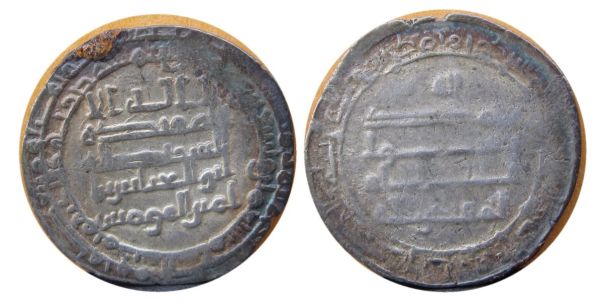
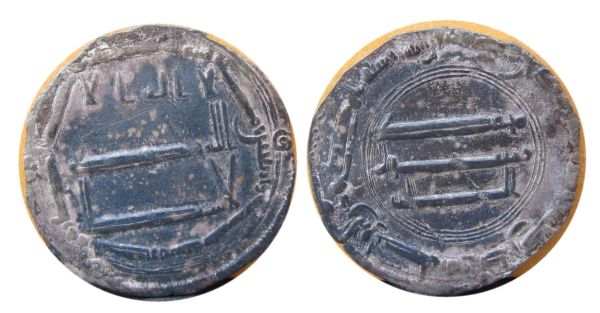
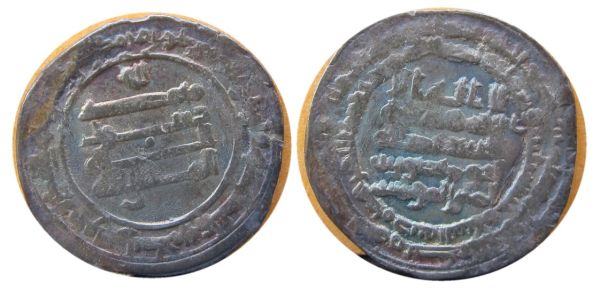
The language is Arabic. The script is not the modern, flowing "Naskhi" script typically used to write Arabic today; when these coins were made, that had not been invented yet. The script on these coins is called "Kufic", and is much harder to read even for a native Arabic speaker as many of the letters look more or less identical.
Also not yet invented were "Arabic numerals", a concept which was invented in India and did not enter the Islamic world until parts of India were conquered. The numbers comprising the date on these coins are written out, in full; as if this year's AD date were written as "two thousand and fourteen". On all three coins, the date can be found on the innermost circular legend on the obverse (left, left and right sides of your coins, respectively) from around 5 o'clock backwards up to around 1 o'clock. Some time ago I did up a translation graphic for an earlier Umayyad coin, which has much the same principles as your coins with regard to the date:
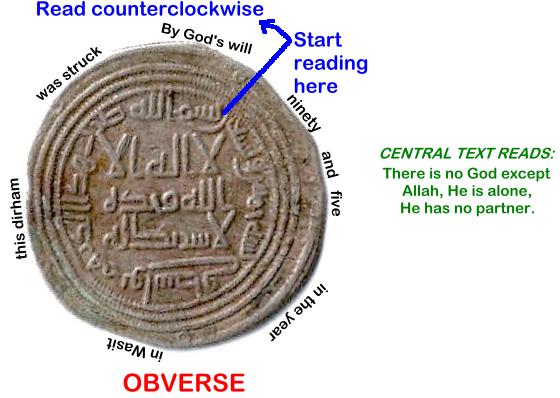
Plant's book is invaluable in reading Kufic date-words, as it shows what each numeral-word is supposed to look like and some of the variations of those words that can be found on the actual coins of the period.
Hope this helps.
Don't say "infinitely" when you mean "very"; otherwise, you'll have no word left when you want to talk about something really infinite. - C. S. Lewis











 Posted 05/27/2014 5:04 pm


