| Author |
 Replies: 16 / Views: 4,874 Replies: 16 / Views: 4,874 |
|
Pillar of the Community
Hong Kong
1270 Posts |
I try some studies about French King Louis XIV who is regarded as the Sun King. My evidence: 1)In Versailles, there is a fountain inside telling the stories of Apollo. Probably it was ordered by Louis XIV so left it as a legend about the King. 2)When in his youth, Louis XIV costumed as Apollo for the ballet Fetes de Bacchus performed in 1651. Was the nickname "Apollo" or "Sun King" started at that time? I have his coin shown here, there is a drawing of "Sun-like" figure above his head. Was it a mint mark or it was a personal emblem of Louis XIV? Another question: Did Louis XIV name himself "Sun King" or this was a later nickname called by the historians? Who can answer my questions. Thank you, Henry 26.68 grams, 42.5 mm 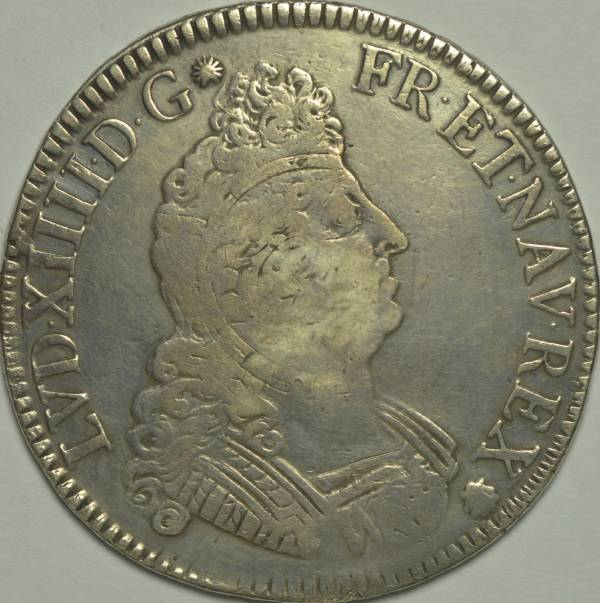 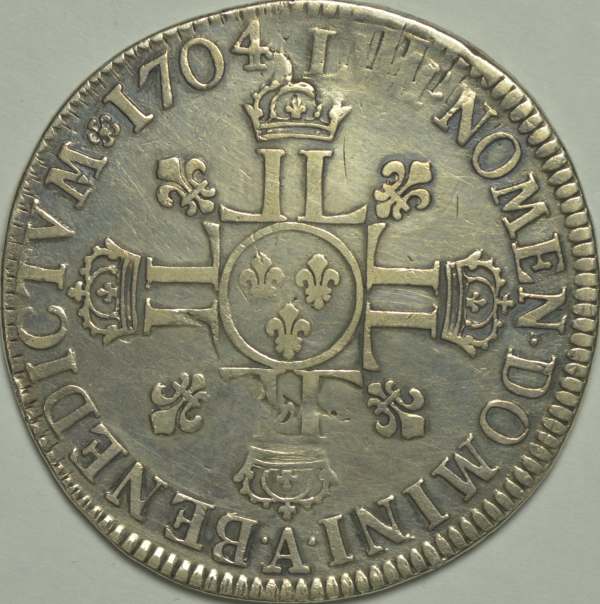 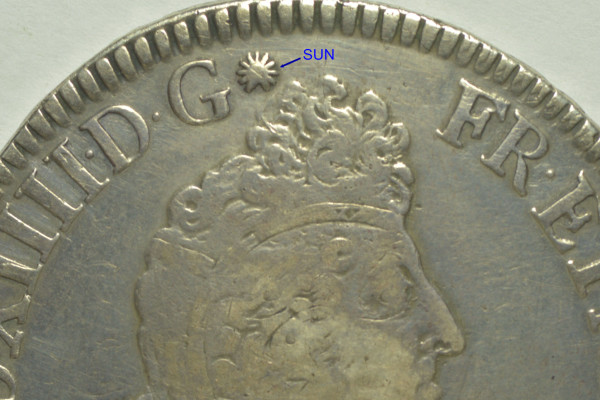 |
|
|
|
Pillar of the Community
United States
3253 Posts |
The sun-in-splendour was the personal heraldic badge of Louis XIV, but in this case the monarch's badge is being used as a mintmark. I believe the first time that personal royal badges replaced some random symbols as coinage mintmarks was under Edward IV of England, who also used a sun-in-splendour.
|
|
Pillar of the Community
United States
1156 Posts |
Quote:
but in this case the monarch's badge is being used as a mintmark It is being used as a personal symbol, but not as the mintmark. The mintmark is "A" for Monnaie de Paris. ~jack |
|
Pillar of the Community
Canada
4911 Posts |
This coin appears to be flipped and double struck, look at the 4 I's at the top of the reverse and the M/W at the bottom of the obverse.
Feel free to call me Will.
|
|
Pillar of the Community
778 Posts |
This coin appears to be flipped and double struck, look at the 4 I's at the top of the reverse and the M/W at the bottom of the obverse.
As I remember, most of these coins were overstruck on French crowns of the 1690's.
|
|
Pillar of the Community
778 Posts |
Here is my doublestruck 1704 ecu. Note the "1691" date showing at about 7 o'clock. 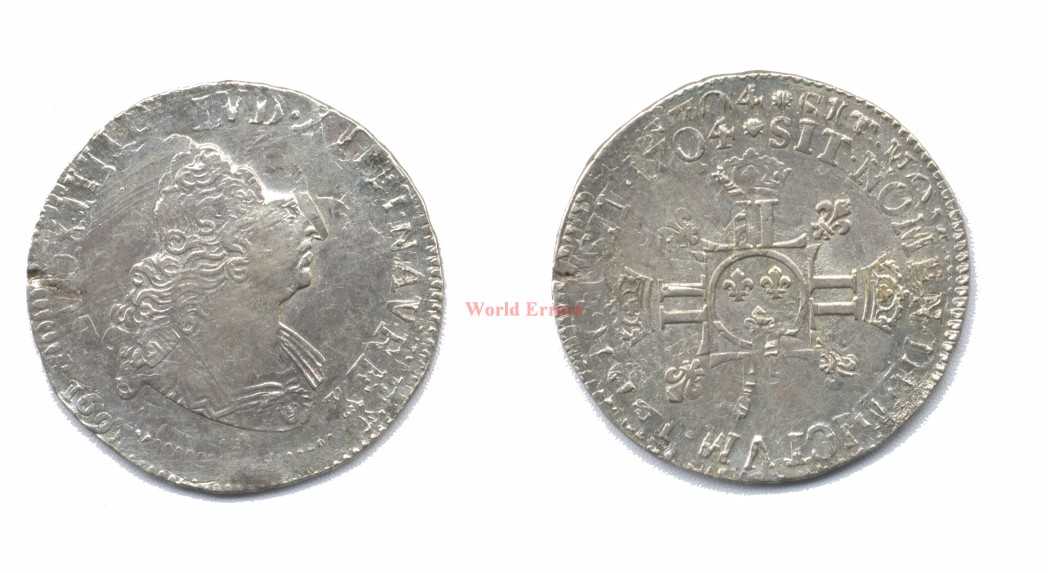 |
|
Bedrock of the Community
Australia
21789 Posts |
MY first thought was
'overstruck', not
double struck.
Overstriking was a VERY common practice during this period of French coinage. Inflation and counterfeiting were problems that drove that practice.
Ref. 'Coinage in France' from the Dark Ages to Napoleon', by Nicholas Mayhew.
|
|
Valued Member
United States
365 Posts |
Regarding the OP's question:
There are many, many scholarly sources on Louis XIV, his court, his impact on French culture, etc... Virtually all of which will in one way or another discuss the cultivation of various mythologies around the figure of the king, including the choice of Apollo (among other greco-roman heroes). You just have to look up a few books on the man, you'll quickly find what you're looking for. I recommend you start with some basic encyclopedic reference materials, and from those follow bibliographies back to some of the better critical sources.
The Sun King was very mindful of the kinds of images that were associated with his person--very much ahead of his time in this regard, please recall that Twitter had not yet been invented--and insisted that his government ("l'état, c'est moi") control very carefully how the king was written about, spoken of, thought of. Jail was never far for the unwise or outspoken critic. The decorations at Versailles are methodical, deliberate, calculated. The first true genius of absolute power, Louis XIV broke the mold, while breaking of course the bank, and unintentionally paving the way for the Revolution of 1789 (aided in this by the fairly incompetent tenures of his [distant] progeny, Louis XV and XVI).
These broad strokes of Sun King history are some of the reasons why I delight in possessing a few coins struck during his very long reign. These overstrikes are a great reminder of the only real limitations that existed on Louis XIV's absolute power, namely the limited monetary policy choices available to the French monarchs. Whether you are a fan of modern finance or not, love the credit systems of our neo-liberal capitalist system or despise them and barter for all of your household needs, you have to admit that those in power today have more options than old Louis here did in the 17th and 18th centuries.
|
|
Pillar of the Community
 Hong Kong
1270 Posts |
SeriousCERES, thank you your input. I will certainly read more about K. Louis XIV later. In your opinion, do you think the nickname "Apollo or Sun King" was added by historians for the monarch's absolute power or Louis XIV called himself "Sun King". There are many adjectives like Louis VI, the Fat, Frederick II, the Great, Richard, the Lion..., all the nicknames were added later.
|
|
Pillar of the Community
United States
5362 Posts |
I personally love the overstrikes - however I did not that in the case of French Ecu's the practice was so prevalent that a strike on a "new" planchet actually carries a premium in nearly all cases.
|
|
Valued Member
United States
365 Posts |
I realize that actually I was confusing two separate questions: 1) why is Louis XIV called the 'Sun King' and 2) where does the expression come from? For the purposes of clarity I'll treat them in order! 1) It is well-known that the king made appearances dressed as the Sun/ Apollo at parties in the mid- to late-1650s. (There exist engravings depicting this.) By 1662 he had definitively chosen the sun as an emblem for himself (some say as early as 1656)--well in advance of the decoration of the new construction at Versailles. Playwright and official court historian Racine compares Louis to the Sun in a text from 1663. So by the 1660s the court is well aware of the symbolism that the king has himself chosen, but why would anyone living at the time have called him anything other than "Sire mon Roi"?. Nor would the king himself have any reason to call himself anything other than "Nous" (!). The historians living in his day had a role, certainly, in spreading the king's (approved) historiography throughout the learned culture of Europe, but none of them coined the exact expression "Roi Soleil" and you won't find it in that form anywhere. Look, though, at his blason, NEC PLURIBUS IMPAR ( http://fr.wikipedia.org/wiki/Roi_So...s_Impar.jpg) and you'll see why the expression is just, well, a no-brainer waiting to happen (!). It is said (by Voltaire) that Louis' advisers came up with this sun motif because of the king of Spain it was commonly said that "the sun never set" on his empire; so it would have been one-upmanship toward the Spanish king. Curiously, Voltaire reports that Louis never liked this particular image (and never wore it or used it elsewhere) but kept it to please those who'd come up with it. BTW, historians also often note that later on, as Versailles is well advanced (i.e. the sun motifs are already too firmly implanted to change direction), Louis backed off of the sun a bit and turned instead to Hercules and a couple other greco-roman figures. Hence a few different modes of kingly figuration appear in the ceilings and on the walls. 2) as for the expression itself, "Roi Soleil"--I've seen it asserted that the term doesn't come into existence until the reign of Louis-Philippe I, the July Monarchy, a king also popularly referred to as the bourgeois king because of the peculiar way in which he came to power. In other words, the expression comes into existence the way we use it now almost 200 years later. Was it historians? Was it the regime of Louis-Philippe itself, that wanted so badly to convince the French to accept him as a legitimate chink in the eternal chain of great French kings that it invested a great deal of time, money and effort into glorifying the popular kings of France's history? In any case, the likelihood is that the expression became a popular way of referring back to the kind of absolute power Louis XIV crafted for himself and exerted like no other before or since. (The bourgeois king had far less power, for instance.) It also expresses a great deal of nostalgia (on the part of many, in the 1830s and 1840s) for a time that could only have seemed so much like a Golden Age to them: in retrospect, one could see how French power, wealth, and glory had hit an apogee (expressed in the grandeur of Versailles, and the apparently blunt arrogance of a king who figured himself as a celestial being) and would thereafter stagnate through the next two kings on a collision course with the disasters of 1789, the terror, 1814, 1815, and the dreary and severe eras of Louis XVIII and Charles X. Many in the 1830s-40s were equally nostalgic for the much more recent glory days of Napoleon's empire (and had dreamed of his return). (Indeed, Louis-Philippe is the one who has Napoleon's body brought back from St. Helene and interred in the Invalides, another grand gesture meant to draw Bonapartists to him.) The only difference was that you were ALLOWED to be nostalgic for the bygone era of the French monarchs of yesteryear, but you weren't supposed to be running around seditiously advocating for the return to power of a Bonaparte (fast forward to 1848, if you like...). All that is just to say that there's good reason to suggest that, with the rise of literacy in the first half of the 19th century (your historians and their ideologically charged versions of histories), the power of nostalgia within a disillusioned and beaten population (this is the period of French Romanticism, after all), and the efforts of the bourgeois king to suggest he's full-on part of that glorious past, it's quite reasonable to understand how the expression "Roi Soleil" became a popular one for retelling a colorful and lengthy piece of "glorious" French political history. |
|
Pillar of the Community
United States
3229 Posts |
Great coin wonghinghi!  Awesome info SeriousCERES! Cool thread.  |
|
Pillar of the Community
United States
1156 Posts |
Quote:
a strike on a "new" planchet actually carries a premium in nearly all cases swamperbob, I assume you mean the premium to modern collectors and not that an overstruck écu of the same series would have a lower value in contemporary French livre than a "new" one. Here's my finest écu and it doesn't seem to have been struck over an older coin. And, yes it came to me with a hefty premium. Right now it's in for conservation so I hope to post a nicer picture when we get to the year 1698 in the "How far back can we go? Second Edition!" thread. https://goccf.com/t/161525~jack 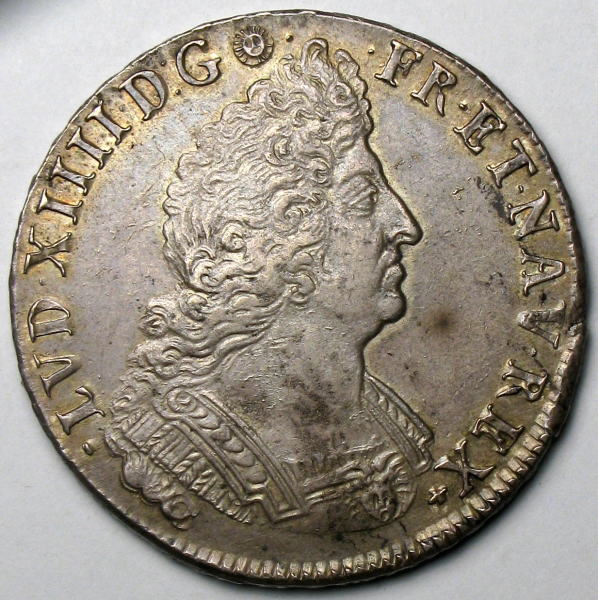 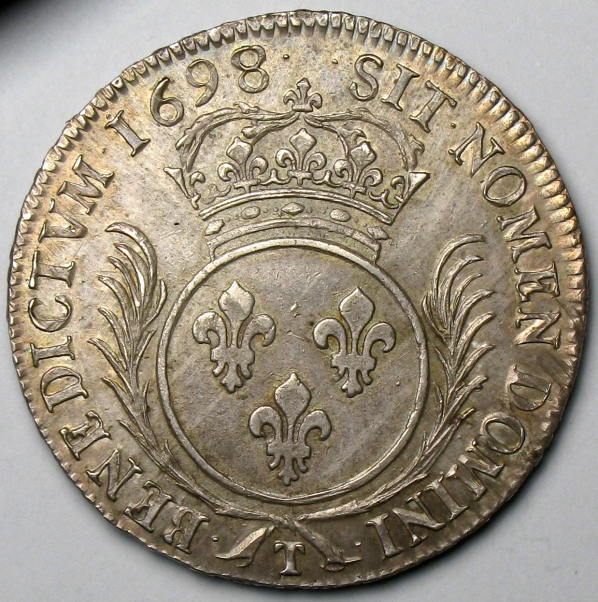 |
|
Pillar of the Community
United States
5362 Posts |
jgenn Yes, the premium is to modern collectors. At the time they were made - they were simply money.
It appears that the 1698 type is the under-type on the 1704 coin.
|
|
Moderator
 Australia
16964 Posts |
Quote:
I have his coin shown here, there is a drawing of "Sun-like" figure above his head.
Was it a mint mark or it was a personal emblem of Louis XIV? To answer this question, which has yet to be addressed. Early French coins bear not only a date and mintmark (in this case, 1704-A) but also bear up to three "privy marks"; these are little tiny images, personal marks assigned to particular individuals - there are three of them for the three officials responsible for producing that coin: the Engraver-General (for the entire country), the Mint Director (for that particular mint) and the Engraver (for that particular die, though most mints only had one Engraver at any one time). You can see all three privy marks on your coin: the little flower before the date is the Engraver's mark; the sea-scallop shell after "REX" is the Director's mark, and the sun above the king's head is the Engraver-General's mark. A sun was used as the Engraver-General's mark from 1682 to 1715. For any French coin (from any mint) between those two dates, if there are three privy marks visible, a sun will be one of them. Don't say "infinitely" when you mean "very"; otherwise, you'll have no word left when you want to talk about something really infinite. - C. S. Lewis
|
|
Pillar of the Community
Hong Kong
1270 Posts |
Quote:
the sun above the king's head is the Engraver-General's mark. Thank you your input, Sap. Back to answering my early question, this means the emblem of the burning sun on the coin was not struck for the "Sun King" Louis XIV, it is only a coincidence that the emblem happened to be on a coin of Louis XIV who was known as Sun King in his reign. If someone think the emblem on the coin is the King's "deliberated" implication to his subjects, it is equvalent to "to graft on twig on another". Henry |
| |
Replies: 16 / Views: 4,874 |









 Posted 07/13/2014 10:23 am


