| Author |
 Replies: 10 / Views: 3,812 Replies: 10 / Views: 3,812 |
|
|
New Member
United Kingdom
6 Posts |
I have recently acquired a large quantity of Asian coins. I show four of the better ones here (some are even more indistinct). Some of the characters look Vietnamese to me, but I cannot be sure. If you can help me identify these, it would be much appreciated. I am not sure if it helps, but the top left is non-magnetic (I presume bronze), the others mildly magnetic, so I presume steel. With the coins there was a large urn/vase - quite plain and bronze, stuffed with coins and set in sand/earth in quite an elaborate pattern - also shown. I suspect they have been prepared as some sort of burial ceremony - possibly to bury with the body, but that is just a wild guess. 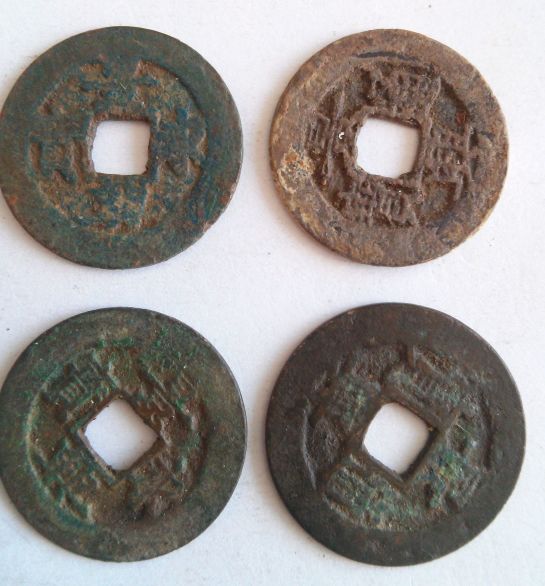 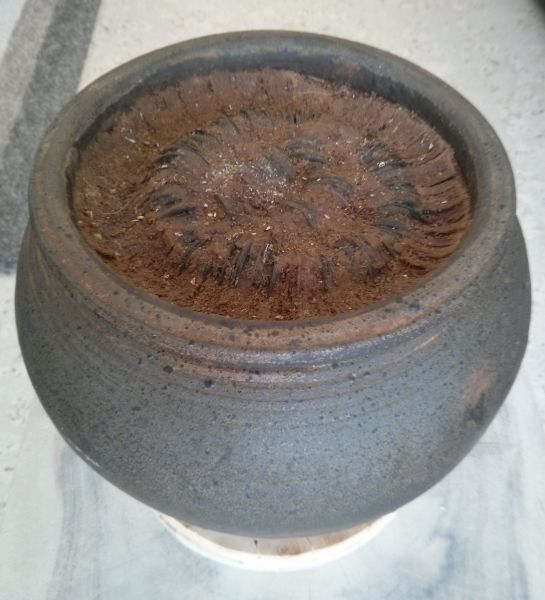 |
|
|
|
Pillar of the Community
Thailand
1509 Posts |
First of all welcome, middler2, to the community.
I can't help with the identification of the coins (and you may well be right) . As for the urn (pot) I might offer an alternative explanation.
Because the coins appear to have been placed in a specific pattern I might suggest it could have been a temple offering. These would be buried under the foundations of a (then) new temple to ensure prosperity.
My wife once acquired something similar here in Thailand. Although the urn didn't contain coins they did contain 99 Bhuddist figures. They were discovered (nine urns in all) when the temple was laying the groundwork for a new building. They were sold to raise money for the building costs.
Oops, forgot to ask how many coins were in there?
Edited by thai-vic
07/21/2014 04:33 am
|
|
New Member
 United Kingdom
6 Posts |
Many thanks for your comments. I don't know how many coins are in there, as I am reluctant to touch it until I know what it is, as I may destroy it's value, but I will wager over 1000. The coins I have shown accompanied the urn.
|
|
Pillar of the Community
Thailand
1509 Posts |
I understand your reluctance in not wanting to to empty it but your guestimate is interesting. The numbers 9, 99, 999 etc have a special significance to Buddhists.
How about a CAT scan to find out how many? Haha.
|
|
Pillar of the Community
United States
1247 Posts |
well, the more they stay in the dirt, the more wear they will get..
You might be better off dumping the dirt out.
|
|
Pillar of the Community
Belgium
2895 Posts |
There is a chinese coin that is known to be a luck-charm. You can burry this coin in your driveway or in a certain place on your property, or put the coin on a wall in your home, all this to bring luck and fortune. This is the coin from the emperor K'ang-hsi (1661-1722). I found next tekst on internet ( http://primaltrek.com/charmfeatures.html#kang_xi):A Chinese Coin with the Powers of a Charm
This is an example of an official Qing (Ch'ing) Dynasty minted coin, meant for general circulation, but which was immediately considered to have the powers of a charm. In the year 1713 AD, to celebrate the 60th birthday of Emperor Sheng Zu (Kang Xi), this special issue kang xi tong bao (康熙e€š宝) coin was cast with a bronze of a golden color. A 60th birthday is considered a major event in China. In honor of this milestone, the Chinese character xi (熙), which is located below the square hole, was written slightly differently. The character would normally have a vertical line at its left. Also, the part of the character normally written as (臣) has the center written as a (口) instead. Finally, the upper left part of the tong (e€š) character, located to the right of the square hole, has only one dot instead of the usual two.
There are several stories connected with this coin that have been passed down for the last 300 years which have given this coin the power of a charm. The stories have turned out to be historically false but continue to be believed. The different versions of the story basically state that the bronze used in the casting of this coin came from the melting down of gold statues of the eighteen disciples of the Buddha. These disciples were called lohan (luohan 罗汉) in Chinese. Because the metal used to cast the coins was believed to be directly associated with these disciples of Buddha, the coin is believed to have special powers and is usually referred to as the lohan coin or arhat money.
Because of its special charm qualities, these coins were given to children in olden times as lunar New Year money (yasuiqian 压岁- '- ).
These coins were also considered to represent good luck because they commemorated a reign lasting for sixty years which is a complete cycle of the traditional Chinese calendar and thus symbolic of a long life.
Traditionally, these coins also acted as a keepsake or pledge of love between a man and a woman. Some women would even wear one of these coins tied to their hand in lieu of a "gold" engagement ring.
Up until about the 1940's, there was a tradition in the rural villages of Shanxi Province where stylish young men liked to carry a lohan coin between their teeth. This was an attempt to mimic the tradition of stylish young men in the cities who liked to show off a gold tooth.
If you examine this particular coin carefully, you will notice what seem to be gold specks on the surface. My guess is that sometime in the (distant?) past someone put gold leaf on the coin. Then, again, maybe the stories are true and the coin does contain real gold!Here is a modern reproduction : 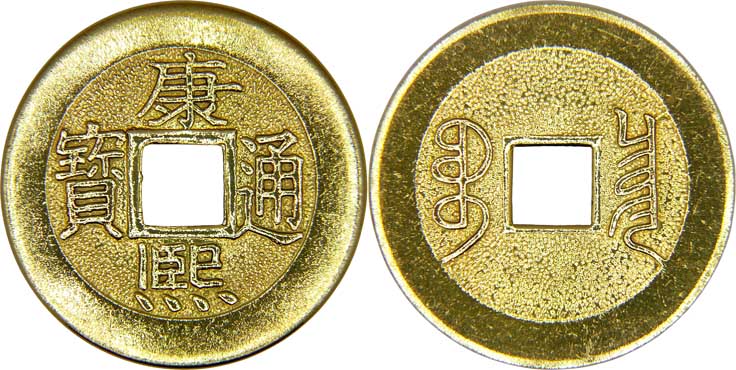 Edited by Petrus
07/21/2014 2:19 pm
|
|
Valued Member
United States
347 Posts |
The coins are Vietnamese (Annam).
The coins were cast by Le Hien Tong who ruled under the reign of Canh Hung for 36 years.
The inscription on the coins at the top left and bottom left read Canh Hung Vinh Bao (景興永寶).
The inscription on the coins at the top right and bottom right read Canh Hung Thong Bao (景興e€š寶).
These coins were cast during the years 1740-1776.
Regarding the vase, in China coins were usually buried in this manner during times of war and unrest. The coins were strung on strings (typically 100 or 1000 on a string) and then placed inside the vase. This is the reason for the coins being arranged in such order. The strings would deteriorate over the years but the coins would remain in the same orderly manner.
Many times the owner would perish during the war, or be unable to locate the hidden cache during times of peace.
There was no particular religious or other reason for burying the coins other than to keep them from being stolen. Also, there was no special meaning as to the number of coins placed in the vase.
I emphasize that this was a very common practice in China and that these types of vases containing coins are frequently unearthed even today.
I am not familiar with the burying of coins in Annam (Vietnam). I suspect that the reason is the same as in China but cannot say for sure.
Gary
|
|
New Member
United Kingdom
6 Posts |
Thanks so much. That is really helpful.
|
|
Moderator
 Australia
16982 Posts |
Finding fused lumps of Vietnamese cash coins that had been buried in pots is very, very common in Vietnam. They were buried in strings or simply tossed loose into a pot and buried. Almost certainly, this quantity of coinage is a lost cache, rather than grave goods. Chinese funeral tradition (shared by the Vietnamese) is to publicly burn "joss paper" or similar afterlife-money on behalf of the deceased, rather than bury it with them. Sometimes strings of coins were burned in such fashion; the strings would burn but the coins would survive, to be recovered from the ashes and re-used. Don't say "infinitely" when you mean "very"; otherwise, you'll have no word left when you want to talk about something really infinite. - C. S. Lewis
|
|
New Member
United Kingdom
6 Posts |
Thanks for this further information, but exactly what do you mean when you say a lost cache?
|
|
Moderator
Australia
16982 Posts |
Someone buried their money and never came back for it; either because they died without telling their heirs where it was, or they forgot where they buried it (or the landmarks they used when they buried it had been destroyed).
Don't say "infinitely" when you mean "very"; otherwise, you'll have no word left when you want to talk about something really infinite. - C. S. Lewis
|
| |
Replies: 10 / Views: 3,812 |
|










 Posted 07/21/2014 05:08 am


