| Author |
 Replies: 13 / Views: 2,600 Replies: 13 / Views: 2,600 |
|
|
New Member
United States
5 Posts |
Good afternoon, I'm sorry but the images posted are the best I can do. I hope that they are legible enough for your use. This coin was recovered along the Texas Coast and I am trying to determine its origin. Could be Spanish or French from the 16th Century forward. It was found in a Native American site and was the only non-indigenous item recovered. Not being numismatically aware I have tried researching through various reference books but to no avail. I am hoping that a member of the community can help with identification. Thanks 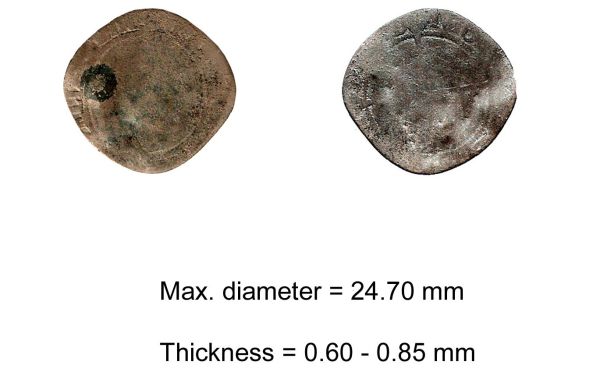 Edited by TexasArchaeologist
08/26/2014 4:05 pm
|
|
|
|
Pillar of the Community
Belgium
2895 Posts |
 Can you post two seperate picture that are bigger? Thanks |
|
Moderator
 United States
56855 Posts |
to CCF. Cool find. Give it a bit and a member will help you out shortly. John1  |
|
Pillar of the Community
United States
1431 Posts |
Based on the diameter and what little design I can see, my best guess would be a hammered British sixpence of Elizabeth I, but that's really just a shot in the dark.
Better pictures may help.
|
|
Pillar of the Community
United States
1431 Posts |
Upon closer examination, I can more confidently stand by my original supposition. I've highlighted areas that are congruent with an image of an Elizabeth I 6d for comparison.  Note the "ELI" in Elizabeth, and the "O" in "POSVI". The obverse in your photo is likely upside-down. comparison: (Image courtesy of Tony Clayton and http://www.coins-of-the-uk.co.uk/ )  Of course these came in several varieties from several mints. Pinpointing the particular variety of yours may be impossible. Even if that's what it is though, it's still a very peculiar thing to find on the South Texas shore! Edited by Kefiroth
08/26/2014 5:27 pm
|
|
New Member
 United States
5 Posts |
I am much obliged, Kefiroth, for the quick reply and accurate attribution. Yes - an odd duck to find in South Texas, for sure. Cabeza de Vaca came through this area in the 1520s. This coin may very well have been traded from the Atlantic Coast into the interior before ending up in South Texas. Your contribution is VERY much appreciated.
Cheers,
Clint
|
|
Pillar of the Community
United States
3253 Posts |
Welcome!
The second pic is the reverse of the coin, with a long cross (the arms extend beyond the inner circle of pellets(dots) and divide the legend into quarters). Was about to pronounce Kefiroth crazy; Elizabeth I? Where's the Tudor shield? But looking more closely, is the second pic upside down? Can we see the straight side of the central shield on the right at least, with the rounded bottom at the top? If so, the cross arm at the top of the pic divides the second and third quarters of the legend. Sure looks like a D to the left of that arm, with an I to the right, followed by a pretty clear V, what I can make myself believe is a T, and then an O.
|
|
Pillar of the Community
 United States
1950 Posts |
That's a fascinating find for Texas!
|
|
Pillar of the Community
United States
1431 Posts |
Quote:
The second pic is the reverse of the coin, with a long cross (the arms extend beyond the inner circle of pellets(dots) and divide the legend into quarters). Was about to pronounce Kefiroth crazy; Elizabeth I? Where's the Tudor shield? But looking more closely, is the second pic upside down? Can we see the straight side of the central shield on the right at least, with the rounded bottom at the top? If so, the cross arm at the top of the pic divides the second and third quarters of the legend. Sure looks like a D to the left of that arm, with an I to the right, followed by a pretty clear V, what I can make myself believe is a T, and then an O. Crazy?  I'm glad you pointed that out though, because I do now see what you're talking about there. It seems that I matched up the wrong "O" in my comparison, and that both the obverse and reverse pictures are in fact upside-down. You certainly have a better eye for these things than I do. Edited by Kefiroth
08/26/2014 6:58 pm
|
|
New Member
United States
5 Posts |
From time to time we find very worn coins in both proto-historic and historic archaeological sites. I am glad to know where I can go to get solid advice and counsel on these artifacts. Their origins are important because they help us to understand chronology, presence, and trade patterns among other things. I'll keep you posted though it may be a bit before another interesting find comes my way.
|
|
New Member
United States
5 Posts |
Hello, Kefiroth - I'd like to contact you but as a newbie I can't send e-mails. Would you please drop me a line seeing as you are a site veteran? I wanted to speak with you about this topic. Much obliged.
|
|
Valued Member
United States
309 Posts |
I'm going to opine a guess too in Sherlock Holmes style. Definitely English, a silver six pence. If we have the reverse in proper alignment the touch mark appears to be "1" which would give us everything about the origin of the coin. Date: 1601, Elizabeth I, hammered six pence, Sixth Issue, of Sterling fineness, from the Tower Mint, London. This coin has been clipped and worn down from long circulation for at least three quarters of a century or more to reach such a poor state of preservation. You didn't clean it? It does not look like coins from graves as they have wild toning. Queen Anne's currency reforms of 1704 sought to redeem and melt such thin old silver into proper coin of the realm. I would place it in Texas soil no earlier than 1675. If a pocket piece from a former English citizen (many had to leave England during their Civil War), it could have been dropped at most any time later up to about Andrew Jackson's Presidency. I am leaning to the latter time and thinking about a loss during the Republic of Texas. What else was found with it? Being small and slick it is obvious why it easily dropped away from its owner; and having nominal value the owner would have abandoned the search for this lost coin with little ado. If in the hands of Native Americans we might expect it to be holed for adornment or rolled into a strap-end. Being still flat I would say it was lost by a sailor who reckoned it as ready money, if found within a day's walk of the Gulf coast. The nickname of the sixpence is "fiddler." And here I must stop short of placing it in the hands of Davy Crockett or Sam Houston as my powers of observation have expired, my dear Watson. But not knowing exactly what might have been, this coin does have just that sort of historic potential. Elementary!
|
|
Pillar of the Community
United States
1431 Posts |
Quote:
Hello, Kefiroth - I'd like to contact you but as a newbie I can't send e-mails. Would you please drop me a line seeing as you are a site veteran? I wanted to speak with you about this topic. Much obliged. TexasArchaeologist, I tried to contact you, but it appears you have your profile here set to reject e-mails from other members. This setting can be changed from this page: http://www.coincommunity.com/forum/...sp?mode=Edit |
|
New Member
United States
5 Posts |
Hello, Kefiroth! I have no idea how that happened since I hadn't changed any settings - but I am now contactable. Mea culpa!
|
| |
Replies: 13 / Views: 2,600 |
|





 Posted 08/26/2014 3:49 pm





