| Author |
 Replies: 16 / Views: 5,573 Replies: 16 / Views: 5,573 |
|
Valued Member
United States
320 Posts |
Guys, are these real? They weight about 40 lbs each and look like they were never used.  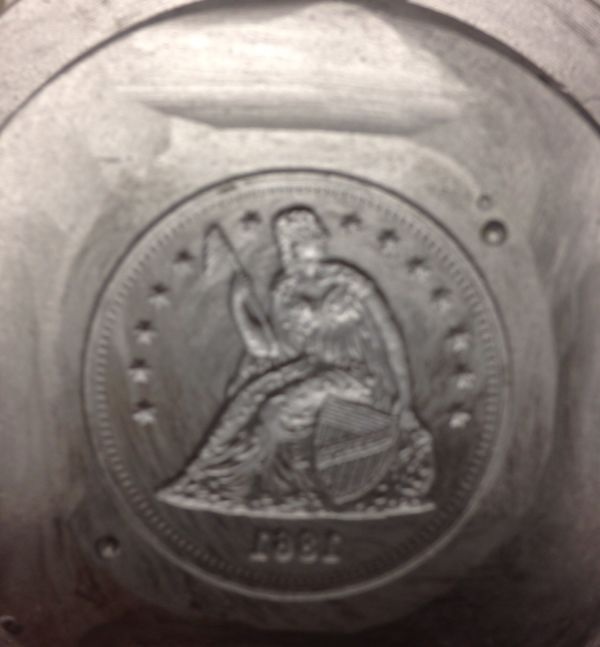 |
|
|
|
Moderator
 United States
23522 Posts |
Dies are little cylindrical things that fit in the palm of your hand and weigh about a pound, and are negative designs so the coin comes out a positive. The only numismatic item similar which could weigh that much is a galvano, a large (12-15") diameter version of the coin which was used as a guide for making the Master Die with a Janvier copying machine. The Janvier traced the large design on the galvano and reduced it to coni size, carving it into the softened steel which became the Master Die. A Galvano reads correctly, though, just like a coin, and won't have a date on it.
These? I dunno. What size are they?
|
|
Pillar of the Community
United States
6370 Posts |
They look like dies to make modern reproductions. They do not look original at all.
|
|
Bedrock of the Community
United States
10045 Posts |
All the dies I've seen from 19th C. onwards don't have such a large shoulder around the design. And the machining shows much higher tolerances overall. After all, the die had to fit into a collar with very little extra room to spare. Granted, most of the dies I've seen have been in Europe, but I think they used the same general principles as their American contemporaries.
|
|
Pillar of the Community
United States
3253 Posts |
Finding the die for a St Gaudens double eagle would be one thing. But a die for a 1933 St Gaudens double eagle?
|
|
Pillar of the Community
United States
3363 Posts |
This link shows the galvano for an Eisenhower dollar. It is a positive image like your examples, and it has a date. But the Eisenhower galvano is a large plaster model of the actual coin, not its reverse image. (Link from "coin auctions help" - remove the spaces). (052) Not Allowed - Auto-Removed .com/mintingprocesshistory.html#.VAW8HJK9KSM How big are these things and what are they made of? If your examples were used as dies to press coins they would read correctly but would be incuse, like an Indian head half eagle. "Two minutes ago I would have sold my chances for a tired dime." Fred Astaire
Edited by thq
09/02/2014 09:08 am
|
|
Valued Member
 United States
320 Posts |
Its roughly 5 inches around but much heavier then 1 lb. should I go on ebay and find a press? We can start banging out st guadens coins lol. Whatever they are they are pretty cool |
|
Moderator
United States
23522 Posts |
Quote:Its roughly 5 inches around but much heavier then 1 lb. should I go on ebay and find a press? We can start banging out st guadens coins lol. Whatever they are they are pretty cool They're not dies. They can't make coins. A die is a cylinder maybe .125" wider in diameter than the coin itself. And it wasn't until the 1980's that dates were added to Galvanos. |
|
Pillar of the Community
United States
3363 Posts |
"Two minutes ago I would have sold my chances for a tired dime." Fred Astaire
Edited by thq
09/02/2014 11:00 am
|
|
Bedrock of the Community
United States
17884 Posts |
I'm not sure what they are but the workmanship is much too crude to be of use use for anything.
|
|
Pillar of the Community
United States
1158 Posts |
There are a lot of silver rounds with designs copied from popular U.S. classic coins. That would be my guess for what they are from.
|
|
Valued Member
United States
320 Posts |
Thanks for the info. I agree, they are much too crude to be used for currency. Maybe something novelty
|
|
Moderator
United States
23522 Posts |
The thing that gets to me is, these are positives. That means anything they're used to produce will be incuse in design. I thought about them being a half of a casting mold (the dots on the Seated mold could be registration points for the other half), but I'm still stopped at the positive/negative orientation of the design.
|
|
Valued Member
United States
234 Posts |
Quote:
The thing that gets to me is, these are positives. That means anything they're used to produce will be incuse in design. I thought about them being a half of a casting mold (the dots on the Seated mold could be registration points for the other half), but I'm still stopped at the positive/negative orientation of the design.
They don't look like positives to me. It's a bit tough to tell from the slightly-blurry straight-on pictures, but the objects in question look to have incuse designs. Could be my eyes playing tricks on me, though! Definitely not actual coin dies, though, as everyone else has said. |
|
Valued Member
United States
331 Posts |
They are stamps for metal ceiling tiles.
|
|
Pillar of the Community
United States
2540 Posts |
Check the edge for a notation:
"Made in China"
|
| |
Replies: 16 / Views: 5,573 |







 Posted 09/01/2014 10:02 pm





