Coin Community Family of Web Sites Join Thousands of Coin, Bullion, & Money Collectors
Royal Estate Auctions - $1 Coin AuctionsRoyal Canadian Mint products, Canadian, Polish, American, and world coins and banknotes. Vancouvers #1 Coin and Paper Money Dealer Coin, Banknote and Medal Collectors's Online Mall 300,000 items to help build your collection! Specializing in Modern Numismatics Join Thousands of Coin, Bullion, & Money Collectors


Username:
Password:
Save Password
Forgot your Password?


This page may contain links that result in small commissions to keep this free site up and running.

Welcome Guest! Registering and/or logging in will remove the anchor (bottom) ads. It's Free!

1930-S Lincoln

To participate in the forum you must log in or register.
Author Previous TopicReplies: 32 / Views: 5,770Next Topic
Page: of 3
Bedrock of the Community
BadThad's Avatar
United States
19952 Posts
 Posted 09/14/2014  03:14 am  Show Profile   Bookmark this reply Add BadThad to your friends list Get a Link to this Reply
Notice the O in ONE is opposite the shoulder, an area of the die that takes a great deal of metal to fill. When it cannot fill properly, signs of the original planchet show because surfaces don't get fully "smoothed out" during coining.

The EDS in UNITED STATES is weak because it is opposite the check and upper beard.....high points on the design. Similarly, the AMER in AMERICA is opposite the hair, temple and forhead. All areas that take a lot of metal flow to fill the die.
Lincoln Cent Lover!
VERDI-CARE™ INVENTOR
https://verdi.care/
Edited by BadThad
09/14/2014 03:15 am
Pillar of the Community
Mike1487's Avatar
United States
709 Posts
 Posted 09/14/2014  09:38 am  Show Profile   Bookmark this reply Add Mike1487 to your friends list Get a Link to this Reply
Learning a lot from this thread, great information! I would give the coin MS65RD.
New Member
Saifa's Avatar
United States
19 Posts
 Posted 09/14/2014  2:33 pm  Show Profile   Bookmark this reply Add Saifa to your friends list Get a Link to this Reply
Also, I would like to add that the insufficient pressure does sort of look like wear on the coins obverse. But, generally if the uneven wear occurs on lettering, a surface that should be relatively even to start, its usually due to uneven pressure rather than wear. That being said, always check the lettering, especially if its in the center of the coin, opposite high points. This happens on all coins to an extent. Nickels have a high occurrence of this due to the harder metal they are made out of. Sometimes dealers even miss this and under grade coins.
Pillar of the Community
noD's Avatar
United States
1584 Posts
 Posted 09/14/2014  3:10 pm  Show Profile   Bookmark this reply Add noD to your friends list Get a Link to this Reply
What causes insufficient pressure? Die spacing or something else?
New Member
Saifa's Avatar
United States
19 Posts
 Posted 09/14/2014  3:51 pm  Show Profile   Bookmark this reply Add Saifa to your friends list Get a Link to this Reply
Well, this is my humble opinion on the insufficient pressure. I think most times its a combination of the pressure the machine puts out, die spacing, and also the design of the coin. At least on this coin, the rims are very nice and its struck well, so I would rule out die spacing to a large extent. I would have to say the majority of the insufficient pressure is coming from the machines being used at the mint in 1930. This type of effect is also caused more often on early die state coins too.
New Member
Saifa's Avatar
United States
19 Posts
 Posted 09/14/2014  4:09 pm  Show Profile   Bookmark this reply Add Saifa to your friends list Get a Link to this Reply
Hopefully, BadThad or one of the others will chime in on this too.
Bedrock of the Community
BadThad's Avatar
United States
19952 Posts
 Posted 09/14/2014  7:48 pm  Show Profile   Bookmark this reply Add BadThad to your friends list Get a Link to this Reply

Quote:
rims are very nice and its struck well


The rims are already formed on the planchet and not during the striking process.
Lincoln Cent Lover!
VERDI-CARE™ INVENTOR
https://verdi.care/
Bedrock of the Community
BadThad's Avatar
United States
19952 Posts
 Posted 09/14/2014  7:50 pm  Show Profile   Bookmark this reply Add BadThad to your friends list Get a Link to this Reply

Quote:
What causes insufficient pressure? Die spacing or something else?


Normally, it's because the dies are spaced too far apart. Honestly, I don't know if there's a pressure adjustment on the coining machines.
Lincoln Cent Lover!
VERDI-CARE™ INVENTOR
https://verdi.care/
Bedrock of the Community
BadThad's Avatar
United States
19952 Posts
 Posted 09/14/2014  9:20 pm  Show Profile   Bookmark this reply Add BadThad to your friends list Get a Link to this Reply

Quote:
This happens on all coins to an extent. Nickels have a high occurrence of this


True indeed, some worse than others because of the design. On Memorial cents the steps are often incomplete due to the amount of metal required to fill the obverse die. One thing I seek on Memorial cents is full steps.

On another note, the mint lowered the relief of the shoulder due to metal flow issues. If fact, I recall that they lowered it TWICE during the production of Memorials.
Lincoln Cent Lover!
VERDI-CARE™ INVENTOR
https://verdi.care/
New Member
Saifa's Avatar
United States
19 Posts
 Posted 09/14/2014  11:27 pm  Show Profile   Bookmark this reply Add Saifa to your friends list Get a Link to this Reply

Quote:
I would have to say the majority of the insufficient pressure is coming from the machines being used at the mint in 1930.


I could be mistaken but I was thinking I read an article somewhere, possibly Coin World or The Numismatist, that mentioned new more modern, more powerful coining presses being purchased in 1937. Not positive though.
Pillar of the Community
mcshilling's Avatar
Canada
9162 Posts
 Posted 09/15/2014  09:10 am  Show Profile   Bookmark this reply Add mcshilling to your friends list Get a Link to this Reply
Very good info guys, thanks, still learning.
Bedrock of the Community
BadThad's Avatar
United States
19952 Posts
 Posted 09/15/2014  5:36 pm  Show Profile   Bookmark this reply Add BadThad to your friends list Get a Link to this Reply
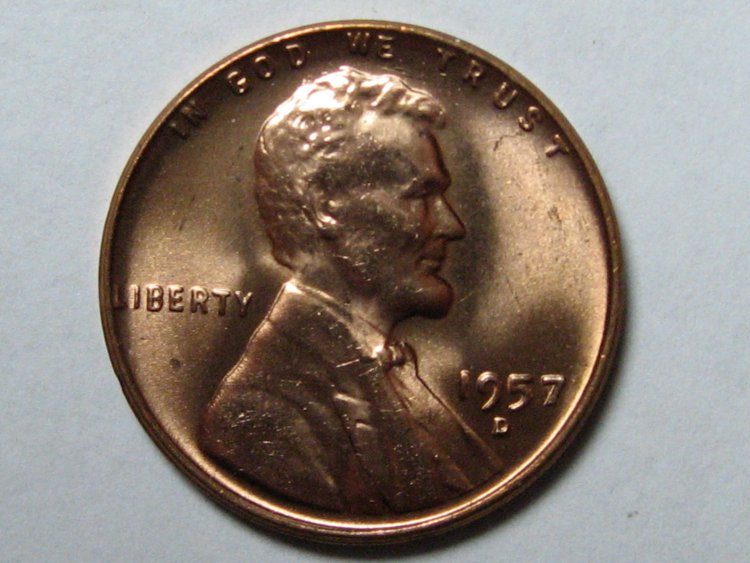
I generally try to grade using TPG standards but there are times I disagree with them, usually they are overly conservative. I have graded this coin as MS-63.

In this case, it's one criterion that TPGs put most of the grade toward and that's luster, which made me be conservative. The obverse doesn't cartwheel much due what I call "halo luster". That is luster than tends to radiate outward from the portrait forming a sort of halo appearance in the fields. On Lincolns this is typically seen on LDS coins so it's a bit odd to find it on an EDS example, nonetheless, that's what I see and I suspect it came from the weak striking pressure. TPGs love to see bright, flashy cartwheel luster, it can even overcome some pretty serious hits to produce high grades. With this coin the strike and the toning have subdued the luster on the obverse.

The reverse kind of speaks for itself. Nice red color and very strong, cartwheel luster. If I only saw the reverse I would have guessed MS-65, the reverse is basically flawless except for the weakness in strike. In my experience with TPGs, strike weakness only starts effecting the grade at 66 and up. TIP - when you think you're seeing wear on the obverse, check the reverse! It's clear to see from the reverse picture that this coin has not seen any circulation so you know it's mint state. Never judge a coin by one side!
Lincoln Cent Lover!
VERDI-CARE™ INVENTOR
https://verdi.care/
Bedrock of the Community
BadThad's Avatar
United States
19952 Posts
 Posted 09/15/2014  5:44 pm  Show Profile   Bookmark this reply Add BadThad to your friends list Get a Link to this Reply
I have better example of halo luster, but this is one I found where you can tell.

1930-S-Lincoln
Lincoln Cent Lover!
VERDI-CARE™ INVENTOR
https://verdi.care/
Rest in Peace
dave700x's Avatar
United States
10625 Posts
 Posted 09/15/2014  7:19 pm  Show Profile   Bookmark this reply Add dave700x to your friends list Get a Link to this Reply
Great information. Thank you for posting this test.
Pillar of the Community
Jon K's Avatar
United States
723 Posts
 Posted 09/22/2014  10:09 am  Show Profile   Bookmark this reply Add Jon K to your friends list Get a Link to this Reply
I have stood in front of a punch press for more hours than I care to think about. I might be able to lend some insight.

The photos that I have been able to find show the coin presses to be very similar to the presses that I have experience with.

The tonnage of the press is inherent, and is pretty much set at the press factory. The energy used to cycle the punch is stored in a very heavy flywheel. This flywheel is "spun up" to a certain RPM and then engaged into the mechanism to cycle the press.

Tonnage can be tuned if necessary by increasing or decreasing the RPMs of the flywheel. It can only be increased to the maximum allowed in the construction of the press, to prevent the press from "exploding". The flywheel takes a bit of time to spin up to RPM, I can't imagine that the mint would slow down the RPMs, and thus slow down production speed.

That is my theory, I have never stepped inside a mint.

Daniel Carr has a press that is rated at 400 tons. That is an enormous amount of pressure to work such a small piece of copper such as a cent.

What is adjustable is the stroke location. The stroke itself is not adjustable, it will be set at (for example) three inches. But the open height and shut height is easily adjustable to obtain the amount of compression of the cent.

The lower part of the press (the table) is not easily adjustable.
So at 400 tons we have what is nearly an unstoppable die. It smashes the upper die into the fixed lower die.

I would consider that the operator adjusts the shut height until the desired result is obtained. If (as in the case of this cent) the relief is too deep to properly fill, then the planchet should be made thicker (not going to happen) or the dies should be modified. This modification to the dies is what Brad discusses above.

Again, much of this is theory, based on my understanding of punch presses.

Perhaps Daniel will chime in. I believe he is a member here. Perhaps.

Oh, and as strike is important to grade, I would venture a 63 on this cent at a TPG. I would submit that the TPGs are not too concerned with WHY the strike is soft, or the deep recesses are not filled, just the result of such on the coin.

Though Brad is infinitely more knowledgeable than I as concerns Lincolns. If he says it is a 64 then I humbly defer to his knowledge and experience. Edit: Oh, I see Brad is at 63 as well.

Brad, is this one going to the graders?

Edited by Jon K
09/22/2014 10:16 am
  Previous TopicReplies: 32 / Views: 5,770Next Topic
Page: of 3

To participate in the forum you must log in or register.


Disclaimer: While a tremendous amount of effort goes into ensuring the accuracy of the information contained in this site, Coin Community assumes no liability for errors. Copyright 2005 - 2026 Coin Community Family- all rights reserved worldwide. Use of any images or content on this website without prior written permission of Coin Community or the original lender is strictly prohibited.
Contact Us  |  Advertise Here  |  Privacy Policy / Terms of Use

Coin Community Forum © 2005 - 2026 Coin Community Forums
It took 0.55 seconds to rattle this change. Forums