Coin Community Family of Web Sites Join Thousands of Coin, Bullion, & Money Collectors
Specializing in Modern Numismatics Join Thousands of Coin, Bullion, & Money Collectors 300,000 items to help build your collection! Vancouvers #1 Coin and Paper Money Dealer Coin, Banknote and Medal Collectors's Online Mall Royal Canadian Mint products, Canadian, Polish, American, and world coins and banknotes. Shop for APMEX Bullion on eBay!


Username:
Password:
Save Password
Forgot your Password?


This page may contain links that result in small commissions to keep this free site up and running.

Welcome Guest! Registering and/or logging in will remove the anchor (bottom) ads. It's Free!

Help Identify This Coin And Value?

To participate in the forum you must log in or register.
Author Previous TopicReplies: 6 / Views: 4,305Next Topic  
New Member

United States
2 Posts
 Posted 08/23/2007  12:36 pm Show Profile   Bookmark this topic Add Silverfox203 to your friends list Get a Link to this Message Number of Subscribers
Hello. I have a coin that the 2007 World Catalog of Coins cannot identify or value for me.
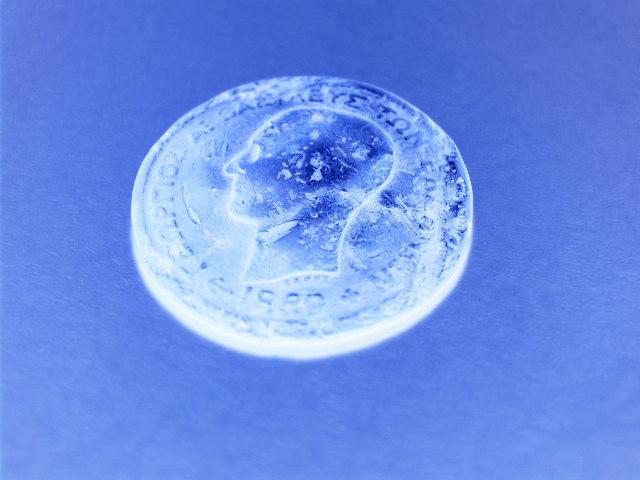
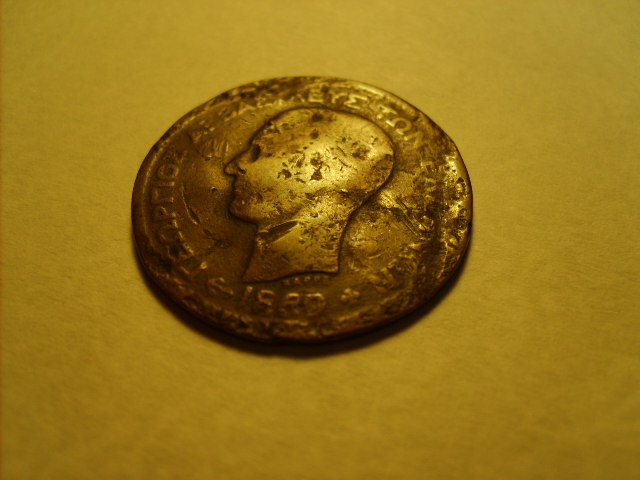
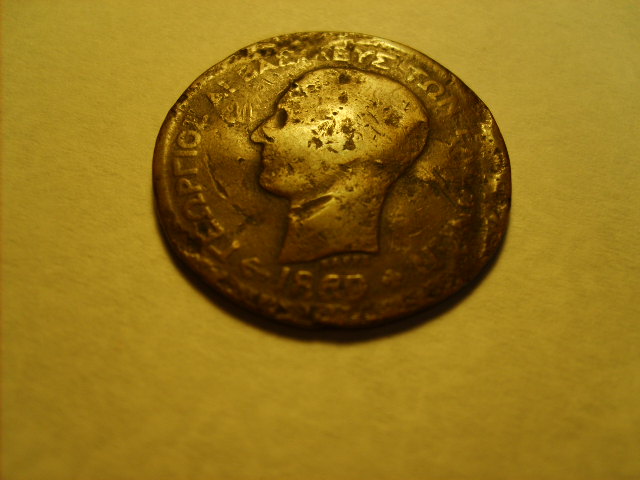
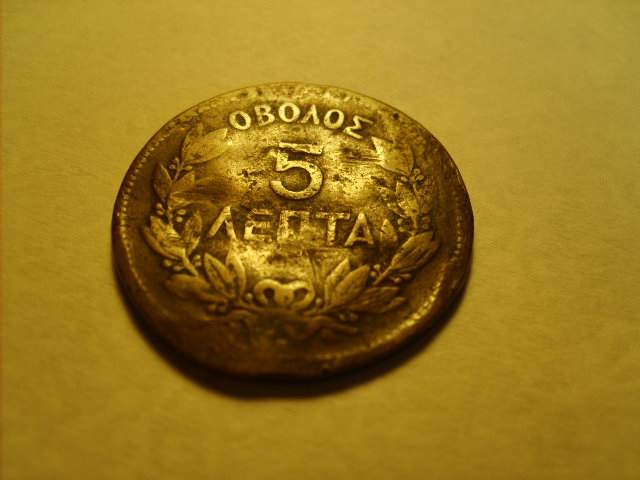
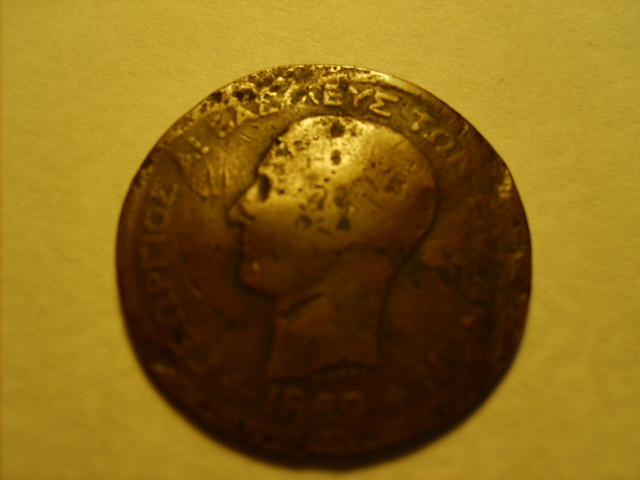
As you can see from the photos, this coin is in pretty decent shape considering the age of it.
Its believed to be a George 1 coin from what the book stated, but thats all the book really did tell me.
The date on the coin is: 1869 (next to the dates to the left next to the 1 is a curved arrow and next to the 9 is a cross of some sort.
If this coin was gold at one time, its not anymore. Its a Brass Copper color now.
Underneath the bust on the front is the word BAPPE
Everything is written in Greek.
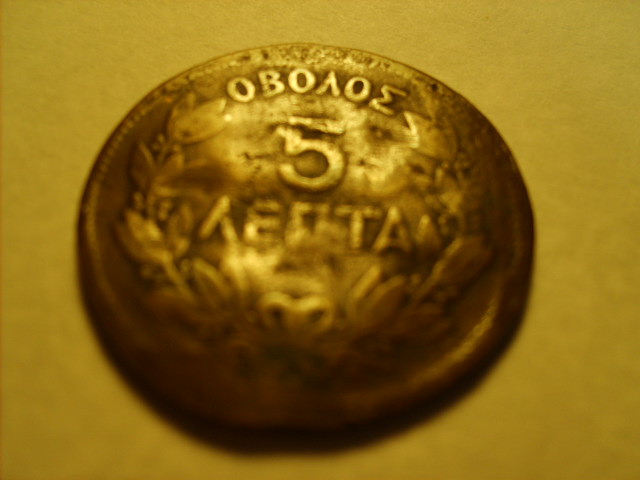
The back of the coin has the wreath that starts at the bottom and stops at about 10 and 2 and between the wreath ends at the top is another word in Greek.
It says 5 AENTA in the middle of the back.

If you could help me identify this or tell me a value on this coin. It would be greatly appreciated. Thanks again!

The first photo is the picture color inverted out, that gives better detail, because the lighting is dark and I cant seem to lighten it up at all.

Image: Help-Identify-This-Coin-And-Value? invertedcoin.jpg
36.6 KB

Image: Help-Identify-This-Coin-And-Value? S5001787.jpg
97.49 KB

Image: Help-Identify-This-Coin-And-Value? S5001789.jpg
97.36 KB

Image: Help-Identify-This-Coin-And-Value? S5001790.jpg
97.12 KB

Image: Help-Identify-This-Coin-And-Value? S5001791.jpg
98.4 KB

Image: Help-Identify-This-Coin-And-Value? S5001788.jpg
96.8 KB
Edited by Silverfox203
08/23/2007 12:46 pm
Pillar of the Community
halfabustisbetter's Avatar
United States
1984 Posts
 Posted 08/23/2007  12:43 pm  Show Profile   Bookmark this reply Add halfabustisbetter to your friends list Get a Link to this Reply
Welcome! It should be in the world coin book. It looks to be a KM#42 5 Lepta of Greece. Don't have the book handy (I have to go to the library to use it), so I can't help with current value. Someone will be by to assist soon if they haven't already.
New Member
United States
2 Posts
 Posted 08/23/2007  12:47 pm  Show Profile   Bookmark this reply Add Silverfox203 to your friends list Get a Link to this Reply
Thank you. I hope someone can help, we havent been successful with this book we have, it only goes back to 1901, and unfortunately the dates are farther back then that!
But Thank you!
Moderator
Learn More...
echizento's Avatar
United States
23731 Posts
 Posted 08/23/2007  1:45 pm  Show Profile   Bookmark this reply Add echizento to your friends list Get a Link to this Reply
Hello and Welcome,

The coin is a copper 5 Lepta from Greece. The date is hard to read put looks like 1869 which would make it Krause# KM#42. Sorry to say the condition isn't that good, with the wear and damage I'd grade it as about good. As to values, krause has it at $2.00 in fine condition. This would be less than half that.


Veiw my collection at: http://www.omnicoin.com/?collection=echizento
Pillar of the Community
atlashealth's Avatar
United States
1691 Posts
 Posted 08/24/2007  1:48 pm  Show Profile   Bookmark this reply Add atlashealth to your friends list Get a Link to this Reply
It's GREEK to me!
Valued Member
valutarick's Avatar
Netherlands
376 Posts
 Posted 08/26/2007  4:57 pm  Show Profile   Bookmark this reply Add valutarick to your friends list Get a Link to this Reply
THE KINGDOM OF GREECE

First king of Greece was Otho, who begins playing king in the year 1832. He was the guy that introduced the long standing Greek monetary system of 1832-2001.
1 drachma became 100 lepta.
Denominations were in copper 1,2,5 and 10 lepta, silver 1/4, 1/2, 1 and 5 drachmai, gold 20 drachmai.
Design was the portrait of the king in front and a scutcheon at the back for silver and gold; for copper coat of arms in front and denomination at the back.

Meanwhile, Great Brittain possessed the Ionian Isles, which were bought by the British from the Ottoman Empire in 1814. The British had two local coinages installed. The first was based on a 4 lepta of the obol, and the copper lepton, obol and 2 obol, which were issued in 1819-1821.
The second system was introduced in 1835, and had 5 lepta to the obol and the coins issued were the lepton in copper and the silver 30 lepta coin. All these designs are the Venetian Lion in front and Brittannia at the back (like she sits at all English Pennies until 1970). In the year 1864 the Ionian isles were given as a gift from Victoria to the new Greek monarch George I.

Georg von Holstein forced Otho to abdicate and ruled the country until 1913. There were no coins struck until the year 1868 and in the mean time Greece had joined the Latin Monetary Union.
Subsequent gold and silver issues were aligned to equivalent French Francs, and therefore they were minted in Paris, Bordeaux and Strassbourg. You can find 20 and 50 lepta in silver as well as 1,2 and 5 drachmai. Golden 5,10,20,50 and 100 drachmai also were struck.
The lepton and 2,5 and 10 lepta were issued in copper. THIS IS THE PERIOD IN WHICH YOUR COIN WAS BORN (1868).

From 1893 on the nickel was introduced for the 20 lepta and lesser denominations.

Until 1897 the isle of Crete remained under Ottoman Empire-ruling. Under the Greek prince Georg was a virtual proclamation of independance created, and therefor coins were struck aligned to Greece in 1900-1901. In the year 1908 Crete became fully united with the Greek throne.

The issues of 1910-1911 were very innovatory designs with scenes from classical Greek Mythology replacing the national coat of arms. All silver coins used a scene from the Illiad, copying a coin of King Pyrrhus of Epirus (295-272 BC), and the whole based coins shoed either Athena or the Athenian owl.

Under Constantine the first (1913-1923) little current coinage was issued. You can find a cupronickel 50 lepta which was minted at little private British Mints, and an aluminium 1922 10 lepta, minted in Poissy, France.

In coinage the stormy political events are not depicted, only banknotes will tell you that story by the way.

In between 1924-1935 the first Greek Republic was installed to replace the monarchy. At The Royal Mint of London cupro-nickel 20 and 50 lepta, 1and 2 drachmai, nickel 5 drachmai, and silver 10 and 20 drachmai were struck with mostly heads of deities portrayed.
1935 the monarchy was back in town, and under king George II (1935-1947) only commemoratives celebrating the restoration were struck. So the existing coins were roulating also under the new king.

His succeeder king Paul(1947-1964) made it possible to issue new coins with his face looking left and the Greek national arms at the back of each coin.
In Berne, Switzerland, the aluminium coins of 5, 10 ad 20 lepta were made, as well as the nickel 10 drachmai.
The silver 20 drachmai was made in London.
The cupronickel 50 lepta, 1, 2 and 5 drachmai were all minted in Paris.

Constantine II (1964-1973) made it possible that all the high values were transformed in cupro-nickel, minted in COMMUNISTIC Prague. In 1968 he was abdicated by military forces, but in his name and under his reign coins were still issued facing his portrait, while the King was not even living in Greece anymore... subsequentley exile.

The 2nd Republic was proclaimed in 1973, called the Hellenic Republic. The Athenian owl and the rising Phoenix were shown again in the design, to be replaced by Greek individuals in 1976, just until the Athenian owl walks again at the Greek euro of 2002.

Edited by valutarick
08/26/2007 5:02 pm
Moderator
Learn More...
echizento's Avatar
United States
23731 Posts
 Posted 08/26/2007  5:18 pm  Show Profile   Bookmark this reply Add echizento to your friends list Get a Link to this Reply
Interesting historical right up Eric. Thanks for the info.

Ron
  Previous TopicReplies: 6 / Views: 4,305Next Topic  

To participate in the forum you must log in or register.


Disclaimer: While a tremendous amount of effort goes into ensuring the accuracy of the information contained in this site, Coin Community assumes no liability for errors. Copyright 2005 - 2026 Coin Community Family- all rights reserved worldwide. Use of any images or content on this website without prior written permission of Coin Community or the original lender is strictly prohibited.
Contact Us  |  Advertise Here  |  Privacy Policy / Terms of Use

Coin Community Forum © 2005 - 2026 Coin Community Forums
It took 0.27 seconds to rattle this change. Forums