Coin Community Family of Web Sites Join Thousands of Coin, Bullion, & Money Collectors
Royal Canadian Mint products, Canadian, Polish, American, and world coins and banknotes. Shop for APMEX Bullion on eBay!Coin, Banknote and Medal Collectors's Online Mall 300,000 items to help build your collection! Join Thousands of Coin, Bullion, & Money Collectors Vancouvers #1 Coin and Paper Money Dealer Specializing in Modern Numismatics


Username:
Password:
Save Password
Forgot your Password?


This page may contain links that result in small commissions to keep this free site up and running.

Welcome Guest! Registering and/or logging in will remove the anchor (bottom) ads. It's Free!

A Difficult Dutch Duit Defies Definition

To participate in the forum you must log in or register.
Author Previous TopicReplies: 1 / Views: 4,950Next Topic  
Moderator
Learn More...
Sap's Avatar
Australia
16826 Posts
 Posted 08/25/2007  01:37 am Show Profile   Bookmark this topic Add Sap to your friends list Get a Link to this Message Number of Subscribers
I have a copper duit from Zeeland which is puzzling me.

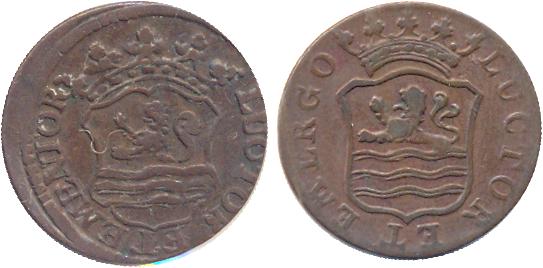
The motto of the Dutch province of Zeeland is "LUCTOR ET EMERGO", Latin for "I struggle and rise above". This motto appears on many Zeeland coins, including the copper duits of the 1700's... except for one variety.

A one-year type dated 1754 (KM# 91) bears the legend "LUCTOR ET EMENTOR" instead. Here's a pic of my EMENTOR (left), with a 1792 EMERGO next to it (right) to compare:
A-Difficult-Dutch-Duit-Defies-Definition

When I acquired this coin back in 1997, my only reference was an old Craig catalogue, which had the following statement concerning these coins: The 1754 with "LUCTOR ET EMENTOR" is a scarce fantasy piece. My 1700's Krause just gives it a separate KM number (and a value considerably lower than normal motto coins of that date) and doesn't attempt to explain the different legend.

So I look it up on the 'Net. Apparently, "ementor" isn't a real Latin word; it might be related to the word ementare "to kill" - giving a meaning something like "I struggle and was killed". But it's also close to the word ementior, "to counterfeit". (Latin scholars, please excuse my mangling of the language).

Not surprisingly, most of the sites about Dutch coins are in Dutch, but Babelfishing the relevant paragraph from this site seems to indicate that the popular theory behind the origin of these coins is a disagreement between a junior die-cutter and the Zeelandian government over pay and/or promotion. However, this same fellow did indeed get promoted to mintmaster a decade later... something which was hardly likely to happen if the guy had gone around making embarrassing protest coins.

I suspect they're more along the lines of an evasion - a token or fake coin made to appear similar to a real coin except for a different legend, to fool illiterate people into believing they were real coins. If this were true, then if the evader were caught he'd have a ready defence: "look, these medals I make are obviously not real coins, they even say they're fake right there. It's not my fault people are accepting them as money." They might even have been made outside the Netherlands.

I suspect, but I don't know. Does anyone out there actually know the truth about the origin of these pieces? I'm relying on Dutch-to-English translation programs, so any native speakers are free to correct or enhance the translations provided.
Don't say "infinitely" when you mean "very"; otherwise, you'll have no word left when you want to talk about something really infinite. - C. S. Lewis
Valued Member
valutarick's Avatar
Netherlands
376 Posts
 Posted 08/26/2007  3:40 pm  Show Profile   Bookmark this reply Add valutarick to your friends list Get a Link to this Reply
The earliest duits which were intended for circulation in the Netherlands for Zeelandia was 1604. The scutcheon as depicted at both sides were used in general in the period 1724-1754, and later on 1792-1797.

Photograph 1 shows the offcentric struck scutcheon of 1724, photo 2 the scutcheon as it was depicted in 1792 and later on.

Maybe it has something to do with resistance, because from 1796 on the Netherlands were occupied territory by the French.

www.geldmuseum.nl is a dutch link which you can use for reaching experts on this subject.

The existing 1754 type has to weigh 3,84 grammes. At the backside you ought to see ZEELANDIA 1754, AND ABOVE THE ZEE A CASTLE IN BETWEEN 2 ROSES. The castle is the mintmark of the city of Middelburg.

For the year 1754 there exists both a duit with text EMENTOR as well as EMERGO. THEY ARE RATED COMPARIBLE PRICES OVER HERE IN HOLLAND.

Duits are forged heavenly. The German city of Reckheim was known for copied Dutch duits with many writing errors.

But this is not a forgery, this is a Joke!

Martinus Holtzhey was the person who struck the duits.
All duits had restricted text luctor et emergo.
He was father too a son, named Johannes Martinus Holtzhey Junior.

Father wanted that his son also become a coinmaker, but Junior revolted against the authorities in Middelburg after he had failed to pass his exams. Formally papa has used his influence at these authorities to arrange that the son was given formally a years wages for his duties as making the duits; instead, pappa did all the work for Junior.

Junior did not make any duit for Zeeland as the authorities were agreed to the fact that the boy did not have any skills to do so. Instead Junior became nevertheless essayeur in 1765 after his fathers depart.

However, in 1754 there was a frauduleus scam in the minting house of Middelburg, which after it was discovered by the authorities, never have been taken notice from again by published punishment or publiced motivations about how and why it was done by whom.

A lady, M. de Man, did some extensive research about this in 1900, but did not find anything in the archives.
Fact is that in 1753 there has been an official agreement about giving the duit a more modern appearance in the forthcoming years.
Usually duits were struck in january and february of the forthcoming year.
Fact is also that in 1754 no new design was available.
Junior made his own duit and made the writing error ementor in stead of emergo.
Ementor is a non existing latin word.
Ementare means to kill, so the lyrics should pass for I fight and kill or I fought and was killed.

The authorities in Middelburg would not be the laughing stock of the nation, and besides, who can read latin those days.
So ementor duits were pressed in the mint of Middelburg, and later on that year of 1754 also the duits with the text emergo were made.
There are actually more duits EMENTOR struck then there are EMERGO, so Emergo is more expensive to obtain than his Joke-cousin Ementor.
Was it an illegal activity of minting personnel? Doubtfull.

there is another existing link, which may provide more knowledge about your specimen.
http://www.duiten.nl/zeeland.htm#N_4_

Edited by valutarick
08/26/2007 4:16 pm
  Previous TopicReplies: 1 / Views: 4,950Next Topic  

To participate in the forum you must log in or register.


Disclaimer: While a tremendous amount of effort goes into ensuring the accuracy of the information contained in this site, Coin Community assumes no liability for errors. Copyright 2005 - 2026 Coin Community Family- all rights reserved worldwide. Use of any images or content on this website without prior written permission of Coin Community or the original lender is strictly prohibited.
Contact Us  |  Advertise Here  |  Privacy Policy / Terms of Use

Coin Community Forum © 2005 - 2026 Coin Community Forums
It took 0.19 seconds to rattle this change. Forums