| Author |
 Replies: 7 / Views: 2,792 Replies: 7 / Views: 2,792 |
|
|
Pillar of the Community
 United States
5029 Posts |
Any thoughts/comments on these bills? Apologies in advance for the less than awesome picture quality - in particular on the backs. 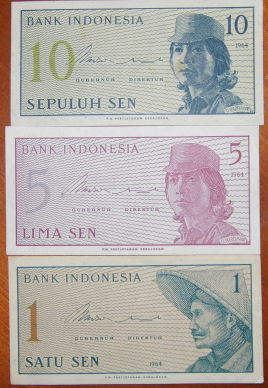 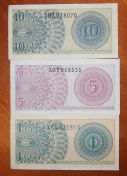 Thank for any input - Scott |
|
|
|
Pillar of the Community
Canada
2529 Posts |
I myself just got some of these out of a world notes bin. They're "sen" denominations, 100 sen is 1 Rupiah. I think they were all pulled from circulation 31 years later, except the 1 sen note which is still legal tender.
For the rest, I'll just give a translation from a blog I often go to for Indonesian money reference. Consists of Rp. 1, 5, 10, 25 and 50 denominations, they are the smallest paper denomination issued. They are still very common and have the lowest sell price. They sell for Rp. 100-500 per sheet.
Edit: If you can read Indonesian, I can give you the link to the blog.
Edit again: I found the actual series name and date of being pulled, from an archived page of the BI website. They're the "Dwikora" series. These apply to 5, 10, 25, and 50 sen denominations. So I got it right that the 1 sen is still legal tender.
Date pulled: 15 November 1996
Time limit to exchange at Kantor Bank Indonesia: 14 Nov 2029
Time limit to exchange at Kantor Pusat Bank Indonesia: 14 November 2029
So you can still exchange these notes for new money at face value at the office of the Bank of Indonesia until 2029, but they're technically not legal tender anymore. They're worthless now anyway, the cheapest thing nowdays is at least Rp. 1000. Yes, even candy, unless you get the really cheap one. A coconut has doubled in price to Rp. 8000 in the last 10 years.
Imagine buying a candy with 100000 of the 1 sen notes since they're still legal tender!
Also I'm not sure if "pulled" is the appropriate translation in this case, the Indonesian is "ditarik" which directly translates to "pulled".
Edited by Altaira
10/08/2014 01:10 am
|
|
Pillar of the Community
 United States
5029 Posts |
That is good info. That you for you the reply! I do not plan on getting rid of them. I am a coin guy so font know too much about notes.
I found them with some of the paper I have from my travels around the world. I think they are interesting. And their condition was unfolded... like the Korean note I posted also.
My other notes are worn, crinkled, wrinkled and well used. However, they all have a story behind them so I like them nonetheless.
|
|
Pillar of the Community
Canada
2529 Posts |
If you have any more questions on Indonesian money you can ask me and I'll try looking it up the best I can.
Most Indonesian money is well circulated and dirty, especially the smaller denominations ([partially because the people who use them are the poor). You don't find a lot of nice ones unless you buy a bundle of notes from the bank, then that's all new money..
Oh, and I think a more appropriate translation for "pulled" would be "withdrawn".
|
|
Pillar of the Community
United States
5029 Posts |
Well I appreciate the offer of using you for a contact on Indonesia money!
|
|
Pillar of the Community
Canada
2529 Posts |
There are a couple of blogs and those archived pages I often refer to when looking up Indonesian money, and as fas as I can see, they're pretty accurate. Also, growing up in Indonesia, I have used the Rupiah for years and saw it inflate as time pass. Hence the sentence about the coconut in my post above  |
|
Pillar of the Community
United States
746 Posts |
These are one of the most commonly available sets of paper money available from any country. These notes survived in unused packs and are still often given away by paper money dealers.
|
|
Pillar of the Community
Canada
2529 Posts |
I could imagine these not circulating too much because of their too small denomination. They have Rp. 10000 denominations back then. It's just like printing a Rp. 5 note today, it's a bit silly. There aren't even any more coins smaller than Rp. 1000 minted now.
|
| |
Replies: 7 / Views: 2,792 |
|










 Posted 10/08/2014 08:16 am


