| Author |
 Replies: 19 / Views: 3,262 Replies: 19 / Views: 3,262 |
|
New Member
United Kingdom
10 Posts |
Hi, I was wondering if someone might be able to shed some light on this coin. It appears to be genuine however there is one feature that I can't explain and which doesn't come out very well in the photos. The coin has a heavy tarnish, so heavy that it could be either bronze or brass. It's very dull, however on the reverse where the c-stamp has struck, the metal is glossy and looks like silver. Any advice would be appreciated. Image:  1792CarlosIV8RCstampRev.jpg 1792CarlosIV8RCstampRev.jpg36.92 KB Image: 1792CarlosIV8RCstampObv.jpg35.3 KB Thanks Shannon |
|
|
|
Moderator
 United States
23731 Posts |
Swamperbob is the expert on these coins.
|
|
Forum Dad
United States
24231 Posts |
I just sent him an email.
|
|
Pillar of the Community
Czech Republic
803 Posts |
It appears to be an octagonal countermark of George III, revalidating this 8 Reales to be used in Great Brittain. I don't know much about the countermark characteristics to judge it's authenticity, however the host coin is counterfeit. The date, portrait and legend positioning are wrong. Best way to identify a counterfeit is to compare it to a known authentic example, side-by-side. Here's one sold by Classical Numismatic Group in January: Image courtesy of CoinArchives.com Bob should be able to give you more information on whether the counterfeit is contemporary, or not. I would recommend posting weight and description of the edge to help him identify it. Regards, ~Roman |
|
Pillar of the Community
United States
5362 Posts |
First I want to say Thank-you, Bobby for directing my attention to this post. I just got back from a 10 day trip back to New England and for the entire time I had no access to a computer. I did get some nice counterfeits but that is a different story.
Hello Shannon,
What you appear to have there is a period counterfeit referred to by specialists as a part of the Birmingham Emission (Birmingham for short). I will explain the type first and then the reasons for my uncertainty as to the precise age of this particular coin.
The Birmingham series of forgeries was begun about 1796. They were made for the most part (as implied by the name) in Birmingham, England. They were manufactured using Sheffield Silver plate and were produced initially with the support of (or at least no opposition from) the English Government. They were intended to be sent overseas to the orient (mostly China) to destabilize the Spanish Economy. England and Spain were at war in 1796 and this was part of the "War effort" so to speak.
As a tactic it failed. The Chinese merchants caught on quickly and used chop punches to disclose the fraud. The Spanish Government produced a list of the dates and mint marks of the coins discovered and the "jig was up". The list of dates and mints involved is found in Cayon's (I am not positive of this name without checking) book on Spanish Forgeries.
Even though the effort initially failed - the forgers didn't stop. They kept the dies and continued to make coins sporadically. They actually passed better in the British Colonies so an "underground" operation began that continued for many years (at least through 1820 or so). These counterfeits were dumped into Canada and some found their way to the US. They did circulate for long periods of time - even after the silver layer wore off exposing the core. I am of the opinion that they circulated as a token coinage even though the fraud was obvious. I place them in a category quite similar to the Blacksmith Shop coins.
As an aside, I should explain that Sheffield silver plate is a process dating back to the 1770s where a metal sandwich composed of two thin silver layers were pressed onto a core layer of copper, brass or nickel. It was developed to produce inexpensive silver flatware and bowls, but the forgers quickly took note. It had the advantage of being able to use layers of 0.900 fine silver on the outside so that the color of the forgery was correct. Even if silver electroplating was available (it was not until the 1840s by the way), it would be the wrong color. Most applications of surface silver are the wrong color. Coin silver (anything in the 0.800 to 0.925 range) has a distinctive color that is different from pure silver. So a Sheffield Plate copy could be made with the correct assay silver on the outside.
Back to your coin.
When the English Monetary Crisis of 1803-1804 was at it's height. The forgers started applying the Bank of England Counter-stamps to their forgeries to pass them at home. This is what finally caused the British Government to act. What you have is an example of the second Bank Counter-stamp the Octagonal puncheon. Initially the Spanish 8Rs were stamped with a small oval punch (too easily copied) so a bigger Octagonal punch was made. That also failed and the BoE started re-coining the 8Rs entirely with the famous 1804 Bank design.
As another aside. The punch showing George III was always applied to the neck of Charles IIII of Spain which gave rise to the limerick - "The Bank, in order to make it's money pass, stamped the head of a fool on the neck of a butt."
Anyway, back again.
The copies of this type that can be die matched to the original Birmingham series of forgeries are VERY valuable to specialists like myself. I would gladly pay $300 for such an example because they are Exceptionally rare. However, modern forgers have begun to notice the increase in interest and price of the Birmingham's so in the past year or so some modern forgeries (closely resembling Birmingham's) have entered the market. These Modern fakes are far less valuable (say $30-50) but are still collectible. Their value rests largely on the information they impart about which die types are being copied and what the "new" dies look like. High grade copies are needed to identify die features.
The third class are the period forged host coins (after the Birmingham issue but made before 1820) which were stamped in England. These counterfeits still fall in the $100 or higher range depending upon the material used and the results of XRF testing which can identify trace contaminants associated with individual forgers.
Which category your coin falls into is what I can not be 100% certain of. I am leaning towards an older issue, but some of the die work looks just a bit strange - especially on the shield details.
I will go through my files and answer again - whether or not I can find a match.
However, in the meantime I have some questions which might shed light on the issue of age.
1. How much does the coin weigh in grams (to the 1/10 or 1/100th)?
2. Does the edge have the proper colonial design?
3. How many overlaps are there in the edge design?
4. What is the specific gravity of the coin?
5. What is the diameter of the coin?
|
|
Pillar of the Community
Czech Republic
803 Posts |
... and that's why Bob is The Man  Edited by TwoKopeiki
08/28/2007 5:30 pm
|
|
Forum Dad
United States
24231 Posts |
But I only wanted to know if it was real or not.   |
|
Pillar of the Community
United States
1231 Posts |
Of course it's real. A real fake!!
|
|
New Member
 United Kingdom
10 Posts |
Well, feed me garlic and call me stinky, if that isn't the most comprehensive response I could ever hope for!
Thank you Swamperbob for the detailed explanation with the many sidebars included. Fascinating stuff!
I'm working on attaining the answers to your questions and hopefully should have something for you later today regarding questions 1 and 5.
Question 1: 40grams although I am re-weighing on finer scales
Question 2: I am not familiar with the colonial edge design, however the edge design is circle,sqaure,circle,square linked together.
Question 3: There are no overlaps on the edge design, although I'm not sure if I'm analysing the edge correctly. Should there be obvious signs of overlap?
Question 4: I haven't yet figured out a safe way to immerse the coin into water to perform this test.
Question 5: 13.2cm
Look forward to hearing anything further that you may have found out.
|
|
New Member
United Kingdom
10 Posts |
My apologies for the error. The weight is 29.0 grams, not 40.0 grams.
Shannon
|
|
Pillar of the Community
United States
5362 Posts |
Shannon - The correct weight of an 8R is 27 grams. There is a very narrow range 26.5 to about 27.1 that is normal. At about 26.2 grams an 8R was worn beyond recognition.
The correct diameter is about 37 to 38 mm. A coin as large as 40mm was encountered in some period but was normally considered suspect. The smallest issues tend to be those of Durango which can be 35mm quite often.
Pure water will not harm the coin, but SG is really not needed at this time because I was able to type match the host coin. It is one of the later English issues dating to the latter part of the "Emergency" (when the cruder copies were the norm).
I located a copy with the oval CS and another with no punch at all. All three are thin plated copies which also points to a later issue date.
The pictures I have are too large to upload but they are the same.
|
|
New Member
United Kingdom
10 Posts |
Thanks for the further information. After acquiring this coin, I've found that there is some further reading available at https://www.counterfeitcoins.com. I'm not sure if this is right place to discussing selling this coin, so if not, then can you let me know your email address. I'm at shannon.cox@chevron.com. Cheers, Shannon |
|
New Member
United States
3 Posts |
I was just browsing and I also thought the legends were all wrong till I found Heritage sold the same one for 1,150 in 2006.  |
|
Pillar of the Community
United States
5362 Posts |
Meiji - Very interesting. Heritage clearly has sold a forgery as the real thing.
One of the diagnostics for the host coin that proves beyond any doubt whatsoever is the shape (font) of the numerals in the date.
Look at the 9 for instance. It is the wrong shape - the Mexican 9 has a loop not the straight connection seen on this host coin. PERIOD.
Heritage is wrong.
I tried 4 different times to add a scan showing the 9s but for some reason I could not do it. I will try later. But if you compare the 9 in the Heritage picture with the 9 in the picture above posted by TwoKopeiki you can see the difference.
Edited by swamperbob
10/03/2007 8:49 pm
|
|
Pillar of the Community
United States
5362 Posts |
Here is the RIGHT shape 9 Image Insert: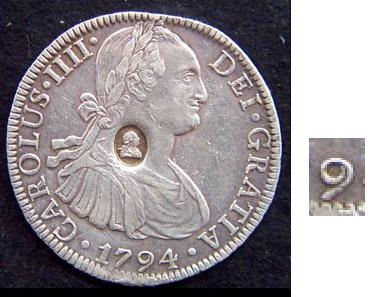 Here are TWO INCORRECT 9s including one that is so worn out that half the underlayer shows. These are the same host coins. Image Insert: Edited by swamperbob
10/03/2007 9:05 pm
|
|
New Member
United States
3 Posts |
Right that's what I meant when I said the legends were all wrong. The 9 and 2 were blatantly wrong for Mexico, so I moved on. Then I saw the same one sell on Heritage for $1,150.00 What I can't believe is if your going to pay over 1k for a coin, you should do some research. It's amazing how identical the 2 coins are. They both have worn E on ET, same N on IND. Shame on you Heritage. Here is the link if you're interested: http://coins.ha.com/common/view_ite...13591&src=prEdited by Meiji
10/04/2007 12:35 am
|
| |
Replies: 19 / Views: 3,262 |







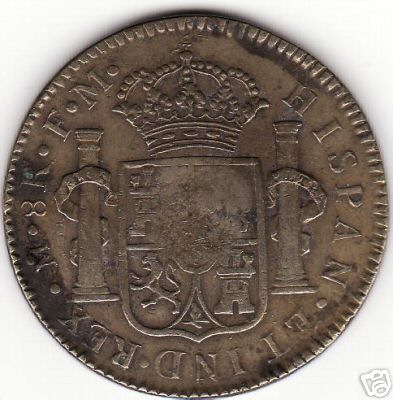 1792CarlosIV8RCstampRev.jpg
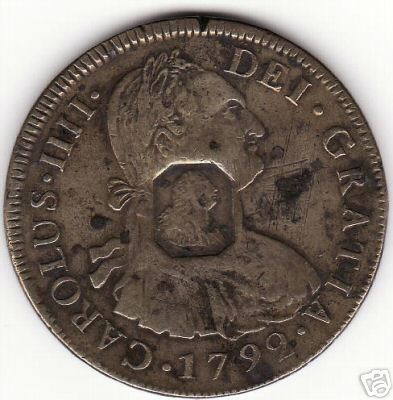 1792CarlosIV8RCstampObv.jpg


 Posted 08/28/2007 1:48 pm





