| Author |
 Replies: 14 / Views: 4,797 Replies: 14 / Views: 4,797 |
|
|
Valued Member
United States
220 Posts |
I do not know much about large cents, or error varieties either, but this looks like an 1808 large cent that has a very severe multiple strike error. I can read the date quite clearly, though it may not show in the pictures. I tried to angle the obverse photo to show all of the detail. Can anyone tell me what this is? 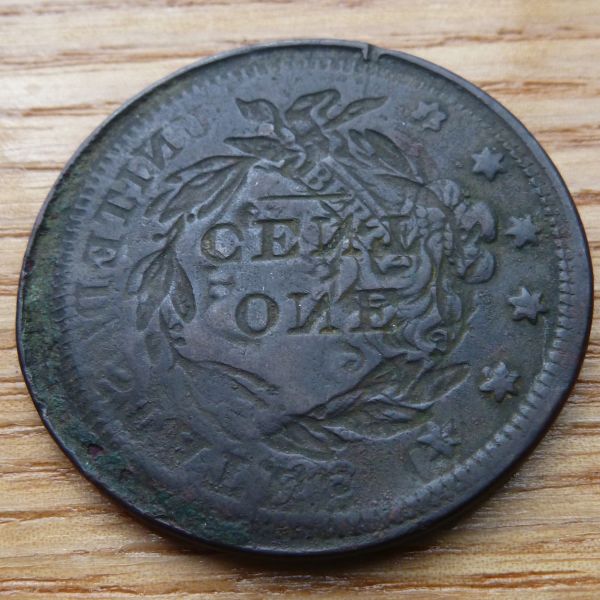 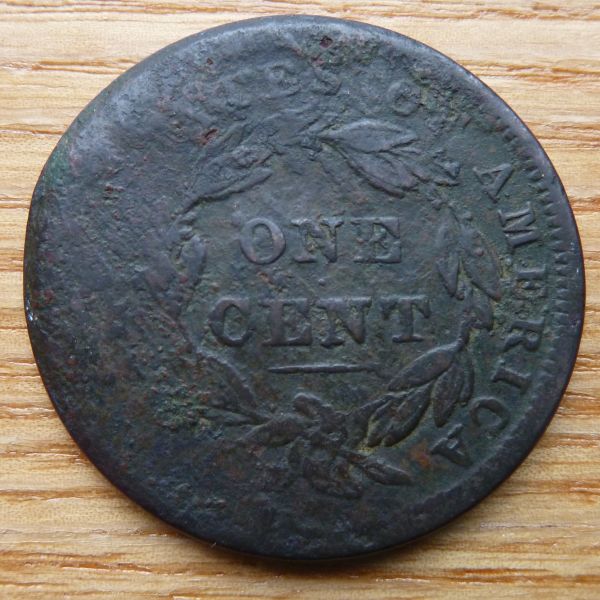 |
|
|
|
Pillar of the Community
United States
4409 Posts |
It's either an 1816 or 1818 based on the design.
I don't believe this left the mint this way as clashes aren't usually that prominent/deep. IMO, someone took the reverse of another cent and pressed or squeezed it to transfer the design.
I am far from an expert on errors so hopefully someone more knowledgeable will chime in.
-MV
|
|
Valued Member
Canada
488 Posts |
As well no pro, but I agree. Hope not though.
|
|
Pillar of the Community
United States
4897 Posts |
Quote:
someone took the reverse of another cent and pressed or squeezed it to transfer the design.
it is incuse and reversed....there is no other explanation.... |
|
Valued Member
 United States
220 Posts |
Could a coin have gotten stuck in the press during the minting process?
|
|
Pillar of the Community
United States
1211 Posts |
1. I am almost certain the host coin is 1838.
2. I am almost certain that the explanation given that the reverse of another large cent was pressed into the host coin's obverse is the most logical explanation.
|
|
Pillar of the Community
Korea, Republic Of
1881 Posts |
Looks definitely like a vise job--the incuse, reversed design and the irregular shape that looks mushed in places are big giveaways. PMD. |
|
Bedrock of the Community
United States
17884 Posts |
1838 with the reverse of another cent forced into it AFTER it left the mint. Has to be an 1838 because the last digit is an 8 and the bust has beaded hair cords which were not introduced until 1837. Quote:
Could a coin have gotten stuck in the press during the minting process? If a cent had gotten stuck in the press it could form a brockage image of the reverse (incuse and reversed). HOWEVER, if a struck cent had stuck to the obverse die and a previously struck cent was fed into the press, you could get an obverse with a reversed, incuse reverse pressed into it. But it would also show a double struck raised reverse with the first reverse strike being partially flattened. This coin does not show that. Edited by Conder101
10/16/2014 11:57 am
|
|
Bedrock of the Community
United States
37206 Posts |
Looks like someone set the 1838 down then hammered another cent down on top of it. You can tell that the coins shape has been deformed by a hard hit on the left side.
|
|
Pillar of the Community
United States
4897 Posts |
Quote:
If a cent had gotten stuck in the press it could form a brockage image of the reverse (incuse and reversed). HOWEVER, if a struck cent had stuck to the obverse die and a previously struck cent was fed into the press, you could get an obverse with a reversed, incuse reverse pressed into it. But it would also show a double struck raised reverse with the first reverse strike being partially flattened. This coin does not show that. This! The reverse damage is a give away to the PMD. Also, @ Conder... would not the obverse image be mushy and less detailed if it were struck through a capped die? |
|
Valued Member
United States
220 Posts |
Thank you all for the very informed comments. I just don't understand why someone would do this to a coin, and then keep it as part of a very extensive coin collection. I guess I was hoping for "cool!" And not "junk". Also, I do see the 1838 date.
|
|
Pillar of the Community
United States
1247 Posts |
As for the "cool" not "junk" how many 1838 coins do you have in your collection?
I have none, so if you think it is junk, send it to me.
|
|
Bedrock of the Community
United States
17884 Posts |
Quote:
would not the obverse image be mushy and less detailed if it were struck through a capped die? Possibly, but the copper of the coin stuck to the die is softer than a die would be, and similar to the hardness of the copper in the previously struck cent, so it may not flatten the design that much. Quote:
I just don't understand why someone would do this to a coin, and then keep it as part of a very extensive coin collection. Because someone else made it and the collector, like you, did not know what it was. Years ago few collectors truly understood error coins and how they were created. Errors were not widely collected and most collectors just considered them as defecting and not worth keeping. Often errors would just be thrown away or melted down if they were gold or silver. This piece was probly just kept because it was so visually impressive, and as a curiosity. |
|
New Member
United States
1 Posts |
Good morning,
I came across your coin and the replies you received. Hopefully you have not gotten rid of your coin yet. What it appears to be is an off-center (incused) brockage. The only positive way to find out is to submit it to PCGS or NGC and see what they say. While I respect all the people on Coin Community, sometimes they miss something, and in this case I think they did. Some time ago I did what you did and asked for help to identify two error coins (both incused brockage large cents). I was told they were fakes and vise jobs. Turned out they were error coins and worth a lot. I cut and pasted this for you, hopefully to give you a better example of what you have. There is a lot of information about brockage coins, and that is what your coin appears to be. Here is the information. Jake
BROCKAGE
A brockage error can only occur when there are two coins involved. One of the coins involved will always be a struck coin which has not ejected properly. That struck coin will find its way back between the dies and will be struck next to a blank planchet which was fed into the collar. The image of that first struck coin will be impressed into that side of the blank planchet. The result will be a second coin which has images of the first coin impressed into it. Those images will be pressed into the coin and the image will be in reverse. This incuse sunken image is known as a brockage.
|
|
Valued Member
United States
152 Posts |
Sorry but it is PMD, NOT a brockage ! |
| |
Replies: 14 / Views: 4,797 |
|







 Posted 10/15/2014 11:19 pm





