Yippeee, another coin for the "Unusual Modes of Transportation" set arrived today.
Biga. Of Cupids.
Awesome.
At the risk of sounded totally girlie, isn't it
adorable?

Here's a hasty picture. The iridescence is even better than shown here so I will keep trying to capture better images.
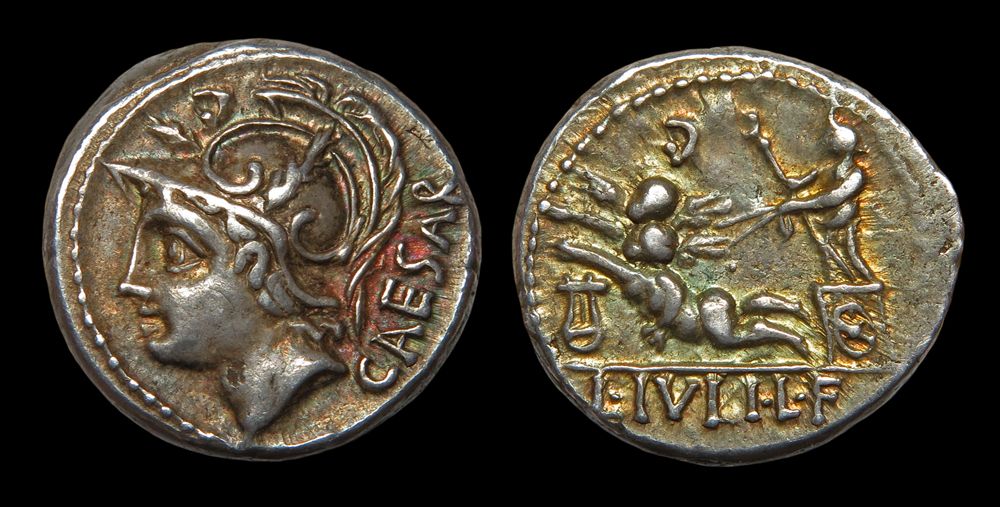 Roman Republic, L. Julius L. f. Caesar
103 BC AR denarius, 17mm, 3.9 gm
Obv: Helmeted head of Mars left; CAESAR; ・J above
Rev: Venus Genetrix in chariot left, drawn by two Cupids; lyre to left; ・J above Ref: Crawford 320/1.
Jencek E-auction 26, lot 58, 14 October 2014. Ex CNG XXXI lot 699, September 1994; ex RBW Collection A bit about this moneyer, from CNG's archives: Quote:
L. Julius Caesar, a member of the gens Iulia and, thereby, a relative of Caesar the Dictator, was one of the earliest members of the family to attain the consulship. Governor of Macedonia in 94 BC, and consul during the Social War, he passed the basic law which offered Roman citizenship to the Italian allies; as censor along with P. Licinius Crassus, grandfather of the triumvir, he helped to enroll the first of them. He was an opponent of Marius and was killed on the latter's return to Rome in 87 BC. He was also the grandfather of Mark Antony.
Why Venus Genetrix? The Julian family claimed descent from Venus through the Trojan exile Aeneas. As for the use of Cupid on this coin, Cupid/Eros is by some accounts the infant of Venus. I guess Venus was making the most of her children's gifts although one could argue that it's child abuse

.
Regarding the ・J control marks, from a similar coin's description in a Goldberg auction: The controls found on the denarii of L. Julius L.f. Caesar are the letters of the Latin alphabet (only through S) either alone or found accompanied by one or two pellets. The same control mark that is found on the obverse invariably appears on the reverse also, and no pair of controls has more than one pair of dies.
About the RBW Collection: RBW curated an outstanding collection of Roman Republican coins, jumping from
US coins to his first ancient coin in 1960. Like many of us, he was amazed that an ordinary person could own such an antiquity-- and for so little money! Next he bought a book-- Sydenham's work on coins of the Roman Republic-- and then he was hooked. Without coin collecting heirs, he decided to sell his collection late in life. The first part was offered by NAC in 2011.
The rest of his brief autobiography and a delightful introduction by Roberto Russo can be read in the
NAC auction brochure. It's definitely worth a read.











 Posted 10/20/2014 4:36 pm


 .
.