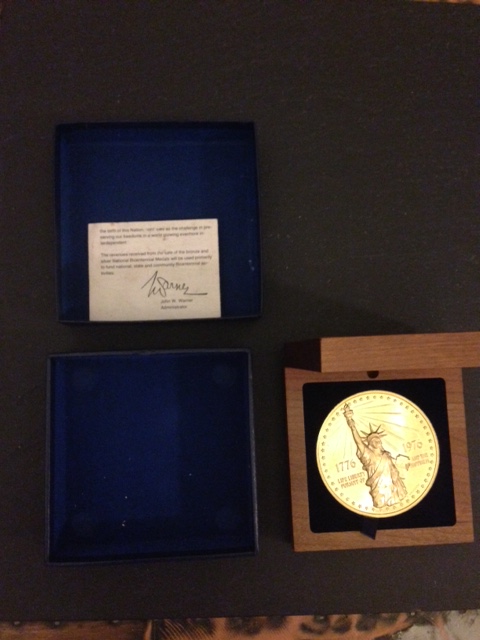
From your images, it does appear that you have one of the large 3" gold medals struck by the US Mint for the American Bicentennial. It is considered a "National Bicentennial Medal" and was available in the following sizes/metals:
- 1.5 inch bronze
- 1.5 inch gold-plated bronze
- 1.5 inch 0.925 fine silver
- 3.0 inch 0.925 fine silver
- 0.906 inch 0.900 fine gold
- 1-5/16 inch 0.900 fine gold
- 3.0 inch 0.900 fine gold [Original selling price: $4,000]
The medal was designed by
Frank Gasparro.
Your gold piece contains 13.18 troy ounces of gold. At today's spot price, it contains roughly $16,395 worth of gold.
The medal does command a numismatic premium over its "melt value" and
should not be sold for its bullion value alone.
Examples of the medal do not appear on the market very often, but when they do they sell for more than "melt." One sold at auction in Feb-08 for $13,800. At the time, the value of the gold it contained was roughly $12,060. So, it sold for $1,740 more than melt â€" a numismatic premium of approximately 14.5%.
Another example sold at auction in Jan-06 for $10,925. At the time, gold was about $538 per ounce, so the medal had a gold value of $7,091. The value differential of $3,834 represents a 54% numismatic premium.
One last thing, the large gold medal was "struck to order" - a total of 424 of them were ordered/minted. A number have been melted over the years, so it's unknown how many of the original 424 remain.
So, bottom line, if you are looking to sell the piece, I would strongly advise that you not take any offers that are strictly based on the medal's melt value. You would be leaving money on the table if you did so. I would hold for at least a 15-20% premium over melt. The number of buyers would be more limited, but it is a far fairer price.
Hope that helps!









 Posted 10/21/2014 6:43 pm





