| Author |
 Replies: 8 / Views: 2,581 Replies: 8 / Views: 2,581 |
|
|
Pillar of the Community
3772 Posts |
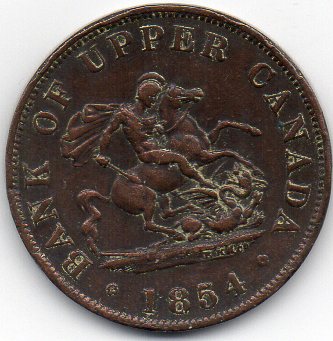  All comments welcome. Question specifally to 'colonialtokens': To loosen up the verdigris (inwards from the E in Penny), I will give the coin a bath in olive oil, so that it can be removed. Do you consider this technique acceptable or do you frown upon any conservation effort?
|
|
|
|
Pillar of the Community
United States
840 Posts |
This is a perplexing series to attribute. Doctor Courteau
separates this series into two groupings according to whether
or not a dot is within the right Rosette on the reverse.
Varieties 111-132 (inclusive) exhibit a dot within the Rosette.
Varieties 133-158 (inclusive) exhibit no dot within the Rosette.
Your token appears to have a dot within the Rosette, thus the
search has been reduced to but 22 varieties. Now you have to compare
your token with each of the 22 varieties and begin the time consuming
process of elimination.
doug
|
|
Pillar of the Community
 3772 Posts |
Thank you, I will once/if I get hold of those books you are referring to.
Any comment to grade? And to my other question?
Yes, you are right, there is a dot in each of those rosettes.
|
|
Pillar of the Community
Canada
2786 Posts |
pics might be too small for accurate grade,
as for getting rid of the green, have you tried forum member badthad's verdi-gone? works wonders and I don't think it does much to affect value to circulated coins/tokens.
|
|
Pillar of the Community
United States
840 Posts |
Grade VF-30
Will endeavor to attribute further when I have more time.
doug
|
|
Pillar of the Community
United States
840 Posts |
Varieties 133, 134, 136, 136, 150, and 152 can be readily eliminated
from consideration as they all shew no left foot to the man.
ergo,
137, 138, 139, 140, 141, 142, 143, 144, 145, 146, 147, 148, 149,
151, 153, 154, 155, 156, 157, 158 remain.
Varieties 147, 148, 153, 154, and 156 can also be eliminated as they
shew only the upper section of the section of the St. Andrew's Cross frame
below the E in TOKEN.
ergo
137, 138, 139, 140, 141, 142, 143, 144, 145, 146, 149, 151, 157, and 158 remain.
The
The terminals of the Union Jack and the St. Andrew's Cross frame merge together at the base of the Shield on variety 151.
Variety 157 shews no outline of the Union Jack below the E in TOKEN.
Variety 158 shews no St. Andrew's Cross frame below the E in TOKEN.
ergo
137, 138, 139, 141, 142, 143, 144, 145, 146, and 149 remain.
From the present photos, it is difficult to determine further.
doug
|
|
Pillar of the Community
3772 Posts |
Thanks for the long response 'colonialtokens', it starts to tease me into finding out more about these token. Hope that Doctor Courteau's book will soon be available as pdf. Tried to find it, but only one of his other works has been uploaded so far.
|
|
Forum Kid
Canada
1074 Posts |
Yes a VF-30 is correct! very nice coin!
|
|
Pillar of the Community
United States
840 Posts |
Many numismatists frown on any type of 'cleaning.' However, many die-markers can not be
positively ascertained and properly identified when buried under decades of crud and grime.
Crud and grime is also a common issue on Vicky cents. Olive oil is an effective and popular
treatment. What I normally use is a product called MS-70. I let the coin soak in the solution
for a couple of minutes to loosen up some of the crud and then I soak a swab in the MS-70 and
gently work the swab into areas where crud remains. I rinse the coin under hot tap water to
rinse away the MS-70, then place a drop of liquid dish soap in the coin and gently pat and work
the soap unto the coin and rinse again in hot tap water. Then a quick dip into an ascetone rinse.
A coating of WD-40 is applied to protect the coin from future issues.
I have sent many coins treated this way to certification services and have not yet had any returned
or noted as being 'cleaned.' The only down-side is that sometimes (perhaps 1 in 50), this treatment
causes the coin to turn a dark colour. I do not understand this anomaly.
doug
|
| |
Replies: 8 / Views: 2,581 |
|










 Posted 11/25/2014 02:10 am


