| Author |
 Replies: 19 / Views: 6,683 Replies: 19 / Views: 6,683 |
|
Pillar of the Community
United States
5155 Posts |
I spotted this piece in a lot for sale on the 'bay. I really didnt want many of the coins in the lot, but I did see something that stood out. Something you dont see everyday and something I need for my collection. Among the lot of huge planchet coins I noticed this very tiny piece of ancient chocolate. Confident with what I was seeing I made an offer to the seller for the single piece and he accepted, the offer was decent but I felt I wanted to comp him for terminating the listing, his time and the shipping, yet the deal was still very good. With no further delay.... Anastasius (491-518 AD) AE Small Module 40 nummis (Follis) struck 498-507 AD 23.8 mm x 12.43 grams Obverse: Diademed bust of Anastasius- DN ANASTASIVS AV Reverse: Large M flanked by Stars, Delta Officina - NIC, cross above ref# SB32 Note: Superb condition. Rare in this state. 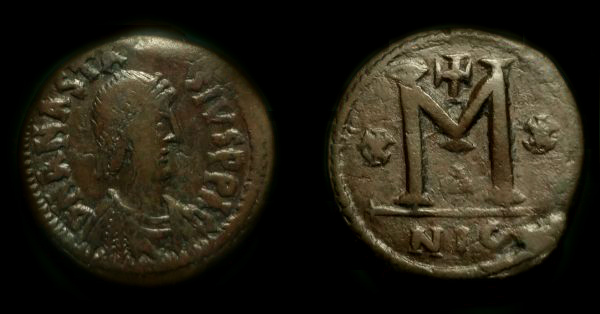 Edited by Ancientnoob
11/25/2014 08:12 am
|
|
|
|
Pillar of the Community
 United States
5029 Posts |
I don't know much about ancients but that is a really nice looking coin. Congrats!
|
|
Moderator
United States
23731 Posts |
A beautiful early Byzantine coin, well struck, super patina.
|
|
Pillar of the Community
3772 Posts |
Quote:
very tiny piece  Definitely more beautiful than my SB#16 and a slightly smaller 'small module', good find.  |
|
Pillar of the Community
United States
1315 Posts |
Great looking coin, Anoob, nice find. I know very little about Byzantine coins, but here is one I recently got our local coin show. In contrast to the OP coin it is a larger module, 32mm, 17.1g. Why is there such a range in size and weight for these types, are they the same or different denominations? 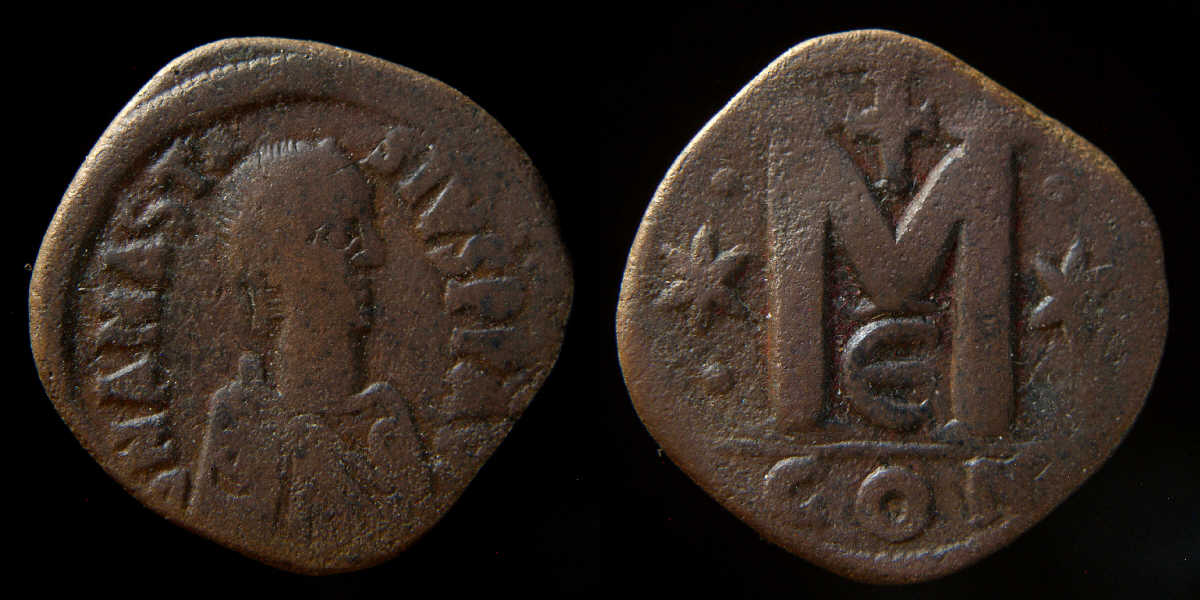 Sear 21, var. star on shoulder. |
|
Valued Member
United Kingdom
435 Posts |
Both coins on this thread are very attractive examples!
|
|
Pillar of the Community
3772 Posts |
They are the same denomination, the M is the Greek '40' indicating that the coin is a 40 Nummi.
|
|
Pillar of the Community
 United States
5155 Posts |
Yes both denominations are the same as Medieval noted. Anastasius was a master economist. He reformed the Roman currency and fixed the system around the Gold Solidus. Towards the middle of his reign he increased the size of the follis, why?, I am not sure and records about this reform are vague at best. One would assume that the treasury grew and he wanted to mint a coin that demonstrated the power of the East Romans in the face of the Barbaric west. When he died he left something like 890,000 pounds of gold in the treasury. A testament to fiscal success.
What I love most about this coin is the condition. I mean the picture does not do it justice. In hand it really is a piece of chocolate with a perfect patina. I also admired its completeness. In most cases on the small module follis there is not enough metal to fill the die and some of both side's detail is lost. Usually the Officina mark under the "M" and the high details on the emperors bust. Oh man I am thrilled. Wait till VK sees this.
|
|
Pillar of the Community
United States
5155 Posts |
BTW - Doucet's coin is quite nice with a great amount of the emperors bust intact. Certainly better than most out there.
|
|
Pillar of the Community
United States
4778 Posts |
Quote:
Arguably the Last Ancient Coin Yes, on account there are many other different interpretations. Here's my personal view. If it were possible to date them, I would consider those coins struck by Emperor Zeno after Sept 4, 476 to be medieval (he ruled for a total of a year before that date and almost 15 years afterwards, so just by assumption most of his coins should be "medieval" but as I implied there is no way to date them. Only coins of Zeno struck by Odoacer in Italy would be safe enough to be called medieval). But since dating them is out of the question, I look to the coins of the emperor right after Zeno that started his reign after 476, Anastasius, as the first medieval coinage, even the pre-reform bronzes (remember this is a European viewpoint, since my collecting habits are ancient/medieval Europe and the Mediterranean, so the end of ancient and the start of "medieval" would probably be different for other places). The aesthetic style is still late Roman; nothing had changed in that regard. But to me the beginning of medieval coinage is with Anastasius. Here is my small-module, 26 mm.  My tiniest Anastasius, the monogram type of course.  This one is my largest Anastasius, at 35 mm wide.  And here's my favorite Anastasius coin.  Edited by VisigothKing
11/25/2014 12:32 pm
|
|
Pillar of the Community
United States
5155 Posts |
|
|
Pillar of the Community
Netherlands
1204 Posts |
nice! |
|
Pillar of the Community
Russian Federation
5186 Posts |
There are different ideas as to the boundary of "ancient" versus "medieval". I do not really see the point of using the year 476 AD specifically.
The most common opinion in Roman coin collecting seems to be putting the border at 498 AD, in which case the last ancient coin is the monogram type above. My own opinion, as of a few months ago, put the entire Byzantine letter-coded series on the "ancient" side, giving a boundary somewhere in the 7th century; lately I've been persuaded to switch to the 498 version of the boundary.
Some don't include the Byzantines at all, occasionally even going as far as putting Arcadius coins in "medieval" while the same types from Honorius are considered "ancient" (IIRC, there's a somewhat infamous catalogue structured that way). Some go all the way in the other direction: I've seen a post which featured a coin said to be the respective member's (I'm paraphrasing slightly) "most recent ancient coin, and probably will stay that way"; it was a small silver coin of John VIII - that is to say, from the 15th century.
The whole thing goes much more confusing once we get to non-Roman issues, obviously; IIRC, some member here, after considering some of these problems, decided to just use the year 500 as a nice round boundary.
|
|
Valued Member
United Kingdom
435 Posts |
I have one to add too...demonstrating AN's point about the lost officina letter. Sometime I need to see if I can remove just a little of the sand to reveal more detail. 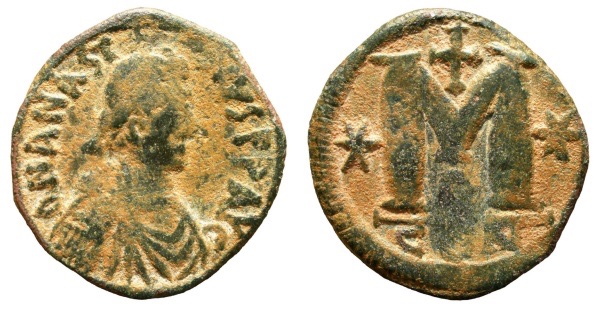 |
|
Pillar of the Community
United States
2368 Posts |
Some great coins in this thread. I have to get some Byzantine issues soon. Quote:
Arguably the Last Ancient Coin Is the Byzantine Empire considered medieval? I've always wondered where to draw the line between "ancient and " medieval". I know there are a lot of different interpretations of it. What's even more confusing to me is where to draw the line between Roman and Byzantine coinage. Some say it's after Theodosius, after Romulus Augustus, after Zeno, or after Anastasius's monetary reforms in 498. Personally, where do you think the split is? |
|
Pillar of the Community
United States
4778 Posts |
Quote:
Is the Byzantine Empire considered medieval? Yes. It was the eastern part of the Roman Empire that remained after the dissolution of what remained of the western empire in 476. It lasted until 1453, a mere 561 years ago. "Byzantine" is a name given more recently to the Eastern Roman Empire; the eastern Romans never called themselves or their empire "Byzantine". Edited by VisigothKing
11/25/2014 3:15 pm
|
| |
Replies: 19 / Views: 6,683 |





 Posted 11/25/2014 08:51 am





