| Author |
 Replies: 11 / Views: 1,992 Replies: 11 / Views: 1,992 |
|
|
Valued Member
50 Posts |
Israeli coin struck on two bonded Canadian cent planchets. The edges of the planchets are slightly folded over, wrapped one over the other. Israeli coins of that time period (70s'-80s') were stuck at the RCM, leading to all sorts of interesting mixups and errors. But not every day do you see a coin struck on two planchets. 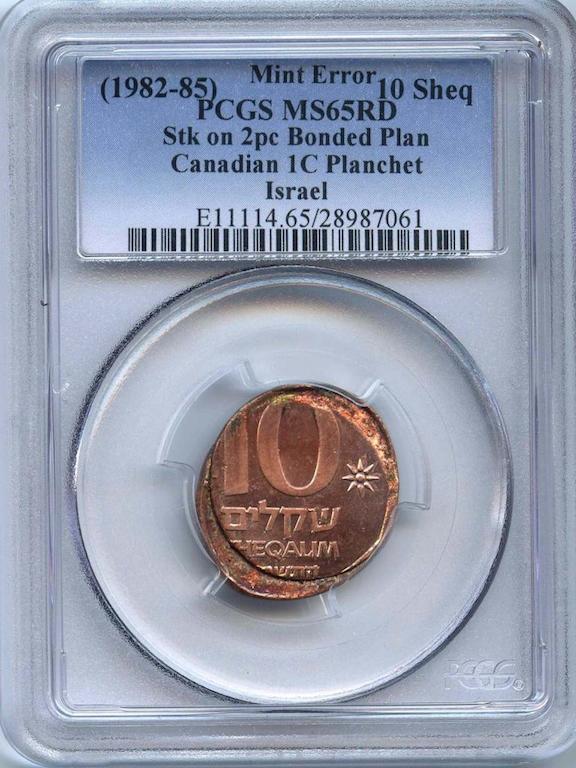 |
|
|
|
Bedrock of the Community
Australia
21789 Posts |
I have never seen an error like this before.
Normally, the two planchets should break apart after striking.
It hasn't happened in this case.
That leads me to the thought that it may be a mint sport,
where the two planchets may have been partly welded by strong heating together before striking. The fact that the extremeties are not turned up or down, suggest that it was not struck in a collar.
I feel it is genuine, inasmuch as that is the way it left the mint. Nevertheless, it probably did not leave the mint in with normal business strikes.
All my opinions. Anyone wish to question them? Feel free to do so.
|
|
Valued Member
 50 Posts |
Hi sel_69l,
First, I agree it could have been mint sport. However, consider this: the cent planchets are smaller and softer that the intended Israeli planchet for 10-shekel coin. The coin press was calibrated for a 26mm cupro-aluminium (copper 75%, aluminium 25%) alloy. It was instead fed two smaller Canadian cent copper planchets. Lying one on top of the other like this, they do not fill the width of the coining chamber, and the rim is not in contact with the collar.
As they were not resting directly one on top of the other, there is some unstruck edge for each one. That edge is slightly curled up and seems to be holding the other planchet in place. Unfortunately, I purchased the coin already in the PCGS slab, so I don't really know how strong or loose this bonding actually is.
What I do know about it is that it was acquired by Fred Weinberg from the son of a late mint employee, who kept this (and many other) errors hidden away for decades. So whether or not it was manufactured deliberately, I do not know, but I do know that it never left the mint normally. This would also explain its excellent preservation in mint state red condition.
|
|
Moderator
 Canada
10473 Posts |
Bonded pairs of Canadian bronze cents are known, but are extremely rare. I think George Manz has a bonded pair of Canadian 1-cent coins for sale on his website: http://www.georgemanzcoins.com/imag...rBond416.jpgBonded clusters do not occur like the zinc Lincoln cents do... I do have a triplet in my collection, but the planchets are not bonded. I published this set in Errorscope last year. 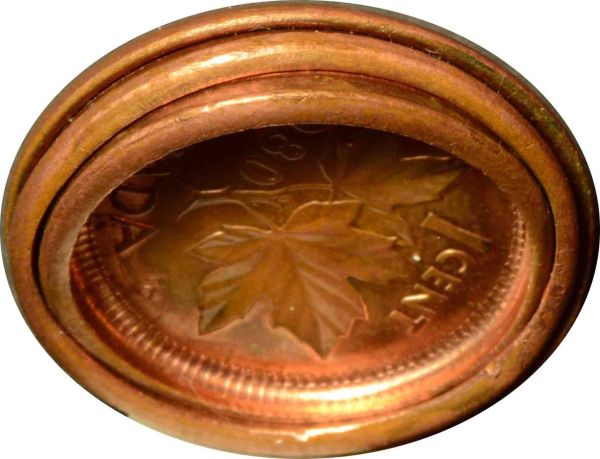 I guess it would depend how different the striking pressure was for the Israeli coin compared to 1-cent strikes. However, the likelihood of two wrong planchets being fed sequentially and together, is near impossible without a "helping hand". Thanks for sharing this error with us. "Discovery follows discovery, each both raising and answering questions, each ending a long search, and each providing the new instruments for a new search." -- J. Robert OppenheimerContent of this post is licensed under a Creative Commons Attribution-NonCommercial 3.0 Unported License. See: http://creativecommons.org/licenses...0/deed.en_USMy eBay store
|
|
Rest in Peace
United States
7075 Posts |
Wow! to both of those coins.
Love those photos!
|
|
Bedrock of the Community
Australia
21789 Posts |
The absolute best thing storage wise you can do for the Canadian bonded planchets is to leave them in the holder.
They may? come apart a bit too easily if you take them out.
It is impossible to confirm HOW they were bonded. One can only believe what PCGS has said, and take their very respected word for it. They, after all, examined them.
|
|
Valued Member
Canada
403 Posts |
|
|
Valued Member
United States
462 Posts |
Just wondering why the obverse and reverse design from the strike did not appear on both planchets. I remember this one on ebay and questioned that when I first saw it. It seems like the design just ends and doesn't continue with the sister planchet on both obverse and reverse. |
|
Forum Kid
Canada
1074 Posts |
wow look at those coins! amazing 1980 by the way!
|
|
Valued Member
50 Posts |
Hi Zimmy, I think that the thickness of the planchets simply prevented the die from reaching the opposing planchet. I tried to create an illustration of what I think happened, in side-view: 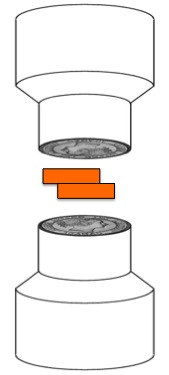 When the dies struck, each die couldn't quite reach the planchet that was on the other side. Also, the edge (the part that wasn't covered by the other planchet) folded over just a little. |
|
Valued Member
50 Posts |
Here's what it looks like on the other side: 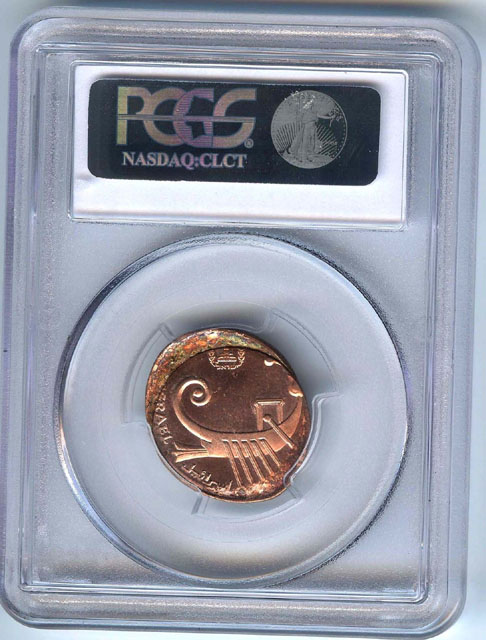 |
|
Valued Member
United States
462 Posts |
That makes sense to me........thanks for sharing off center.
|
| |
Replies: 11 / Views: 1,992 |
|










 Posted 12/15/2014 09:29 am


