



Coin Community Family of Web Sites Join Thousands of Coin, Bullion, & Money Collectors
Vancouvers #1 Coin and Paper Money Dealer 300,000 items to help build your collection! Specializing in Modern Numismatics Royal Estate Auctions - $1 Coin AuctionsRoyal Canadian Mint products, Canadian, Polish, American, and world coins and banknotes. Join Thousands of Coin, Bullion, & Money Collectors Coin, Banknote and Medal Collectors's Online Mall


Username:
Password:
Save Password
Forgot your Password?


This page may contain links that result in small commissions to keep this free site up and running.

Welcome Guest! Registering and/or logging in will remove the anchor (bottom) ads. It's Free!

Forger's Clay Mold?

To participate in the forum you must log in or register.
Author Previous TopicReplies: 7 / Views: 1,443Next Topic  
Pillar of the Community

United States
1045 Posts
 Posted 01/13/2015  11:44 pm Show Profile   Bookmark this topic Add Biancasdad to your friends list Get a Link to this Message Number of Subscribers
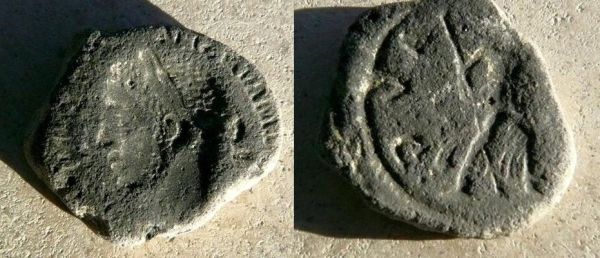
With a friends permission from a metal detecting group, I post this for discussion.

The only information I have is that it was found near the Thames and is 15-16mm. I thought it was interesting and was curious (as is my friend) to know more about it.

Thanks for any comments in advance.
Forger's-Clay-Mold?
Moderator
Learn More...
echizento's Avatar
United States
23731 Posts
 Posted 01/13/2015  11:47 pm  Show Profile   Bookmark this reply Add echizento to your friends list Get a Link to this Reply
Interesting piece, wish I could help but I have no knowledge in this area. Thanks for posting it though.
Pillar of the Community
Medieval's Avatar
3772 Posts
 Posted 01/14/2015  12:04 am  Show Profile   Bookmark this reply Add Medieval to your friends list Get a Link to this Reply
Could be some sort of seal or even bale mark. Many places used ancient designs on one side of those (eg Nemausus = Nimes).

Seems there should be part of the legend on the left hand picture legible - would be nice to see a clearer picture focusing on that part of the object.
Pillar of the Community
United States
1045 Posts
 Posted 01/14/2015  01:38 am  Show Profile   Bookmark this reply Add Biancasdad to your friends list Get a Link to this Reply
That is interesting Medieval, and Echizento you are welcome. I am with you on this one, no clue

I know the pictures aren't the best but that's all he had posted. I was trying to fiddle with my photo editor to see if I could enhance the legend but wasn't very successful. The bust certainly looks like Severus Alexander, and the reverse looks like a typical design for the period.

What intrigues me is that the obverse is convex and the reverse (unless my eyes deceive me) is not.

I posted this on FAC as well and am curious to see what the folks across the pond have to say when they wake up

Edit: Must have been an optical 'delusion' I now can see the reverse is also convex
Edited by Biancasdad
01/14/2015 02:38 am
Pillar of the Community
United States
1045 Posts
 Posted 01/14/2015  01:47 am  Show Profile   Bookmark this reply Add Biancasdad to your friends list Get a Link to this Reply
A well respected auction owner from Switzerland had this to say:

"A neat forger's mold of a Severus Alexander Denarius. The other side shows a PAX AVG reverse for the prototype.

It is rare to find a forger's mold from this era, most of the surviving ones are from the 4th Century and from the eastern part of the empire. Yours may have been used to make base metal cast copies of Denarii that are (other than the molds) quite common in severan times - they may have been produced by local authorities during times of coin shortage."
Edited by Biancasdad
01/14/2015 01:48 am
New Member
United States
6 Posts
 Posted 01/14/2015  12:16 pm  Show Profile   Bookmark this reply Add ancientgalleon to your friends list Get a Link to this Reply
Likely forgers clay mold for casting Severus Denarii.

However smaller in size than one would see as there would be a rim and channel to allow for the metal and depression to flow into the mold and hold the metal between the two pieces. Maybe its there but tough to make due to photos. Many are found broken,with edge pieces missing due to age or use.

Clay would be correct.

Also, tough to tell from the photographs, but one side being convex and the other being concave would be correct as several molds were stacked up against each other and pressed to make the impressions. Thus several were made at a time and this would be a middle piece in a stack.

Can not comment on authenticity without seeing it in hand.
Pillar of the Community
philadelphian's Avatar
United States
3253 Posts
 Posted 01/14/2015  12:46 pm  Show Profile   Bookmark this reply Add philadelphian to your friends list Get a Link to this Reply
Thanks for the info ancientgalleon! I was having a hard time picturing how you were supposed to strike a coin with this thing.
New Member
United States
6 Posts
 Posted 01/14/2015  1:00 pm  Show Profile   Bookmark this reply Add ancientgalleon to your friends list Get a Link to this Reply
To clarify, both sides would still be incuse (engraved) to allow the metal to fill the mold. Having a concave and convex side allowed the other molds to fit together so the molten metal would not flow out of the mold. so they were cast not struck.
  Previous TopicReplies: 7 / Views: 1,443Next Topic  

To participate in the forum you must log in or register.


Disclaimer: While a tremendous amount of effort goes into ensuring the accuracy of the information contained in this site, Coin Community assumes no liability for errors. Copyright 2005 - 2026 Coin Community Family- all rights reserved worldwide. Use of any images or content on this website without prior written permission of Coin Community or the original lender is strictly prohibited.
Contact Us  |  Advertise Here  |  Privacy Policy / Terms of Use

Coin Community Forum © 2005 - 2026 Coin Community Forums
It took 0.25 seconds to rattle this change. Forums