| Author |
 Replies: 16 / Views: 2,843 Replies: 16 / Views: 2,843 |
|
Pillar of the Community
United States
1903 Posts |
Are Black Beauties considered an error or variety?
Are they worth getting slabbed in MS grades?
|
|
|
|
Bedrock of the Community
United States
62064 Posts |
You might check on ebay and see what they are going for. Unless you find them in a OBW roll, they are probably not an error. The ones in circulation are usually coins found outdoors/burned/charred. You might check with Mike Diamond and see what they are worth? |
|
Pillar of the Community
 United States
1903 Posts |
I found four in bank rolls (all from the same box) that are black AND lustrous....I will snap some images in the morning. They are quite nice to look at
|
|
Pillar of the Community
United States
1192 Posts |
I found a 1987 one that was black toned but looked uncirculated. I kept it since it was my birth year.
|
|
Pillar of the Community
United States
1903 Posts |
Based on your commentary though...are legitimate "black beauties" and error coin?
|
|
Bedrock of the Community
United States
62064 Posts |
So how do they remove the black from off the planchets after the annealing? (I know, just want to get some theories?)
|
|
Pillar of the Community
Canada
2531 Posts |
The only thing I can think of that is fast, easy, and not labour-intensive (imagine a line of mint employees polishing the freshly annealed planchets one by one) to do for a lot of planchets at once is by using acid. The acid will eat the black off from all surfaces.
|
|
Bedrock of the Community
United States
62064 Posts |
Acid would reduce the planchet a bit and dull the finish.
But your first clue is getting a little closer to what they do.
|
|
Moderator
 United States
23522 Posts |
As far as I know, the Black Beauties are sintered planchets, aren't they? They're found with other issues as well, but not in quantities of bags of thousands.  If that be the case, I'd think the reapplication of heat might help remove the stuff. Beadblast maybe? |
|
Bedrock of the Community
United States
62064 Posts |
OK, I'll give a clue: 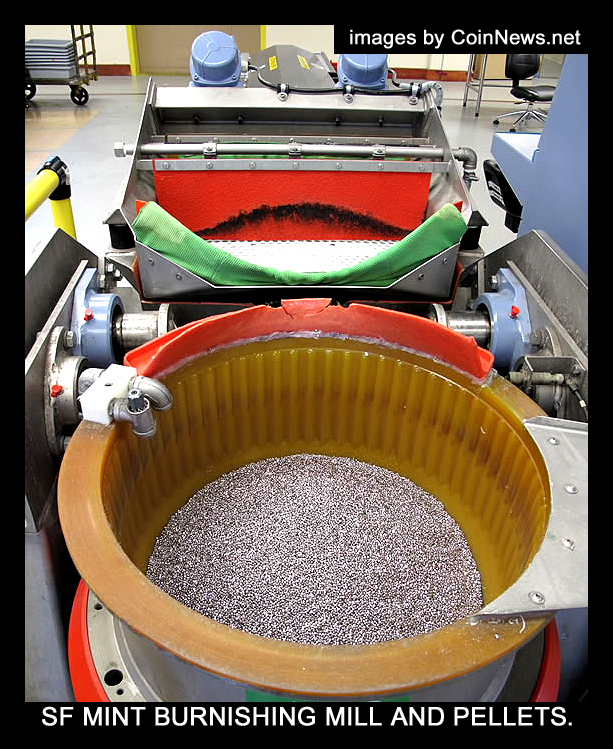 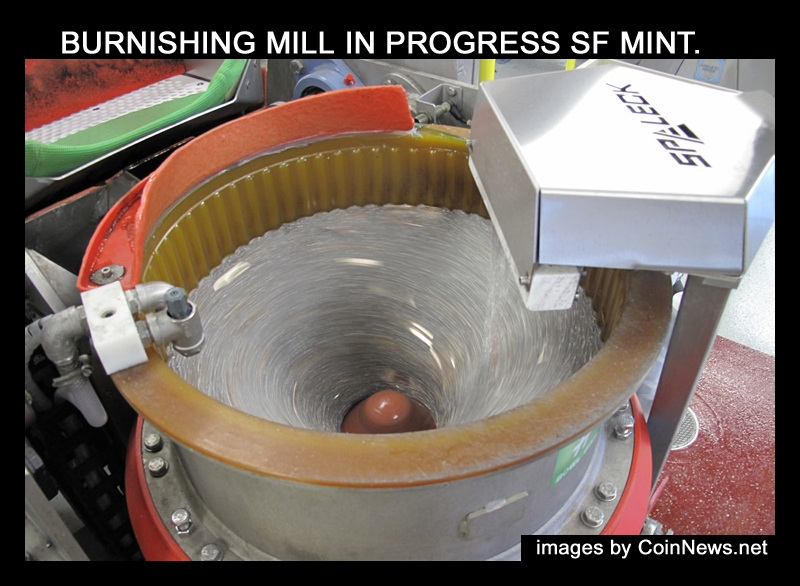 |
|
Pillar of the Community
United States
1903 Posts |
So are black beauties then an error because they weren't properly cleaned?
|
|
Pillar of the Community
United States
1903 Posts |
Would that then by default get them an "improperly cleaned" badge if you had it graded? Lol
|
|
Bedrock of the Community
United States
62064 Posts |
It would probably be called what SsuperDdave called it: Sintered Planchets. It is an error with a premium. (I don't know how much though). So the BBs never got burnished to remove the dark planchet before they were struck.
|
|
Pillar of the Community
United States
1699 Posts |
Coop, improperly annealed planchets can't be "fixed" by the burnishing process. It's a permanent defect that cannot be reversed. If blanks are determined to be improperly annealed, they are cancelled.
|
|
Pillar of the Community
United States
3640 Posts |
 Also, the color runs deep and not just on the surface. |
|
Moderator
United States
23522 Posts |
Well, this is where I have to disagree if these are in fact sintered planchets. What's happening here is essentially powdercoating - the annealing process is too hot, convection currents raise powdered material left from millions of planchets and bakes it onto the surfaces. So, it's a surface-only effect which can be removed, and that's why I suggested beadblasting. As it turns out - according to Coop's images - the actual process is quite similar.
That's why "improperly-annealed" planchets come in varying colors despite their metal composition being similar. If it were heat alone, you'd think the alloy would reach the same color every time.
|
| |
Replies: 16 / Views: 2,843 |









 Posted 01/15/2015 01:05 am


