Welcome to Coin Community, kevinc1980. The 1796 Quarter is a fascinating issue, worth a small monologue of its' own before we address your specific coin.
1796 was the first year in which the US struck every denomination authorized by law, with the Quarter being the last of the issues begun. It was only struck for one year in this design, and not struck again until 1804 with an entirely new reverse. A total of only 6146 were struck, using two obverse and one reverse die. Varieties are designated B-1 and B-2.
There is an intense level of demand for every example of this issue. It's one of very few one-year issues in US numismatics, and the small number of survivors does not cover the collector demand. A genuine example of the more-common B-2 is still worth over $1000 in barely-readable condition. They were saved for posterity in fair quantity as a one-year type, and the highest-graded among them are among the great American numismatic rarities. One sold for over $1.5 Million in 2013.
So.
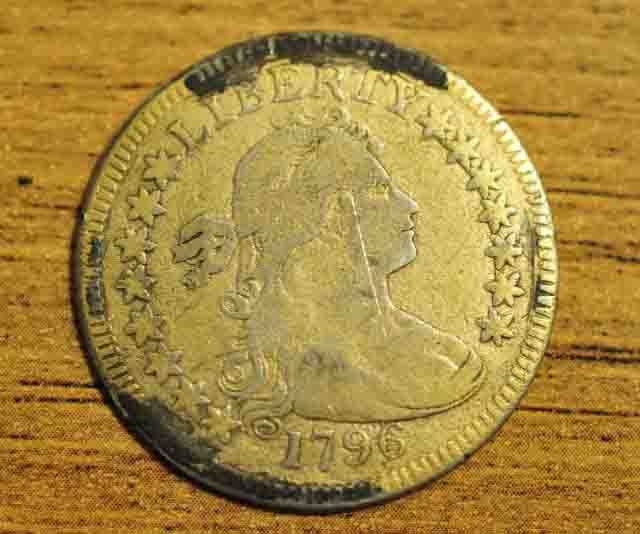
As near as I can tell from the images provided, yours would be an example of the more common B-2 variety if it's real. This is most easily noted by the position of the 6 in the date - the B-1 shows that digit much lower. There are other confirming details which you can check:
The TY pair of LIBERTY should show a little airspace between the letters. On the B-1, they physically touch.
Look at the denticles outboard of the second star down from the L - in normal parlance, this is called Star 7, the count always starting from the star closest the 1 in the date. The point is aimed at the space between two denticles. Looked at from the star, the left of those two denticles should show a bit of a disconnect right at its' base. In a later die state, this denticle becomes entirely detached.
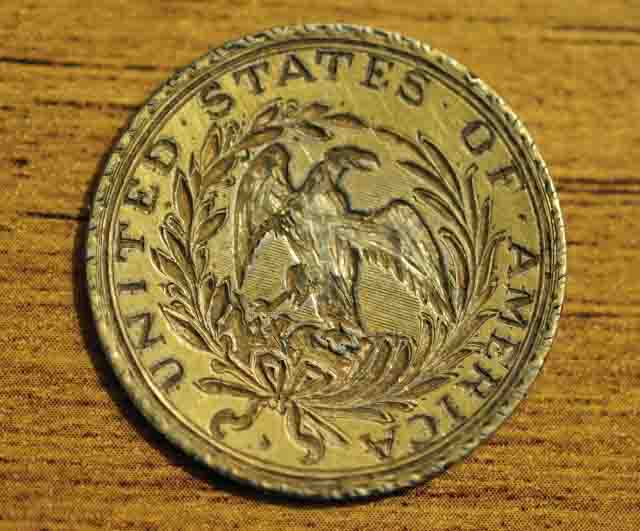
In both cases, (perhaps wishful) thinking leads me to see hints of those features. None of the other details save the irregularity of the denticles themselves are worrisome; this could very well be an authentic coin. Weight and dimension are appropriate. If so, the reverse has been reworked by a contemporary carver, a practice somewhat common in America. It would have to be a contemporary work, as anyone in more modern times would be aware of the coin's great value.
In conclusion, I'm cautiously optimistic but do not see sufficient detail to form any concrete conclusions. All the features on the coin are where I'd expect them. Honestly, it needs to be in the hands of an expert for any firm opinion to be drawn.
So I've typed a bunch of words and haven't helped much.










 Posted 01/27/2015 11:51 am





