| Author |
 Replies: 10 / Views: 2,780 Replies: 10 / Views: 2,780 |
|
|
New Member
United Kingdom
14 Posts |
I recently bought a massive 6kg bag of mixed English Pre WWII and during WWII silver coins. However as I looked through them I found this single Spanish coin with a very interesting Soviet Hammer & Sickle stamp positioned on the head of Alfonso XII(on the coin). The stamp is 'well done' and is clean & crisp, it looks like it has been stamped by someone with at-least a good level of skill.
I understand a photograph is needed but just for now I was wondering if someone has even heard of Spanish coins with Soviet stamps on them, as I have had a look on-line with few results.
If anyone has any ideas please reply
Thanks
|
|
|
|
Pillar of the Community
United Kingdom
2490 Posts |
I'm guessing that this slightly pre-dates the Spanish Civil War (1936-1939). The Republican government had the support of the Spanish Communist party before the war and during its course the communists fought hard supported with weapons and aircraft by Stalin.
The Hammer & Sickle graffiti were as common as the Fasces of the Falange.
|
|
Valued Member
Spain
108 Posts |
Hi. These coins continued in use by the Civil War, so republican struck countermarks on monarchist coins like yours. Is it similar? 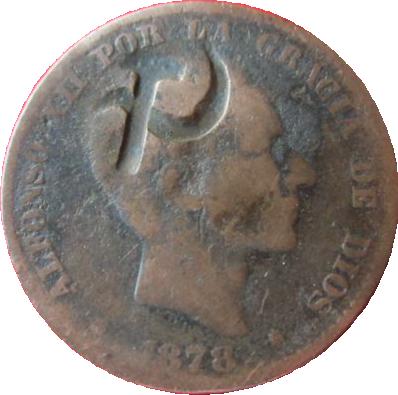 v. |
|
New Member
 United Kingdom
14 Posts |
Yes, the coin is exactly the same, both condition wise and the shape, depth and clarity of the hammer & sickle emblem. So the 'stamp' was just graffiti really, supporting the communist party in Spain at the time aswell as rebelling against the monarchy/royals?
Thanks for your help, are the coins at all rare?
|
|
Valued Member
Spain
108 Posts |
Not exactly, in 1931 was proclamed the second republic, then king Alfonso XIII went to exile. In 1936 General Franco started the putsch (coup?)against the "Frente Popular" govern. These coins were still in use, obviously, communist (and also anarchists like CNT, FAI ...) put this countermark over coins with the face of Alfonso XIII. I think they are not rare, but look at this one (very very follower of communist party): 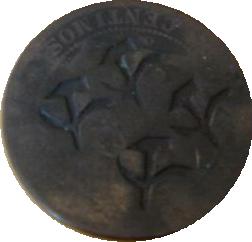 |
|
Bedrock of the Community
United Kingdom
19018 Posts |
Very interesting! I have quite a few Spanish bronze coins but no countermarked ones!
A book I have about Spanish Railways states that the copper wire used for the electrification of the main line between Madrid and Avila was obtained by melting down 800 tons of Spanish bronze coins, which ceased to be legal tender on January 1, 1942!
|
|
Valued Member
Spain
108 Posts |
Interesting information, now we know the final destination of these coins. As curiosity this picture shows a cauldron used to get planchets for medieval coins. Spanish word for cauldron is "caldero" and "calderilla" (small cauldron) is the popular name for worthless spanish coins 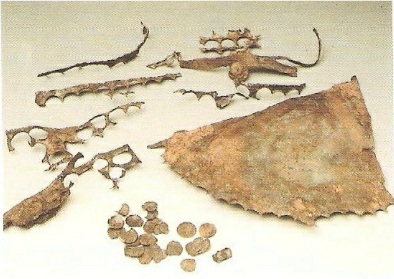 |
|
Valued Member
Spain
108 Posts |
And this one from the other side. (on 10 cts gobierno provisional-first republic). 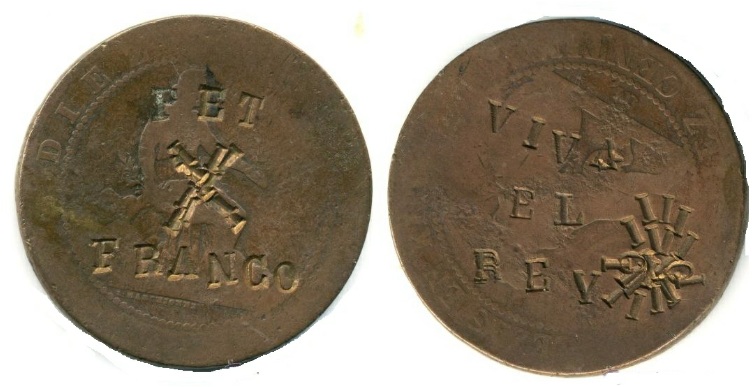 |
|
Pillar of the Community
Canada
2805 Posts |
That's an incredible stamp. It looks as if it was overstruck with crudely made dies - do the letters on the "FRANCO" side come up out of the coin?
What symbol do you think is represented on the "VIVA EL REY" side? Is it the Falangist bundle of arrows?
|
|
Valued Member
Spain
108 Posts |
I have not this coin. FRANCO letters seem to come up, but it may be a visual effect. These stamps seem to be handmade, using a hammer and a punch.
FET means FALANGE ESPAÑOLA TRADICIONALISTA (falangists and carlists [traditionalist], two main parties in Franco,s faction)and the blade is the cross of burgundy or Saint Andrews cross, adopted as symbol by carlist party, but actually was the flag during 1500,s and 1600,s of the spanish empire and specifically was the Viceroyalty of New Spain flag (North of Honduras, Mexico, former spanish North America, spanish Caribbean and Philipines); during that time, it was flag of a lot of infantry units (Tercios) but with different backgrounds and cross colors, and at present is in Florida and Albama,s flags; also it is in the tail of all Spanish Air Force aircraft.
You are right, Nalaberong, it is the falangist bundle of arrows and if you look with atenttion there is a joke . This symbol, also, was adopted by falangists but actually it was the symbol of the Catholic Monarchs, Isabella and Fernando (spelling in that time as Ysabel and Ferdinando) and these initials Y and F are the initials, in spanish language, of joke (=yugo) and arrows (flechas).
v.
|
|
Valued Member
United States
73 Posts |
some really good info veton, I'mfrom alabama and didnt know that lol
cue the "someone from alabama not knowing something! remarks"
|
| |
Replies: 10 / Views: 2,780 |
|







 Posted 02/09/2015 2:07 pm


