| Author |
 Replies: 9 / Views: 3,546 Replies: 9 / Views: 3,546 |
|
|
Valued Member
United States
228 Posts |
I have four Panda coins in excellent condition (from 1985 and 1986)...I think they may be in the original unopened plastic. I'm not sure how high they will grade, but I'm considering sending them to NGC, with plans to sell at some point. Does it make sense to pay the extra $5 for the scratch-resistant holders in this case? I wouldn't want to turn off potential buyers with the non-scratch-resistant slabs, but I also don't want to just waste $5 per coin. Thoughts? Thanks.
|
|
|
|
Pillar of the Community
United States
1796 Posts |
I've always found grading bullion a bit... whimsical.
Unless you're carrying them around in your pocket, the standard holders should be fine.
|
|
Bedrock of the Community
Australia
21792 Posts |
SteveCarso is right. For bullion coins, the TPG fees will not justify any extra value the coins may benefit from. Add to that shipping costs. ebay them as they are. |
|
Pillar of the Community
United States
2543 Posts |
You need to post us some pictures. There were no bullion Pandas minted in 1985. In 1985 only proof Pandas were minted. Limited to 10,000, 27g. In .900 silver. Very hard to find, very valuable.
There were no Silver Pandas minted in 1986.
Please post some pictures so we can determine what you have
Bullion Silver Pandas weren't minted until 1989.
Are these gold Pandas ?
Edited by denco7
02/14/2015 05:39 am
|
|
Valued Member
 United States
228 Posts |
Quote:
Are these gold Pandas ? Ah, yes, sorry I forgot that there were gold and silver Pandas. These are gold Pandas. There's a 1985 100Y and 1986 25Y, 10Y, and 5Y. They look to be sealed in the original plastic. My research so far seems to suggest, as the other posters have said, that it's not really worth having them slabbed. The PCGS price guide for Chinese coins had me thrown off a bit with their numbers for very highly graded Pandas. |
|
Pillar of the Community
United States
589 Posts |
Quote:
In 1985 only proof Pandas were minted. Limited to 10,000, 27g. In .900 silver. Very hard to find, very valuable. The Republic of China introduced the Panda in 1982. The obverse generally remains unchanged from year to year and features the Hall of Prayer for Good Harvest at the Temple of Heaven in Beijing. But the reverse, featuring iconic Chinese Panda imagery, changes annually, making each year a limited edition. The Panda is one of the finest gold bullion coins in the world. There is strong demand for the Panda from Chinese investors, leaving fewer available for the international market. This one was a gift from the bank. 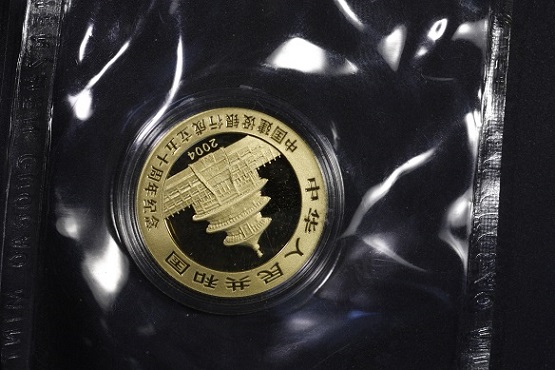 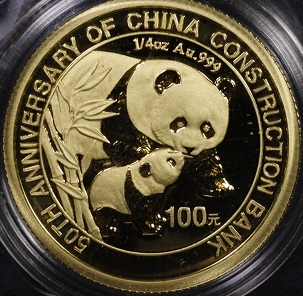 Try finding a 1/10 Oz Buffalo with low premium and same can be said for the Panda. |
|
Pillar of the Community
United States
2543 Posts |
So they are gold Pandas, not silver. The 100y is one ounce, the 1986 1/4, 1/10 and 1/20 ounce.
While not the highest mintage, the 1985 100y is one of the more common coins in the series as far as scarcity goes. So as far as grading giving it a considerably higher value, I would say no. As with all gold/platinum coins, spot is a condierable investment for all but the most deep pocketed of investors. To add a numismatic premium on top of that, the coin has to have considerable "collector " value. Something that MS69, 68 does not add.
Fractional gold is a different animal.Issues such as the Panda, where the reverse changes on a yearly basis, are far more popular among among "series" collectors. Whereas a collector would be hard pressed to collect a 30 year Panda series in 1oz coins, a set in 1/10 or 1/20oz gold coins is doable. Larger customer base = larger premium above spot.
The mintages of the 1986 fractionals are also low, but not low enough to make them scarce. Scarce because many collectors are holding them? Yes! Scarce because of the low mintage numbers? No!. Compare a 1986 1/20 ounce Panda to say a really low mintage coin as a gold Libertad. The mintage of the Panda was 79,194. The mintage of a 2003 1/20oz gold Libertad was 800.
In other words, not worth grading for added value.
As a matter of fact, sealed pouches from the mint, carry a premium with many collectors. Another reason to keep them in the original mint pouches (if they are indeed the original pouches) is,the original pouches should be sealed with a "rope" pattern seal. Each of the three major mints,Shenzhen, Shanghai and Shenyang, had their own rope pattern. An experienced Panda collector can tell you what mint the coin came from by the rope pattern used to seal the mint pouch.
Pictures would still be great if you could.
|
|
Valued Member
United States
228 Posts |
Quote:
An experienced Panda collector can tell you what mint the coin came from by the rope pattern used to seal the mint pouch. Pictures would still be great if you could. Very interesting...thanks for the info. I'll post some pics ASAP. |
|
Valued Member
United States
228 Posts |
|
|
Pillar of the Community
United States
2543 Posts |
Those are the original mint pouches, true Panda collectors definitely prefer original. That pattern I believe is associated with the Shenyang mint.
Unfortunately the original pouches have also been known to " cloud " the coins inside. More so the silver Pandas, but keep an eye on your coins, if they appear to be clouding, remove them from the pouches. Better to have a clear coin than a cloudy one in the OGP.
|
| |
Replies: 9 / Views: 3,546 |
|







 Posted 02/13/2015 10:56 pm





