| Author |
 Replies: 7 / Views: 3,857 Replies: 7 / Views: 3,857 |
|
|
Valued Member
Canada
414 Posts |
I'm looking for some help with this one, tokens are a whole new world to me, not to mention blacksmith tokens. 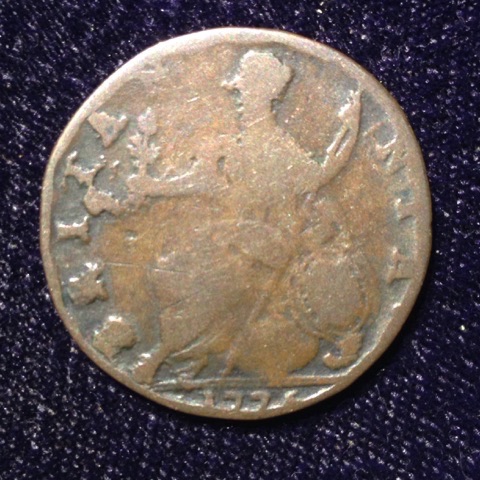 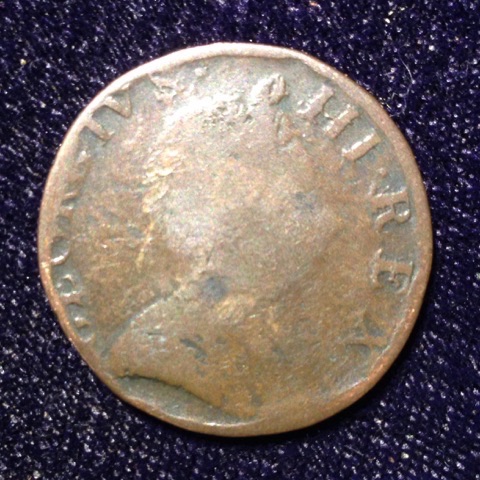 I've been trying to read up and familiarize myself with the blacksmith reference guides such as Wood #'s etc, but without the book I haven't been able to make it very far. The only information I've been able to find is below, it mentions an intermidiate release of crude copies of Machin's Mills tokens that very closely describe my coin. I don't see any mention of the filled letters in 'BRITANIA' such as mine, Quote:
Additionally, Anton and Kesse designated some Blacksmith related coppers as being an intermediate group produced after the Machin's Mills counterfeits but before the fully evolved Blacksmiths, and that these intermediate coins were produced throughout North America. No specific coins were mentioned but rather the group was described as coppers in imitation of George II and George III halfpence, having full or partial legends with an obverse bust that tended to be squarish in the jaw and forehead and a reverse having an amateurish figure of Britannia. I suspect this description is meant to refer to a group of unattributed Blacksmith related tokens listed in the Warren Baker catalog as items 1085-1096. Any help is appreciated... |
|
|
|
Valued Member
Canada
496 Posts |
|
|
Valued Member
United States
309 Posts |
This appears to be a cast counterfeit of a fantasy date - 1776 English copper made to pass for a half penny. It is not from Machin's Mills, but probably from England. The head of George III is more in the style of the Irish half penny circa 1766. It has normal legends, and so is not an evasion, which substituted nonsense words. Most any skilled metal smith could have made it to expedite trade. Copper was considered a token coinage, not of the seriousness of gold and silver coin of the realm. Any reasonable facsimile that would trade hands would have worked in commerce back in the day. With counterfeits most were not fabricated in the year they proclaim, usually reverting to noncurrent designs of decades past to account for the poor fidelity of the image, some thinking it comes from honest wear over the years, and not bad casting done yesterday. It could have circulated in England up to the beginning of WWII, perhaps more so in the Channel Islands. I like it.
|
|
Valued Member
 Canada
414 Posts |
Thank you, I suspected it was cast as well, everything just seemed wrong about it. It was in a 2-pound bag of world junk I picked up in a collection last week so it owes me nothing, I'll make some notes on the 2x2 and tuck it away for one of the local token enthusiasts.
|
|
Pillar of the Community
United States
1757 Posts |
This is why I think my new book will sell no more than 100 copies ... its a shame ... really. Its too much of a quantum leap from Red Book to Forgotten. LOL. John Lorenzo Numismatist United States |
|
Valued Member
Canada
496 Posts |
Chin up John,101 books I'm in
|
|
Valued Member
Canada
414 Posts |
@ colonialjohn, don't be disappointed, I figure I put in my time researching it, learned from it, and now it's my duty to put it in hands of someone who will enjoy it more than me. It's not that I'm not interested in tokens, I just enjoy something that I can talk about. Unfortunately a coin which I can't identify where it came from, who made it, and what it was made for...well that story isn't very intrgueing to me. I see you post on many of the token threads so I was hoping to hear your input.I hate not finding an answer myself so I would be more than happy to own your book, if I needed it once, I'll need it again. If there is something you'd like to add, I appreciate your input so please chime in again  |
|
Pillar of the Community
United States
1757 Posts |
Just joking around ... but not on the sales count ... <BG>. My new book has a whole chapter on Canadian Blacksmiths. Other chapters will includes Kleeberg Bust Type Counterfeit 2 reales (Part 3); Foreign counterfeits - major types 1500-1800; Chinese Modern Forgeries (Detection & Metallurgy); Counterfeit Halfpence/Farthings of GII/GIII (English & Irish) - Brief Overview - and other datum. Although not 100% sure due to the date "only" yours looks like a 1775 GIII Counterfeit halfpence (English). I believe the last numeral is a "5". The most common English GII/GIII Counterfeit type. Although its crude and currently maybe in a listed Family. A core group of ~12 C4 people have been classifying these species in past ANS articles. Not a Machins Mills type. Most Machins Mills types are 1787/1788. Non-regal year types. There plated in the Red Book. Some of the earlier plated ones (i.e., non-1787/1788) particularly if not die linked to a CT or Vt State Copper IMO are not MM's but are listed simply based on OLD SKOOL principles (ie., lettered punch linking; Breen's broken A, etc.). JPL Edited by colonialjohn
02/24/2015 1:13 pm
|
| |
Replies: 7 / Views: 3,857 |
|










 Posted 02/19/2015 10:02 pm


