| Author |
 Replies: 27 / Views: 6,904 Replies: 27 / Views: 6,904 |
|
|
|
Pillar of the Community
  United States
4048 Posts |
Sorry but this is just not axial. Axial lighting comes straight down onto the coin, perpendicular to the coin and parallel to the axis of the lens, which is why it is called "axial". A common way to do axial lighting in microscope systems is to have the prism or beamsplitter between the lens and camera (or eyepieces) and shine light down through the lens. This guarantees perfect axial alignment. What you are showing, which is similar to what I showed in my beamsplitter-illuminated Lincoln Cent image, is a combination of axial and non-axial lighting. There is light hitting the coin that is coming from non-axial angles. Separately, I am concerned about the cup you are using to ensure no direct light hits from the LED panel. I see that you have carefully black-out the rest of your setup, but not the inside of the cup! Light that reflects from the coin or hits the inner surfaces of the cup will re-reflect back onto the coin and cause light to hit the coin from very low angles. If this is your intent, then no worries, but it is another indicator of non-axial lighting. To show you what "true" axial lighting looks like, I took a picture of the same coin as before but with the light only coming from the axis of the lens. Only the flat surfaces are reflected back to the lens with true axial technique. Any angled surface reflects the light away from the lens, and appears dark.  |
|
Pillar of the Community
2087 Posts |
YOu Can't be serious That is just so wrong: In the last axial shot I showed the only way light could get to the coin is to come straight down to the coin from the Plate beam splitter, the shroud was a double check on that. The only way light that could get into that cup and on to the coin is by reflection from the 50/50 beam splitter. Note the light is set up on the left hand side of the coin!
|
|
Pillar of the Community
2087 Posts |
Laid up with Gout has given me the time to carry out some work to show my shots are Axial lighting. rmpsrmps seems to think they are not but he hasn't stated why he believes they are not. Assuming his hypothesis is right all I have to do to disprove my claim is to eliminate all extraneous light sources. The first possible fault in my last set of photos is the blue cup I used as a Shroud theres a chance( very slim IMHO) it might have been acting as a diffuser. So I covered it inside and out with black insulation tape. As below:  Now how to control the ambient light in the room and prove its been controlled? Some more black insulation tape and some surgery on a cardboard box!  Now perhaps when using the "shroud" I was mounting the coin too high so lets get rid of that Microscope objective tube. I just place the coin on the copy stand base board  Then we need a reference shot. Here is a quick photograph ( I blew it slightly as the coin is sitting on that objective tube). This is what the Prager Groschen looks like under direct lighting:  NOw before the first axial coin shot place the Shroud over the coin. You can't see the coin is this shot but you can see how well that shroud blocks light from getting down to the base board:  Then put the beam splitter in place then the modified cardboard box To make sure I didn't damage the beam splitter I changed to a "longer" lens; Olympus Zuiko 135mm F 4.5 bellows lens.  The first result that prager Groschen.....  looks different in comparison to the reference shot....but pretty much like the other two shots I claim are axial. Now what about the shadows on the left hand side of the field....the shroud is conical in shape and slightly higher on that side....those shadows are cast from the narrow part of the shroud. There were similar shadows on the right hand side but they weren't in the lenses field of view Not every one will know what a 500-600 year old coin looks like under axial lighting. So lets return to that Liberty $20.00( like the prager Groschen its sitting on the base board of the copy stand:  Looks like axial lighting to me. It is actually a much better shot than the first one. I does prove that Rmpsrmps was partially right it wasn' 100% axial the first time. Perhaps I read him wrong but I was pretty sure he thought axial lighting was the minimum component.....I disagree axial lighting in the first shot was probably greater than 60% of all the light involved in the shot. In a Home studio situation its a bit hard to get only axial light. There will always be some reflection from else where but to claim the pictures weren't axial just stunned me! I collect larger sized coins I don't have much copper and rmpsrmps is most familiar with copper( from what I have seen( I could be wrong) so how about a copper coin and one more reference shot.....I turrned off the Led Light source and left the beam splitter in place. I was surprised to get an image:  Yep with even all that work and the card board box some light is still getting in but turn on the LED light and:  At a guesstimate around 90 % axial lighting Now go back to rmpsrmps's penny shots.....look at the dark rims......that why I don't think axial lighting and Janscos go together...the lighting source is just too small Edited by austrokiwi
02/23/2015 05:19 am
|
|
Pillar of the Community
United States
4048 Posts |
I agree that you are closer to axial now but I don't think you're at 90%. If you were, the image would look more like my 2nd pic with darker edges on all devices and around the edge. I assume you're not doing a LOT of PP to make it look this way, correct? You're correct when you say stock Jansjos are too small for axial lighting (hence the title of this thread), but even a small amount of diffusion makes them a good source for axial. When setting up an axial system, you want the apparent light source to be about the same size as the subject. To achieve this, a bit of diffusion material over the Jansjo does the trick for the Cent I photographed. For larger coins you would need a bit larger diffuser. If your light source is significantly larger than your coin, you are moving away from axial lighting and getting more diffuse, non-axial illumination on the coin. I made a drawing to explain this, see below. The rays labeled "A" are the true axial rays. Of course some rays from a source the same size as the coin can be incident non-axially, but I have not shown these in the diagram. They are more significant non-axially for larger coins than for smaller. The rays labeled NA1 are benign in that they do not strike the coin. What I'm concerned about are the rays colored in red labeled NA2. These come from the areas of the source that are beyond the size of the coin, and can hit the coin from non-axial angles as you can see from the diagram. I only show the reflections in the vertical direction in the diagram but a similar situation exists in the horizontal. 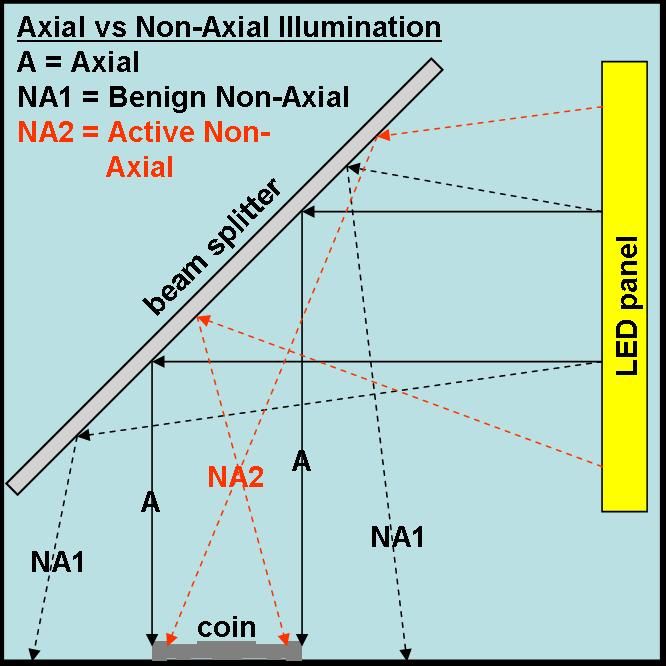 Contact me for photographic equipment or visit my home page at: http://macrocoins.com |
|
Moderator
United States
23522 Posts |
Now you know why I recommend small bulbs or small mirrors for axial lighting. Maybe a circular cutout in black construction paper. Any light which does not hit the beamsplitter directly above the coin is a potential problem.
|
|
Pillar of the Community
United States
4048 Posts |
I like the circular cutout idea. It could be used in two places: horizontally above the coin; and vertically in front of the source. The farther above the coin, and the farther from the source, the more axial the result.
Of course these concepts are only valid if you are trying to achieve "true" axial lighting. I created the diagram to explain to AK why a large LED panel, close to the beamsplitter, creates a non-axial situation. I suspect if he removed all the non-axial rays, he would not be very happy with true axial lighting...
Contact me for photographic equipment or visit my home page at: http://macrocoins.com |
|
Pillar of the Community
United States
4132 Posts |
You could use a very distant light source to get perfectly axial light, but the point isn't to get a "perfect" axial lighting setup. It's to get attractive coin pictures.
|
|
Pillar of the Community
United States
4048 Posts |
Quote:
You could use a very distant light source to get perfectly axial light, but the point isn't to get a "perfect" axial lighting setup. It's to get attractive coin pictures. True, and I have no issue with doing whatever it takes to get the best images. Just don't call it axial when it is not. Contact me for photographic equipment or visit my home page at: http://macrocoins.com |
|
Pillar of the Community
2087 Posts |
rmpsrmps. You sell macro photography rigs so to improve your credibility you must seem more technical.... My impression is now that rather than admit you were wrong you are now going to use every argument in the book to prove your right no matter what was done. Your diagram is a perfect example of that. It is only half the story. You know very well you need to draw in the light path that travels through the beam splitter, passes through the lens and hits the sensor. That missing part of the diagram makes what you saying a half truth. Add in the missing light path and it is clear much more of the true axial light gets to the camera sensor while more of the diverging light does not.
You haven't looked clearly at my set up and no matter what I do You will have to make comment to show you are right. In my usual axial set up with out the shrouding there is no way diverging light from the light source can get to the subject. The only way it can get to the subject is via the beam splitter. The shroud just proved it it didn't enhance the system. you claim you have an axial light set up lets see how perfect it is Other wise don't call it axial lighting (Your words not mine) I will leave you and your cronies in this forum to it I will now get my advice from the photomacrography website. At least there I get proper explanations in plain language ( that quite often contradict what is said here SSuperdave You will be glad I have bowed out as now you can just form your opinions with out always taking the opposite view to mine( yes that is very much the impression I have gained. Neither of you have tried the type of light source I have been talking about and you only appeare to use Janscos..I a light I find useless for any coin of half dollear size or greater( the lagest medal I want to image is 105mm SSuper dave how in the world would a Jansco work for that?
Janco's usually produce a focused light ( hence the image at the start of the thread) and it has to be defocused by use of a diffuser. The other way round that( my method is to use multiple unfocused point sources) Its not perfect every so often I will get an overlaid image of the individual LEDs forming on the beam splitter...I usually just have to dim the LED panel( it has a dimmer control or move it backwards so the light doesn't focus on the beam splitter. RMPS I leave you to your sales pitches
Edited by austrokiwi
02/24/2015 04:08 am
|
|
Pillar of the Community
United States
4048 Posts |
Quote:
...you need to draw in the light path that travels through the beam splitter, passes through the lens and hits the sensor...Add in the missing light path and it is clear much more of the true axial light gets to the camera sensor while more of the diverging light does not. The only light that could go through the beam splitter and somehow reflect up to the lens would be a double reflection off second surfaces, which would be a very, very small amount of light. There is definitely some light that travels through the beamsplitter and may be reflected off objects behind the beamsplitter and then off the top of beamsplitter to the lens. This is taken care of by the shroud you described. Neither of these is relevant to the axial/non-axial discussion. Quote:
In my usual axial set up with out the shrouding there is no way diverging light from the light source can get to the subject. The only way it can get to the subject is via the beam splitter. I agree you have done a good job of keeping any direct light from hitting the coin. But if you look at my diagram, I don't show any light rays going directly from the light to the coin as this is not relevant to the axial/non-axial discussion. Take another look at the diagram and you'll see that all the rays I included are reflecting off the beamsplitter. It is how the light that reflects from the beamsplitter and hits the coin that defines if the light is axial or not. Quote:
The shroud just proved it it didn't enhance the system. you claim you have an axial light set up lets see how perfect it is Other wise don't call it axial lighting (Your words not mine) The picture I showed, with lots of shadows and high contrast, is pretty much perfectly axial. But it is not a great picture of the coin... Quote:
RMPS I leave you to your sales pitches I don't believe I have done any sales pitches in this forum, certainly not in this thread. If you mean my signature line, sorry if that offended you...I have removed it. All the effort I put in to explaining what I do, any new techniques, tips, etc are geared toward bringing up the general quality of numismatic photography. I believe wholeheartedly in the "pay it forward" concept. Coins are a hobby of mine, not a business, and coin photography is a wonderful part of that hobby. When folks have inquired about the systems I build, either on the forum or by email, I always encourage them to build the system themselves rather than buying from me. I tell them what to buy, and even how to modify the microscope stands (which I have posted in detail in an earlier thread). So when you accuse me of posting sales pitches, you are just simply wrong! Contact me for photographic equipment or visit my home page at: http://macrocoins.comEdited by rmpsrpms
02/24/2015 10:46 am
|
|
Moderator
United States
23522 Posts |
Quote:
Super dave how in the world would a Jansco work for that? I wouldn't use a Janso for axial lighting. Too small and too weak. I use 100w incandescents for axial. It presents a much larger light front which I can then use as much of as I need by the amount I allow to hit the beamsplitter, whether that means directing it through a paper aperture the size of the coin or not. In any other usage all you have to do is increase the distance between bulb and subject. Jansjos throw a conical pattern. Make the cone the right size. But the important thing - at least it's seemed intuitively obvious to me all along - is to inhibit any light beside that which directly contacts the coin. |
|
Pillar of the Community
United States
627 Posts |
Just my 2 cents, but rmpsprpms is 100% correct that austrokiwi's pictures are not true axial. But, the most important point he is making is that a true axial image of a coin is not something you ever really would want (as it doesn't look good at all). I refer to the beam-splitter technique as an "axial-like" photography method, which I believe to be more correct exactly because of the reasons that rmpsrpms has delineated.
I will say in reading this post that rmpsrpms is one of the most competent and knowledgeable numismatic photographers in the world in my opinion. He has taken the physics, engineering, and general methods of coin photography to completely new echelons. I have learned more from him than I could even begin to state in this thread.
I found the accusatory and inflammatory statements made by austrokiwi in this thread to be inappropriate and completely unwarranted. AUSTROKIWI if you choose to leave this forum, then that is your prerogative, but don't forget all that you have learned here. Seems you are suffering a bit from "biting the hand that feeds you"...again, just my opinion.
Regards, Brandon
PS - Ray, I hope you do please add back your signature line. I found that link highly helpful.
|
| |
Replies: 27 / Views: 6,904 |







 First Page


 Posted 02/23/2015 01:07 am


