| Author |
 Replies: 10 / Views: 3,250 Replies: 10 / Views: 3,250 |
|
|
Pillar of the Community
Netherlands
847 Posts |
Hello all, Ive got here 2 coins which looks they are from the same emperor. Late roman constantine? It looks a little silver lookalike. Is this what they called an silique? Or do they have to look like silver denarii coins then? 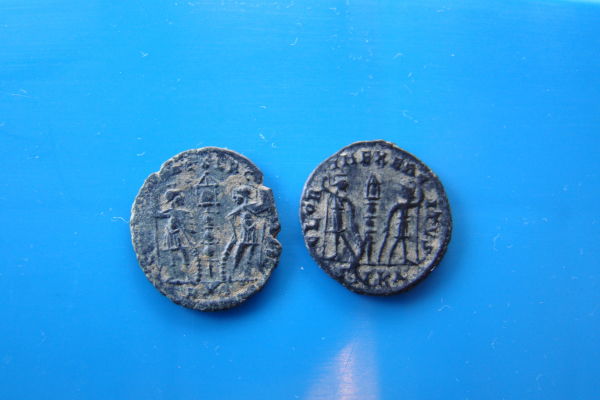 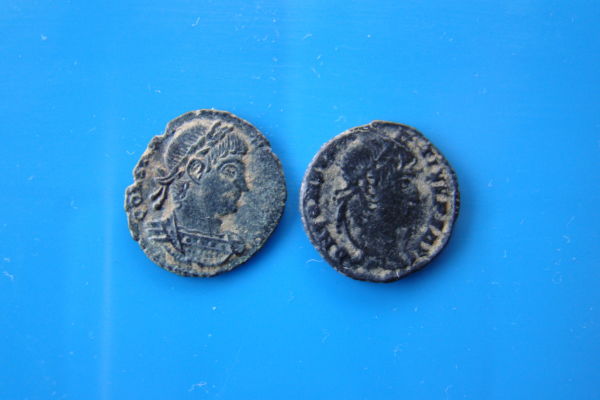 |
|
|
|
Pillar of the Community
United States
513 Posts |
Going by the lettering I can make out I believe the second one is Constantius II. The first one might be as well, but I'm not great at picking out portraits from that era.
They look bronze to me.
|
|
Pillar of the Community
United Kingdom
3626 Posts |
I agree, they both look bronze from the photos. Which one do you think is silver, and why?
|
|
Pillar of the Community
Italy
1790 Posts |
As Chuy already said , they are bronze. The first coin looks like Constantius as well , but could be Constantine II . To kind of answer your question , we really don't known what the real names for these coins were or their values , we just call the AE1-AE4. You have no silver unfortunately but still two nice coins.
|
|
Pillar of the Community
Italy
1790 Posts |
Let me add that initially these were silvered but time has taken its toll on yours. Here is one that got lucky  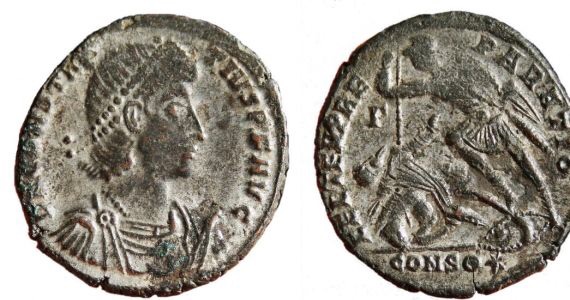 Edited by Augustus Maximus
02/22/2015 12:29 pm
|
|
Moderator
 United States
23731 Posts |
They are both LRB (later Roman bronze) AE3's, Not sure f the first coin is Constantine II or Constantius II, but the second one is Constantius II.
|
|
Pillar of the Community
United States
1046 Posts |
IF these two assumptions about the first coin are true: #1) Mint Mark is R*  for Rome #2) Bust is Laureate and Cuirassed Then it would have to be Constantine II EDIT: Actually, looking a bit deeper in RIC, Laureate cuirassed bust with legend starting with "CON" makes this Constantine II for sure regardlesss of mint Edited by Biancasdad
02/22/2015 3:11 pm
|
|
Pillar of the Community
 Netherlands
847 Posts |
Thanks all for your reactions. I thought they were silver/silvered because of the black lookalike collor. Ive seen that more often. Normally the bronze coins don't have that kind of collor. But they are not that nice to look at denars. Thats why I though maybe silique or something. But like augustus maximus said. They probably of at least one is maybe silvered in the past. That is why I mistaken with an full silver coin.
Why they do that by the way the silver layer? Just for more impressive look. Or going by the silver price in the past? Do you call an silvered coin a siliqua? Or is that a big difference between an silvered roman coin and a siliqua roman coin.
I am still learning on these old coins. They are not that much for sale over here so I started with collection 500-200 year old coins. Now I am going to the romans and before. But they are alot more difficult haha
|
|
Pillar of the Community
Italy
1790 Posts |
I hope this helps. A Siliqua is a modern name for a small silver like coin struck in the mid to later half of the 4th century. Until 353 CE they were the same weight as a Denarius ( 3 grams and up) , but they were reduced in weight to about 2 grams or so. Siliqua are nearly pure silver ( 95% for issues before the 370's and 98-99% for later issues). Here is an example of a Magnus Maximus Siliqua of mine for comparison to silvered coins. 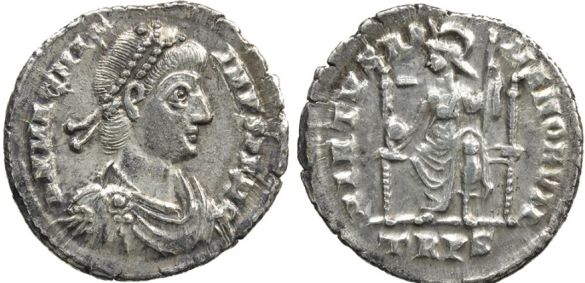 2.05 Grams. Minted Between 383-388 CE The silvering of coins was a remnant of the Reforms of Diocletian. By the time Diocletian became Emperor in 284, silver coins had been reduced to a few grams and had a very thin silver wash. See the picture 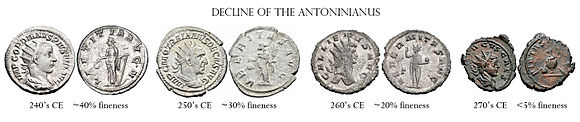 So Diocletian reformed the monetary system and the base unit was a coin called a Follis. The Follis was about 10 grams and had a Silver wash. Eventually the Follis was reduced in weight and evolved into the little AE coins we see today. ( Ex. Your coins) The Romans eventually stopped Silvering coins in the late 300's I think. Here is another picture that better demonstrates the declining weight and value of the Follis.  Edited by Augustus Maximus
02/22/2015 4:33 pm
|
|
Pillar of the Community
United States
1046 Posts |
|
|
Pillar of the Community
Netherlands
847 Posts |
Thanks alot for the explenation. Very helpfull! It is nice to hear about these things. Gives you a better idea about the coins 1700 years ago.
|
| |
Replies: 10 / Views: 3,250 |
|







 Posted 02/22/2015 12:19 pm





