Coin Community Family of Web Sites Join Thousands of Coin, Bullion, & Money Collectors
Coin, Banknote and Medal Collectors's Online Mall Specializing in Modern Numismatics Join Thousands of Coin, Bullion, & Money Collectors Royal Canadian Mint products, Canadian, Polish, American, and world coins and banknotes. 300,000 items to help build your collection! Royal Estate Auctions - $1 Coin AuctionsVancouvers #1 Coin and Paper Money Dealer


Username:
Password:
Save Password
Forgot your Password?


This page may contain links that result in small commissions to keep this free site up and running.

Welcome Guest! Registering and/or logging in will remove the anchor (bottom) ads. It's Free!

Mexican Pillar Dollar 1741

To participate in the forum you must log in or register.
Author Previous TopicReplies: 30 / Views: 7,499Next Topic
Page: of 2
New Member
Netherlands
23 Posts
 Posted 03/23/2015  12:50 pm  Show Profile   Bookmark this reply Add JO3023 to your friends list Get a Link to this Reply
Thank you wonghinghi and PatAR for your comments. Indeed I have read that the book of Gilroy is a very good book but also very hard to find. If I am not mistaken 500 copies were printed, hence extremely scarce.

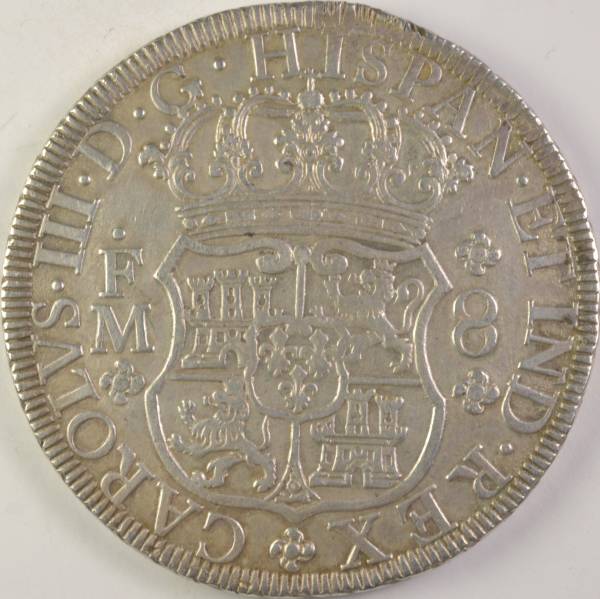
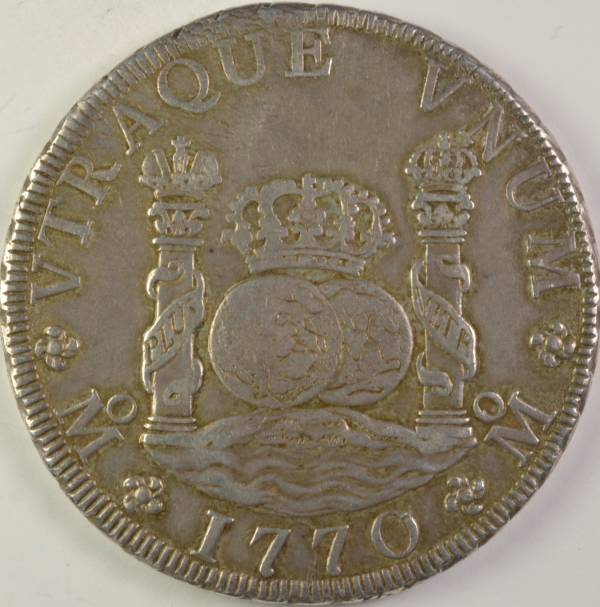
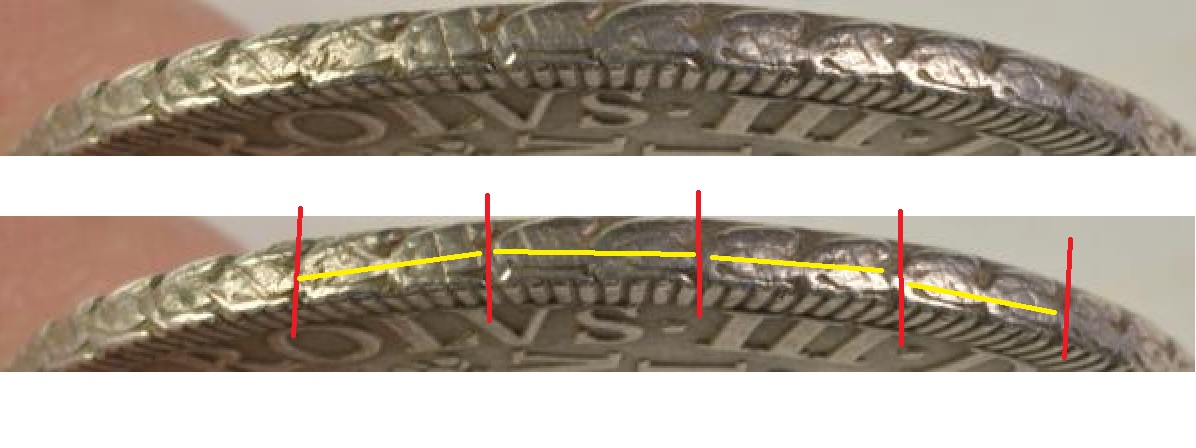
I have been playing around with a USB microscope and have taken some more pictures of the pillar dollar which in the mean time has been looked at by Juan Carlos Miró, a Spanish numismatist. From the photographs I have send him he considered it a genuine pillar dollar and now that he has seen the pillar dollar he is even more convinced of it authenticity. But the truth be told, with this type of coins, there will always be some doubt.


Mexican-Pillar-Dollar-1741

Mexican-Pillar-Dollar-1741

Mexican-Pillar-Dollar-1741

Mexican-Pillar-Dollar-1741

Mexican-Pillar-Dollar-1741

Mexican-Pillar-Dollar-1741

Mexican-Pillar-Dollar-1741

Mexican-Pillar-Dollar-1741


I hope you enjoy the pictures.

Best regards,
JO3023
Pillar of the Community
swamperbob's Avatar
United States
5362 Posts
 Posted 03/23/2015  5:09 pm  Show Profile   Bookmark this reply Add swamperbob to your friends list Get a Link to this Reply
Since not all of the members here are also members of the other forum where this coin has been discussed (Sedwick's) I feel I have to comment in a similar vein as I did on the other.

The new better pictures actually make the case stronger for a numismatic forgery rather than weaker. After personally examining thousands of counterfeits over the past 30 years - the surfaces of this coin look far more counterfeit than genuine.

However, the clincher is the enlarged picture of the edge which can be matched with a sketch I prepared to illustrate a forged overlap for the Sedwick forum. Here is the picture. Note I have rotated and flipped the picture in an attempt to match the picture with the sketch.
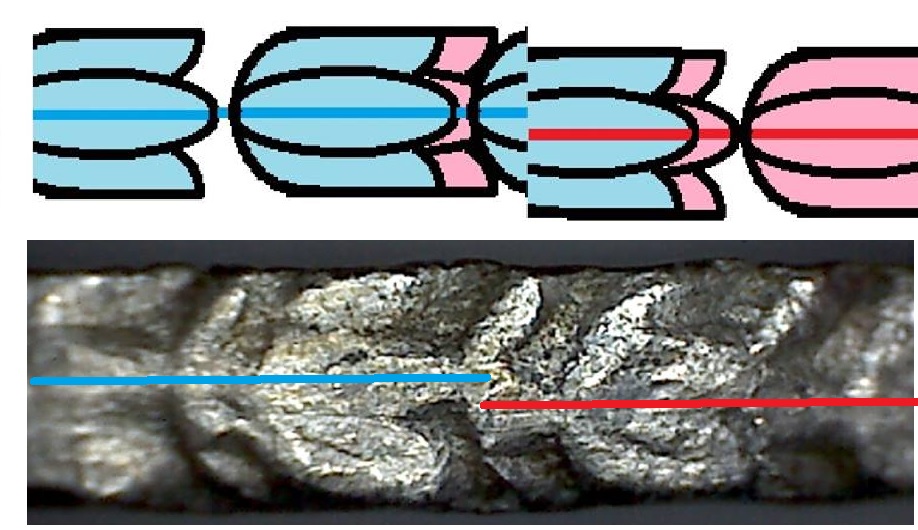
Mexican-Pillar-Dollar-1741

The coin has a clear overlap visible. However, the segments within the left half of the picture are ALIGNED with one another even though they should have been created by two different dies following TWO DIFFERENT alignments. The portion on the right half is less clearly aligned (because of edge damage) but even so most segments are clearly LOWER than the left (at least one set of impressions). That creates an impossible situation which can not be created on a castang machine (two parallel flat bar die edger). It violates geometry and and it is a physical impossibility.

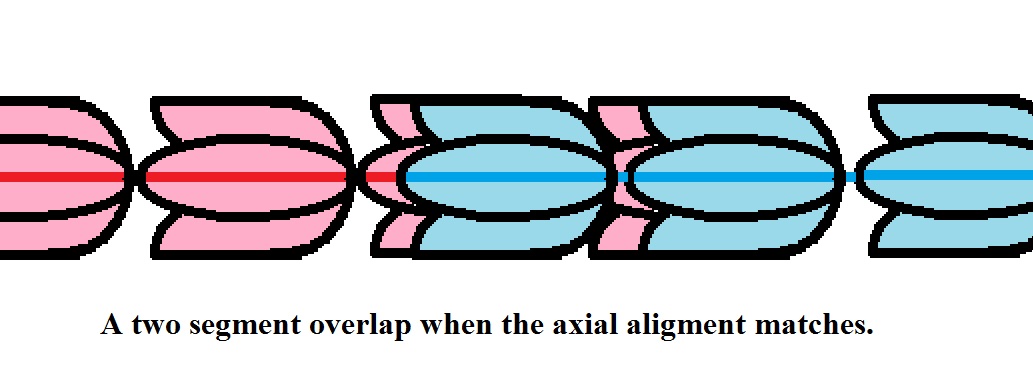
I made a series of sketches to show the problem step by step. The first picture shows a theoretical edge - one that has both edge dies aligned - the center line of each pattern matches. The pink segments were applied to the edge first, at the beginning of the edging process and the segments in blue were added last at the end of the edging process. The elements are all aligned along the center line on BOTH sides of the overlap.
Mexican-Pillar-Dollar-1741

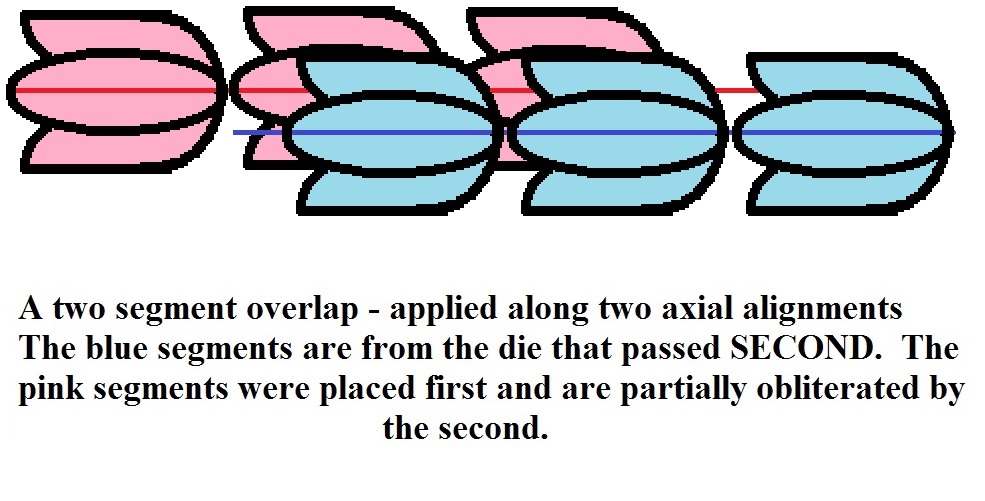
That matching alignment is not quite normal. Most center lines are in reality slightly out of alignment. This next picture shows what the edge overlap looks like when the two edge dies are NOT aligned. If you notice all of the pink segments are aligned along ONE axis and the blue segments are aligned on the second axis.

Mexican-Pillar-Dollar-1741

The geometry of the situation actually precludes any other arrangement. These two alignments are there is. All blue segments should be in alignment as should all pink segments.

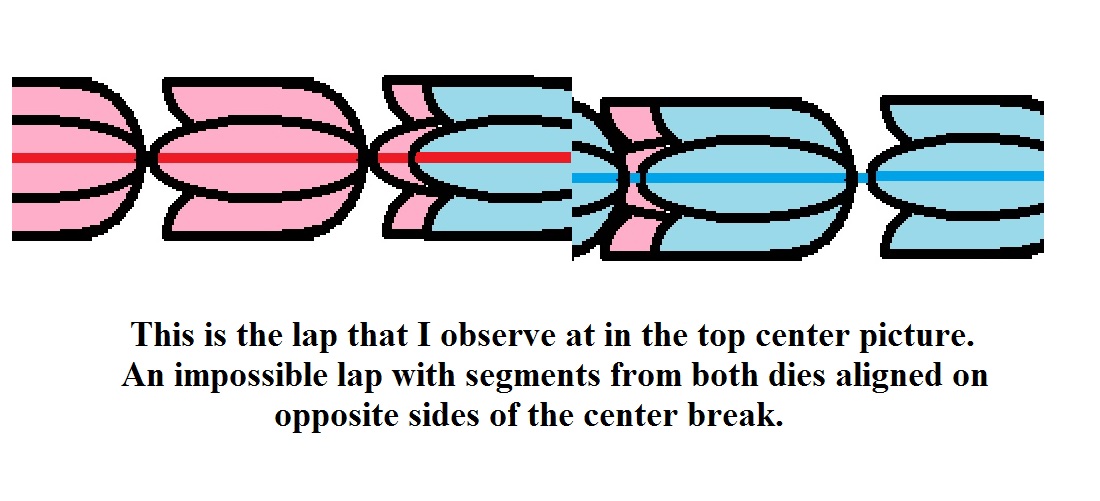
Now here is the edge I see in the case of this coin:

Mexican-Pillar-Dollar-1741

Notice that on the left side of a "seam" the pink and blue segments are aligned with each other. On the right side they are also aligned BUT ALONG A DIFFERENT center line.

This is impossible for an edge made on a Castang machine but is very believable on a cast edge which was copied from a genuine coin if the edge mold was SPLICED together unaligned at one end.

I know that other "experts" have viewed the coin and think it is real. I wonder if they evaluated the IMPOSSIBLE edge? An opinion is one thing a scientific theory is different. There is now a need disprove my theory before advancing to a different opinion.

If someone can explain to me HOW this edge could be created using a two die edger I stand to be corrected of course.
New Member
Netherlands
23 Posts
 Posted 03/23/2015  7:18 pm  Show Profile   Bookmark this reply Add JO3023 to your friends list Get a Link to this Reply
I think it is impossible to draw any conclusions based solely on the edge. One could also see the following:

Mexican-Pillar-Dollar-1741

The edge simply does not show enough detail to be certain about how the "seam" lines run.

Regards,
JO3023
Edited by JO3023
03/23/2015 10:36 pm
Pillar of the Community
swamperbob's Avatar
United States
5362 Posts
 Posted 03/23/2015  11:56 pm  Show Profile   Bookmark this reply Add swamperbob to your friends list Get a Link to this Reply
The edge shows me enough, and I do not agree at all with your placement of center lines particularly with regard to the red line - it does not follow the center lines.

Regarding your experts - did they even review the edge?

New Member
Netherlands
23 Posts
 Posted 03/24/2015  04:17 am  Show Profile   Bookmark this reply Add JO3023 to your friends list Get a Link to this Reply
And I do not agree with your placement of the center lines so I guess we are done discussing this any further. I fear you may have marked COPY (if I remember correctly you tend to do this) not only counterfeited pillar dollars but also authentic ones. It is a pitty that after seeing so many fake examples one ends up considering most pillar dollars as fake ones and strangely enough pillar dollars were the edge in my opinion is too perfect to be true are considered authentic. As an example I refer to the pillar dollar shown in https://goccf.com/t/215231 I think the wear on both sides of the coin does not match the almost perfectly visible edge design. Further more if this is a pillar dollar from the Rooswijk shipwreck I am missing the corrosion unless it has been removed abrasively which is a possibility but again why does the abrasive cleaning not show on the edge? On the other hand one could use the same arguments on my pillar dollar and argue that the coin is almost perfectly struck but not so the edge design. However I tend to believe the edge will be afected first by the salty sea water. As a critical note: Even without having seen the overlap on the 1736 pillar dollar it is almost immediately considered authentic just because there supposedly is a COA If anything can be forged it undoutedly is a COA It would be interesting to see the overlap on the 1736 pillar dollar.

I have three Mexican pillar dollars (this one from 1741 and two other ones from 1740) from supposedly shipwrecks as they all show the environmental damage. The edge on the other two specimens is similar to the edge I have shown for this particular pillar dollar. As to where the center lines should exactly be positioned that is without any doubt subjective unless the edge design is perfectly visible but then again I consider the latter fake pillar dollars.

Both the numismatist from Schulman b.v. and the Spanish numismatist have indeed checked the edge. The latter even checked the corrosion which he found to be solid. As they do I consider this pillar dollar authentic but everyone of course is free to think their own.

I truely hope not too many forum members have marked authentic pillar dollars as a COPY as it would render these columnarios worthless.

Best regards,
JO3023

PS By the way the pictures from the Sedwick forum (I will try to search for this forum at a later moment) are very clarifying but far from perfect as the center lines of one and the same colour are not aligned. You may have noticed this.
Pillar of the Community
MathieuMa's Avatar
France
1591 Posts
 Posted 03/24/2015  07:22 am  Show Profile   Bookmark this reply Add MathieuMa to your friends list Get a Link to this Reply
Just a clarification, the group is not Sedwick's place - he is not an admin there.
Augie was involved when I opened it and helped a lot - but is not part of the admins / owners (which can easily be understood on a business point of view) :)
Pillar of the Community
swamperbob's Avatar
United States
5362 Posts
 Posted 03/24/2015  2:01 pm  Show Profile   Bookmark this reply Add swamperbob to your friends list Get a Link to this Reply
We can agree to disagree regarding the placement of a center line or regarding specific scientific data. That is a valid part of any scientific discussion. A theory is only good until it is disproven by better "more correct" scientific evidence supporting an alternate theory.

However, personal attacks are not part of the process and unfounded scare tactics are not scientific.


Quote:
And I do not agree with your placement of the center lines so I guess we are done discussing this any further. I fear you may have marked COPY (if I remember correctly you tend to do this) not only counterfeited pillar dollars but also authentic ones. It is a pitty that after seeing so many fake examples one ends up considering most pillar dollars as fake ones and strangely enough pillar dollars were the edge in my opinion is too perfect to be true are considered authentic.


Emphasis added.

I agree that we are at an impasse on the subject of the center line at the overlap. We can progress no further.

However, I must defend myself against the personal attack that follows.

What exactly do I tend to do?

Warn people not to take "expert" opinions as gospel without scientific support?

Suggest all coins need to have weight, specific gravity and alloy tested - accurately?

Advise people to become aware of how genuine coins were made?

Look at the edge of a coin?

Always leave room for doubt as long as all scientific tests are incomplete?

If the scientific method destroys the "aura" that surrounds experts or costs dealers money - so what?

I am looking for truth.

Too many coins carry an undeserved stamp of AUTHENTICITY. As proof I point to the many counterfeit coins in TPG holders that exist.

I have (and have stated on many occasions) that there are three different categories of coins: GENUINE - NOT GENUINE and SUSPECT. That last category is critical in the scientific approach because that is where most coins belong until they are scientifically verified or disproved.

To settle the issue of scientific authenticity, I suggest that some data is clearly missing from this discussion. Why not supply the needed data before attacking me personally by questioning my motives or warning others not to believe me?

Please supply SG accurate to 3 decimal points?

Please supply XRF data accurate to 20 ppm?

Those tests could actually settle the argument. The risk of doing the tests comes in the form of the cost and the risk that a negative test proves a forgery beyond most dispute.

I do not condemn anything but obvious counterfeits based on pictures alone. I only mark COPY coins that are beyond all dispute forgeries. I never mark counterfeit issues COPY because they are typically legal to own and COPY is inaccurate for them. I am very cautious before making a final decision or permanently marking any coin.

What I see all to often are dealers and collectors rushing to believe a forged coin is genuine without any real scientific proof. The motives for this avoidance of science are known only to the owners but they are often simply monetary - genuine coins are worth more than forgeries.

I believe there are a significant number of issues with the edge and with the surfaces of this coin which make it far more likely to be a forgery than a genuine issue. Would I stamp COPY into it? Not yet. But I would do tests that could lead to a scientific answer.
New Member
Netherlands
23 Posts
 Posted 03/24/2015  3:50 pm  Show Profile   Bookmark this reply Add JO3023 to your friends list Get a Link to this Reply
I fear you misinterpreted my comment. I am not attacking you personally I just point out that if you are convinced the pillar dollar of this topic is a reproduccion based mainly on its edge characteristics and on the other hand you determine a different pillar dollar as authentic just because it is accompanied by a COA then I fear that you on more than one occassion may have been mistaken in determining the authenticity of a particular pillar dollar and if convinced of its forgery you mark them with COPY or any other term (FALSE, FAKE) then more than one original pillar dollar may have been destroyed irreparably. I would not recommend this activity to anyone unless they know what they are doing.

I too am searching for the truth, but I have also learned that not everything is black and white. There are also grey areas. There is a general tendency to consider most pillar dollars as fake. To me this makes no reason based on the large amounts of pillar dollars struck. Still I am carefull in buying this type of coins.

I am not trying to sell this pillar dollar so I could care less about the monetary aspect. This pillar dollar was not excesively expensive and I bought it from a reliable numismatist. Two other independent numismatists have given their judgement and considered it to be authentic. Fear not, if and when I am able to have the coin analyzed via XRF I will provide the details. So far I have found one company in Spain but they will not mention if present the gold content in their report. Also I have learned that this analisys has labeled a particular coin as a forgery whilst the whole profesional numismatic community was convinced of its authenticity. Are all the numismatists mistaken or is the test not reliable enough? Do not ask me for the details since I do not have these.

Apart from the two tests you mention I have provided everything else I could, mostly in the form a pictures taken from every angle. So until the results of the tests are there any further discussion on this pillar dollar will be merely speculative.

Regards,
JO3023

PS I sincerely hope others that show their pillar dollars would also show all the parts of their coin as I have done.
Pillar of the Community
swamperbob's Avatar
United States
5362 Posts
 Posted 03/24/2015  5:57 pm  Show Profile   Bookmark this reply Add swamperbob to your friends list Get a Link to this Reply
I do not believe I have ever in my life used a COA as the primary or only test for authenticity. It is at most one small piece of a larger puzzle. If I indicated a coin was genuine it would be based on a review of all the data - including the faces and edge. So I believe you are incorrect when you say:


Quote:
on the other hand you determine a different pillar dollar as authentic just because it is accompanied by a COA


Later in your reply you say:


Quote:
Also I have learned that this analysis has labeled a particular coin as a forgery whilst the whole professional numismatic community was convinced of its authenticity. Are all the numismatists mistaken or is the test not reliable enough?


That is a coin I would like to know more about. Sounds like a story fabricated to justify ignoring proven science. The fact that genuine Mexican silver contains gold has been well known and documented for many decades. That is a fact that is 100% beyond dispute. It is a primary basis used by forensic examiners to authenticate silver articles for museums. Most of those tests required sampling of the object for destructive fire assay. XRF tests are non-destructive and potentially more accurate than any other test available. Of course you need to use a reputable laboratory that is properly equipped to do the test. RTI International in the US is one of few labs willing to do the test.

To answer your question directly - If an accurate XRF test showed NO GOLD in a silver coin supposedly made in Mexico before 1800 - I would side with the test against EVERY numismatist in the world.
Pillar of the Community
wonghinghi's Avatar
Hong Kong
1270 Posts
 Posted 03/25/2015  10:59 am  Show Profile   Bookmark this reply Add wonghinghi to your friends list Get a Link to this Reply
JO, is it useful to you if I show my 1770 pillar dollar? It is quite nice and count all the edge tulips accurately. Just reply and I will show.
New Member
Netherlands
23 Posts
 Posted 03/25/2015  2:56 pm  Show Profile   Bookmark this reply Add JO3023 to your friends list Get a Link to this Reply
Hi wonghinghi, it is always good to see as much pillar dollars as possible. Thank you.

Regards,
JO3023
Pillar of the Community
wonghinghi's Avatar
Hong Kong
1270 Posts
 Posted 03/26/2015  07:08 am  Show Profile   Bookmark this reply Add wonghinghi to your friends list Get a Link to this Reply
JO, don't disappoint you, I show my coin here. It is 26.86 in weight and 39.7-39.9 mm in diameter. The number of tulips or laurel at the edge is 43-43.

Mexican-Pillar-Dollar-1741

Mexican-Pillar-Dollar-1741

Mexican-Pillar-Dollar-1741

Mexican-Pillar-Dollar-1741

Mexican-Pillar-Dollar-1741

Mexican-Pillar-Dollar-1741

Mexican-Pillar-Dollar-1741

Mexican-Pillar-Dollar-1741

Mexican-Pillar-Dollar-1741

Mexican-Pillar-Dollar-1741

Mexican-Pillar-Dollar-1741

Mexican-Pillar-Dollar-1741
New Member
Netherlands
23 Posts
 Posted 03/26/2015  2:15 pm  Show Profile   Bookmark this reply Add JO3023 to your friends list Get a Link to this Reply
Thank you wonghinghi for showing these excelent pictures of your pillar dollar. I will refrain from giving my opinion since I guess we can safely conclude that except for easily recognizible forgeries in all other cases it is impossible to determine its authenticity without an SG and XRF analysis.

Regards,
JO3023
Pillar of the Community
swamperbob's Avatar
United States
5362 Posts
 Posted 03/26/2015  11:57 pm  Show Profile   Bookmark this reply Add swamperbob to your friends list Get a Link to this Reply
Nice pictures that show the faces of the coin as well as the edge (allowing positioning of the overlap). Unfortunately only one of the overlaps is really clear - the one positioned over the C in CAROLUS (just before and after). The other lap should be in the area of the ISP of HISPAN where there is damage.

The edge design is of the proper type and the dies were made using a TWO SEGMENT master punch. You can determine this by checking the orientation of pairs of lotus flowers. They align in pairs and the only variations in spacing are seen BETWEEN the pairs of segments. I tried to capture what I mean in the following picture:

Mexican-Pillar-Dollar-1741

The length of two lotus flowers is about the same as the rectangle circle rectangle (three element) punch used to make the 1772 dies for the new portrait series.

I think SG would be a great test. The use of XRF for this date might be wasteful since there are no other serious deviations from standard.
Pillar of the Community
wonghinghi's Avatar
Hong Kong
1270 Posts
 Posted 03/27/2015  10:12 am  Show Profile   Bookmark this reply Add wonghinghi to your friends list Get a Link to this Reply
Yes Bob, I also see one edge overlap for this coin. I am not sure the second overlap is the the knock/nick position or not. Anyway, I am confident this coin is genuine. I will also do a S.G. test for this coin in near future. Will update later.

Jo, I would like to advise a preliminary method to assess a coin is of sufficient silver or not. I have designed a neodymium slide for my silver coins. You can compare the two similar coins by sliding down a magnetic slide and time the sliding for both coins. A coin with a longer sliding time means it slides slower and would have a higher silver content. The test is based on the diamagnetism property of silver.

You can see my experiment in another thread.

https://goccf.com/t/185616&SearchTerms=Romania
  Previous TopicReplies: 30 / Views: 7,499Next Topic
Page: of 2

To participate in the forum you must log in or register.


Disclaimer: While a tremendous amount of effort goes into ensuring the accuracy of the information contained in this site, Coin Community assumes no liability for errors. Copyright 2005 - 2026 Coin Community Family- all rights reserved worldwide. Use of any images or content on this website without prior written permission of Coin Community or the original lender is strictly prohibited.
Contact Us  |  Advertise Here  |  Privacy Policy / Terms of Use

Coin Community Forum © 2005 - 2026 Coin Community Forums
It took 0.48 seconds to rattle this change. Forums