| Author |
 Replies: 12 / Views: 1,231 Replies: 12 / Views: 1,231 |
|
|
Pillar of the Community
United States
1713 Posts |
I have heard about using olive oil as a method for cleaning coins. What kind of results have people had with this? What does it work especially well on?
(I know cleaning coins is not recommended and should not be attempted on valuable coins. I'm merely curious.)
|
|
|
|
Pillar of the Community
United States
954 Posts |
I had a 1908 coin soaking in it for a year and and a half. I never could see any change. It had verdigre from being in an old leather purse. In fact here it is in the oil.... 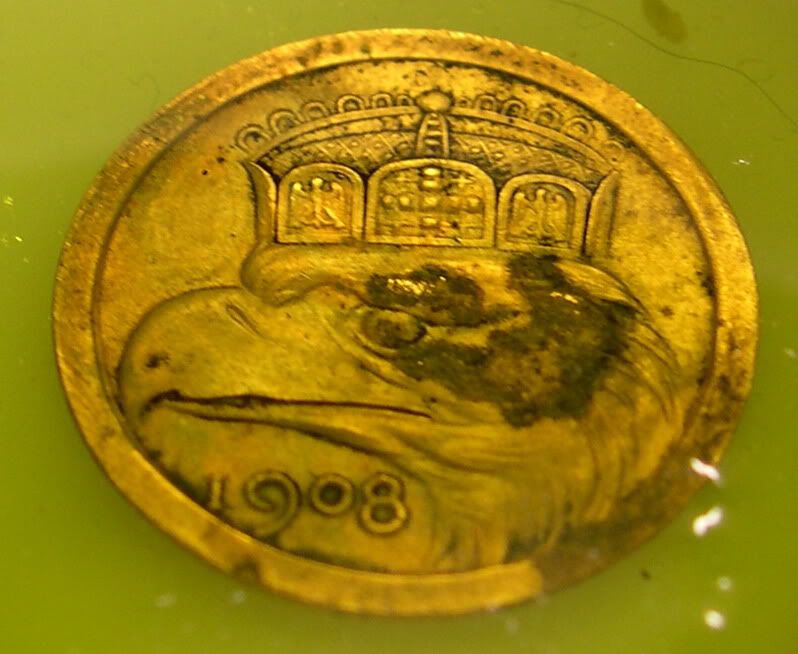 |
|
Pillar of the Community
United States
603 Posts |
I don't want to hijack the thread, but what type of coin is that Becky? I think it is one of the neatest designs I have seen.
|
|
Valued Member
United States
130 Posts |
A friend of mine had some Morgans which had a thin plastic residue. I tried acetone, olive oil and warm water. The water worked best and the cartwheels are intact. I did have to lift the leading edge of the plastic with my nail. Perhaps that left a mark but the plastic was worse!
I'd try water first if I felt I had to do anything at all.
|
|
Pillar of the Community
United States
954 Posts |
That is a pattern coin designed by Karl Goetz. It is a German 25 pfennig.
|
|
Valued Member
United States
123 Posts |
I haven't done anything with olive oil (except for cooking), but I do keep some items (oxygen-sensitive metals and mineral samples) in mineral oil to prevent corrosion. If olive oil behaves much the same way, then it will simply prevent further corrosion, but I don't imagine that it will clean anything. Perhaps a coin that is actively corroding could be kept in mineral oil to slow the process.
Heather
|
|
Pillar of the Community
United States
2443 Posts |
I thought olive oil primary works on copper coins. Becky you have a lot of patience for soaking your coin for a year and a half! I wouldn't be able to do that.
|
|
Moderator
 United States
23731 Posts |
Olive oil works well on copper and bronze, doesn't really do anything on other metals. I have been using it for years on ancients and it works great softening centuries of dirt.
|
|
Pillar of the Community
 United States
1713 Posts |
Becky said that her coin soaked for a year and a half. Is leaving a coin in olive oil that long typical?
|
|
Moderator
United States
23731 Posts |
In some cases I have had coins soaking for over two years depending on how much crud was on them. From what I see on this medal it looks like a transfer stain from the dye in the leather, if that's the case soaking in olive oil isn't going to do anything. I'd try a little acetone.
|
|
Pillar of the Community
United States
914 Posts |
I agree completely with echizento. Olive oil is normally for removing crud and dirt. I've got 200+ roman/greek coins soaking for 9 months now.
The only real way that I can tell it's working is the dirt at the bottom of the oil each month.
It's not going to affect the stain on that coin. I'd go acetone.
What kind of metal is the coin?
|
|
Pillar of the Community
United States
2540 Posts |
Yup, olive oil is good on copper.
|
|
Bedrock of the Community
United States
17884 Posts |
The reason the olive oil works is because oil penetrates and softens the dirt/crud. Mineral oil would do the same thing. But olive oil is also slightly acidic and the acid also works to break down corrosion products such as the verdigris. But it is a very weak acid and works slowly. A stronger acid would work faster, but also result in a coin that looks stripped.
On the verdigris, you also have to "pick at it" from time to time. It may soften but it doesn't move or dissolve. It still sits there until you break it away exposing fresh material for the olive oil to work on. And if you do get rid of it you will still have a rough surface where the coin was corroded. Stains it may or may not do much with at all. The acid in the olive oil is also the reason why it tends to lighten old dark copper. But if done too long can still result in the pink look of a dipped copper coin since what you are doing is actually a very slow dip.
|
| |
Replies: 12 / Views: 1,231 |
|







 Posted 10/25/2007 9:34 pm





