| Author |
 Replies: 13 / Views: 15,817 Replies: 13 / Views: 15,817 |
|
|
Valued Member
Australia
112 Posts |
These ottoman coins appear to be the same except for a number which is different - near the bottom of the coins on the top row it looks like the arabic numbers 3, 4 and 6 respectively. What is this number for?  |
|
|
|
Moderator
 Australia
16982 Posts |
That's the regnal tear of the sultan - the number of years he'd been on the throne. The four-digit year "1327" is his accession year - the year in the Islamic calendar in which the sultan came to power. To get the actual year of issue, add the two numbers together, and subtract 1. The "subtract 1" is because the first year of reign of the sultan was Year 1, not Year Zero. So your three coins are actually dated 1329, 1330 and 1332 in the Islamic calendar. You then use an online hegira date converter like this one, the conversion table in Krause, or some complex mathematics to convert these numbers into AD dates. Do this, and you get (roughly) 1911, 1912 and 1914. Don't say "infinitely" when you mean "very"; otherwise, you'll have no word left when you want to talk about something really infinite. - C. S. Lewis
|
|
Valued Member
 Australia
112 Posts |
Wow thanks! That explains why my ottoman coins were mostly from two years! (so I thought) 1327 and 1293. I've just had a look through the others looking for the regnal year and found most of them except the silver coins here I'm not sure about. Is it the marks that look like "11" or is this just part of the design? Also this gold coin isn't really from 1829 is it? (1223 + 23 - 1 = Islamic year 1245 using the system you just explained) It sure doesn't look that old.  |
|
Moderator
Australia
16982 Posts |
Yup, those "silver" coins (the one on the left is actually cupronickel) are 1293 year 11. You do have to watch for a "third number" - sometimes the denomination numeral like "2 kurush" is on the coin as well, and can be written much smaller than the huge "5" on the 5/10ths qirsh you've got there. In such cases, you have to figure out what the denomination is (or might be) and eliminate that from the possible options. I think your instincts on the gold one, however, are correct - I don't think a real old gold coin would go black and corroded like that. It looks like a "jewellery copy" in brass of the base silver qirsh. Here are the zeno.ru pages for this ruler. Incidentally, the "Ottoman Empire" didn't have an empire-wide coinage, and your coins are from different parts of the empire. The three bronzes are Egyptian, as are the cupronickel 5/10ths qirsh and the "old gold" one. The silver kurush is from Constantinople, Turkey. Don't say "infinitely" when you mean "very"; otherwise, you'll have no word left when you want to talk about something really infinite. - C. S. Lewis
|
|
Valued Member
Australia
112 Posts |
How do you tell which part of the empire the coins were made in?
|
|
Moderator
Australia
16982 Posts |
The name of the mint is written on the coin, in Arabic, in full. This pic I did up for an ACT&B forum member may help explain it: 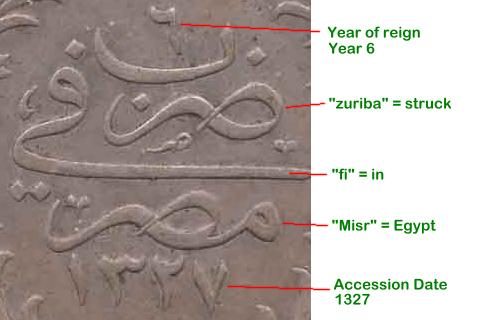 Most "Islamic" coins show the mint city using the formula "struck in (mintname)". The Arabic words are "zuriba" (struck) and "fi" (in). The final stroke of the "fi" is stretched out artistically, to create the long horizontal line. The word appearing under the line is the mint-name. On Egyptian coins, the word is "Misr" (Egypt). On Turkish coins, the word is almost always the much longer "Qustantiniyah" (Constantinople). Other, less common mint names on Ottoman-style coins include Baghdad (Iraq), Jaza'ir (Algiers, Algeria), Tarabalus Gharb (Tripoli, Libya) and Tunis (Tunisia). You should find a page of "Illustrated Guide to Eastern Mint Names" in the front pages of the Krause catalogues to help you out, but be aware that sometimes the shape of the word changes when written on the coin, either for artistic effect or space limitations - "Qustantiniyah" is a long word, and almost always written on two lines. Don't say "infinitely" when you mean "very"; otherwise, you'll have no word left when you want to talk about something really infinite. - C. S. Lewis
|
|
Pillar of the Community
United States
819 Posts |
Thank you for that extremely enlightening post, Sap! I never knew any of that.
|
|
Valued Member
Australia
112 Posts |
Amazing information! Cheers. I have checked and all my Ottoman coins are from Egypt except two from Constantinople. But I am suprised that the Ottoman coins were made in Egypt up to 1914 - I thought Egypt was a British colony at this time?
|
|
Pillar of the Community
Egypt
3470 Posts |
Sap  Except for the the pronunciation of the word "struck",in Arabic it is pronounced as "Duriba" and not "Zuriba"  |
|
Pillar of the Community
Egypt
3470 Posts |
|
|
Moderator
Australia
16982 Posts |
quote:
blueczar1512 asked:
I am suprised that the Ottoman coins were made in Egypt up to 1914 - I thought Egypt was a British colony at this time?
The status of Egypt pre-WWI was... complex. In theory, Egypt was a province of the Ottoman Empire, under the control of a viceroy or "Khedive" theoretically subordinate to the Ottoman sultan, and the Ottoman Sultan's name was the only one shown on Egyptian coins. In practice, Egypt was an independent country, left to it's own devices. Napoleon started European influence in Egypt, and the British largely ignored Egypt once Nelson chased Napoleon's navy away. Once the Suez Canal became more than a pie-in-the-sky dream and actually was built, every European power wanted a piece of the action in Egypt. But Egypt managed to retain it's de-facto independence until 1882, when the British arrived in force to secure the Canal and put down the nationalist, anti-European rebellion of Ahmed Urabi. The British, however, restored the old khedive to the throne and maintained the (now even more theoretical) links between Egypt and the Ottoman Empire. But as soon as war between the British and Ottoman Empires broke out in 1914, the British abolished all the theoretical ties between Egypt and Turkey, and Egypt became a British protectorate. quote:
eg collector said:
I agree, Except for the the pronunciation of the word "struck",in Arabic it is pronounced as "Duriba" and not "Zuriba"
 I'm taking my pronunciations from the book Arabic Coins and how to Read Them by Richard Plant. Mr Plant makes it plain that he's interested in making sure we thickheaded Westerners can read Arabic, not pronounce it properly. As he himself says in the introduction: quote:
After mastering this book, {the reader} will not be able to go out and hold a conversation with an Arab; but he will will have got the "start" he needs towards an understanding of coins inscribed in Arabic.
Given that basis, I think only one word mispronounced isn't too bad! Don't say "infinitely" when you mean "very"; otherwise, you'll have no word left when you want to talk about something really infinite. - C. S. Lewis
Edited by Sap
11/12/2007 08:31 am
|
|
Member
United States
3242 Posts |
Sap is there a coin that U don't know about? this is not a put down .U are a great asset to us
|
|
Moderator
Australia
16982 Posts |
quote:
amac44 asked:
Sap is there a coin that U don't know about?
Sure. Don't ask me about VAMs.   Seriously, I don't know most of the stuff I post. My books know all that stuff. And I've only got lots of books because the old guys down at the coin club keep saying, "First the books, then the coins.". OK, Google and Wikipedia know stuff too. But I only have to remember where I'm supposed to go to find what I need to know. Don't say "infinitely" when you mean "very"; otherwise, you'll have no word left when you want to talk about something really infinite. - C. S. Lewis
|
|
Pillar of the Community
Egypt
3470 Posts |
quote:
Sap said
Given that basis, I think only one word mispronounced isn't too bad!
I think that only one word mispronounced is excellent. Sap as usuall you are so informative, You've covered the point so well that I couldnt find anything to add except that |
| |
Replies: 13 / Views: 15,817 |
|










 Posted 11/10/2007 07:13 am


