| Author |
 Replies: 8 / Views: 1,390 Replies: 8 / Views: 1,390 |
|
|
Valued Member
United States
152 Posts |
At one point in my numismatic journeys I was interested in how far and wide the Venetian grosso had traveled. This led to learn that Roman coins had been found in India. Not 1 or 2, many. So while we all probably have some internalized view of the span of the Roman empire, for me, India is always beyond the horizon. I know that I saw some aureii sold by CNG some years back that were Indian imitations of Roman aureii. Anyway, by chance I located a small card stock book that I think was titled "Roman Coin Finds in India." I will have to browse my library to see if I can locate. However, in some quick web browsing I found an exceptional electronic article here: http://penelope.uchicago.edu/Thayer..._India*.htmlThe Romans were inveterate traders and India very plausibly represented a whole new source of goods and buyers. Yes, it makes sense the Romans would engage in trade. However the distances, the dangers, the time involved, make it a rather complex undertaking. Fascinating article on Rome, commerce.......and of course best of all, ROMAN COINS!! Paul |
|
|
|
Moderator
 United States
23731 Posts |
Very interesting article. I know the Romans traded extensively so it would stand to reason that they trader with merchants from India and other Eastern empires along the Silk Road.
|
|
Valued Member
 United States
152 Posts |
The trade with India was not along the silk road. Many of the Roman coin finds are along the big river that runs roughly north / south in India (name eludes me). Earlier trade was across desert and Gulf of Akabath but later trade was primarily sea borne.
Which brings up another thought. I have never explored if there is any documented evidence of the Roman trade with China.
Paul
|
|
Pillar of the Community
United States
5155 Posts |
|
|
Pillar of the Community
Italy
1790 Posts |
|
|
Pillar of the Community
United States
5155 Posts |
Mainly gold coins of the Romans are found in India. Many scholars struggle with the reason for the lack of silver coins, which are common in just about every other area the Romans had trade relations with.(To what extent I am not sure.) Some suspect the silver coins may have been melted and recoined. There seems to be a unusual occurrence of Nahapana coinage. It is unknown weather the Nahapana was one king or several kings, but the coins are made in an unusual style. It seems to be a composite coin in the style of Augustus. It is odd that the coin is silver since at the time India was dominated by a the Satavahana who largely issued potin and copper coins. Appearances of Satavanaha overstrikes of the silver Nahapana are found. Strange. An interesting subject I would love to learn more about. Nahapana as Emperor Kshaharatas of Saurashtra AD 70-75 circulating to about AD 130. AR Karshapana 21 mm x 2.53 g ref:Bop. 139, #3, M1253 The coin is of about 92-94% silver purity 2.00 grams and 15-18 mm in diameter. The coin features The bust of Nahapana right with a visible collar and wearing a satrapal cap. Surrounded by broken corrupt Greek legend. PANNIW SAHARATAC NAHAOANC, the reverse features an arrow pointing downwards to the left and a thunderbolt between, with two inscriptions. One is Brahmi RaJnoKsattaRataSa NaHa RaTaSa and the other is Kharoshti RANO KSAHARATASA NATHAPATASA.(The Raja Nahapana Kshaharata). The coin really is a blending of coin types most similar to the Indo-Greek King Apollodotos II. 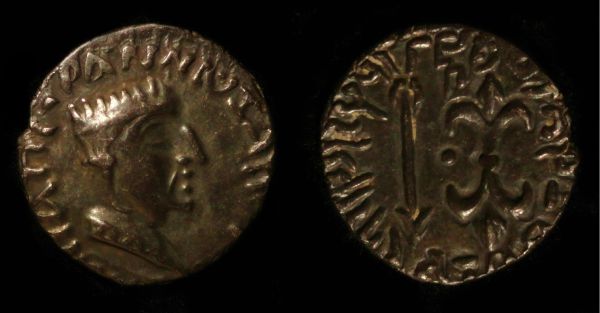 Edited by Ancientnoob
03/14/2015 5:30 pm
|
|
Moderator
United States
23731 Posts |
|
|
Valued Member
United States
152 Posts |
fascinating link on Roman - Sino relations!! I had never run across that before.
thanks!
Paul
|
|
Bedrock of the Community
Australia
21792 Posts |
I always thought the trading routed between the Mediterranean areas and India was via the Red Sea and the Indian Northern reaches of the Indian Ocean, using Arab dhows from the times of the early Roman Empire.
Roman aureii have been found in India, in relatively large numbers.
|
| |
Replies: 8 / Views: 1,390 |
|










 Posted 03/14/2015 3:34 pm


