| Author |
 Replies: 8 / Views: 3,448 Replies: 8 / Views: 3,448 |
|
|
Valued Member
United States
263 Posts |
Hi. I'm hoping someone will know what coin this is, which will hopefully give me enough information to learn more about it. I'm assuming the "1624" is the date. I searched for something that looks like it and I saw a similar coin for sale attributed as a Lithuanian shilling. Unfortunately there was little other information. They said the ruler was Sigismund III. When I searched with that information, I saw a 1625 coin on Numista.com from the Polish-Lithuanian Commonwealth that looked similar. The 1624 version does not have a photo, so I didn't know if it is the 1624 Szelag - Zygmunt III from the Wilno mint, # G1306. Does anyone recognize it? Thanks! 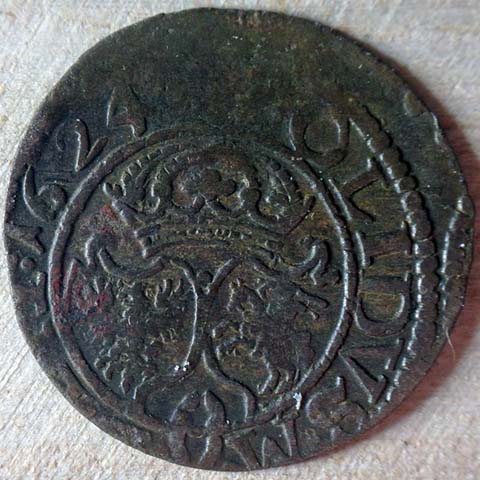 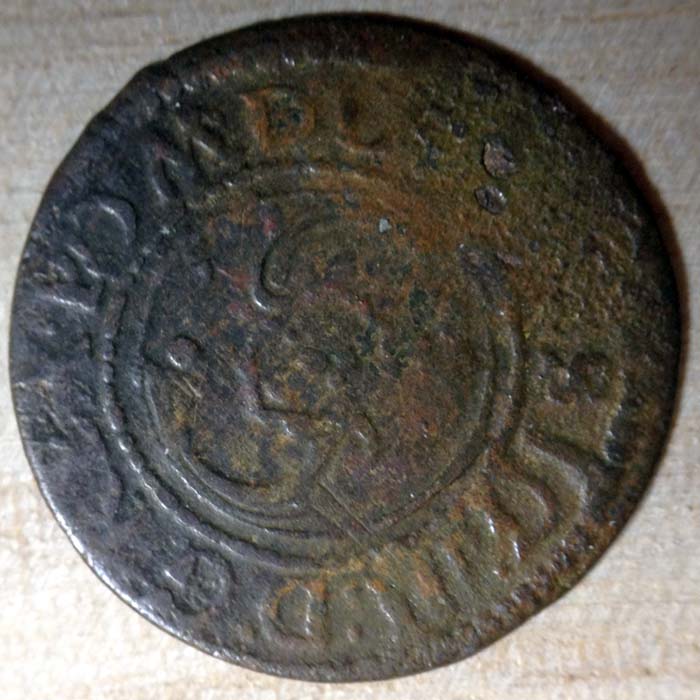 Edited by Spott
03/15/2015 12:59 am
|
|
|
|
Pillar of the Community
United States
589 Posts |
It has the Coat of Arms of the Commonwealth of Nobles, yes. 1624 was during the reign of Zygmunt III Waza. And it says "Solidvs". A solidus, a shilling, Polish "szelag".
For what it was worth: 1 z#322;oty = 30 groszy = 3 szelag
And for your confusion on the nation: Poland was founded on 14 April 966, became a Kingdom on 18 April 1025, was partially joined with the Grand Duchy of Lithuania on 14 August 1385 by the Union of Krewo (creating the Polish-Lithuanian Union), and on 1 July 1569 merged completely with the Grand Duchy of Lithuania by the Union of Lublin (however, the Crown of Poland and the Grand Duchy of Lithuania had shared monarchs starting with Kazimierz IV Jagiello#324;czyk in 1440), to create the largest nation within Europe: the Polish-Lithuanian Commonwealth, the Commonwealth of Both Nations, the Commonwealth of Nobles, the Most Serene Commonwealth of Poland, the First Republic of Poland, the Rzeczpospolita (you can refer to it however you like, most westerners called it "Poland").
Hope that helps. (You were correct on the identification)
Edit: interestingly the forum doesn't render Polish letters properly. #322; and #324; are the barred L, and N with kreska (similar in nature to N acute), respectively.
Edited by Groszy
03/15/2015 02:13 am
|
|
Valued Member
 United States
263 Posts |
Thank you! A new country for my collection and a really cool history to learn more about! Thanks!   |
|
Moderator
 Australia
16991 Posts |
As I mentioned in the recent thread on problems with the Numista country list, there isn't really any such thing as "coins of the Polish-Lithuanian Commonwealth". The two halves of the Commonwealth issued separate coinages, and they are found listed separately in the Krause catalogues - just like a couple of centuries later, the two halves of the Austro-Hungarian Empire likewise issued separate coinages for "Austria" and "Hungary". Unlike the Austro-Hungarian coins, it can be difficult sometimes to tell "Polish" coins from "Lithuanian" coins. You have to examine the legends carefully, to try to determine which country is given pre-eminence. This coin is from the Lithuanian half of the country. This is determined by the reverse (top pic) legend: SOLIDVS M D LITV (solidus of the Grand Duchy of Lithuania). Krause lists it under Lithuania as KM# 31. Here's the NGC database page. Don't say "infinitely" when you mean "very"; otherwise, you'll have no word left when you want to talk about something really infinite. - C. S. Lewis
|
|
Pillar of the Community
Belgium
2895 Posts |
|
|
Valued Member
United States
263 Posts |
Thanks, Sap and Petrus. It's fascinating how much information there is about about things that happened so long ago.
Sap, I had missed the discussion about Numista's list, and hadn't noticed the changing country names [probably since those are ones that I don't have yet]. Maybe someone who knows how to do such a thing could add a list like theirs to this site, and we could include things like the German States, but I suspect that would be a humongous project... It is certainly beyond my computer skills....
|
|
Pillar of the Community
United States
589 Posts |
Quote:
coins of the Polish-Lithuanian Commonwealth While both were nations (hence the Commonwealth of Both Nations), it was still one unified country, with a few caveats. True, coinage was minted independently in both the Crown and the Duchy (and Gdansk, if you want to get technical). The coin is still OF the Commonwealth, albeit minted at Wilno. Since the Commonwealth was technically a nation, with unified currency, then technically there are coins of the Commonwealth, as there are coins of the Eurozone, as well as (for example), Euro coins of Germany. --Missing from your list in the other thread is a differentiation between coinage of the People's Republic and the Third Republic of Poland (marked as PRL and RP with an uncrowned and crowned eagle respectively) And then there's the issue of whether different currencies issued by the same nation should be included (I believe yes), meaning that Congress Poland possessed three currencies, the Zloty (issued in dual Polish and Russian units), followed by the Polish Ruble from the 1850's through to German Occupation during WWI, when the currency was replaced with the Polish Mark. A specimen of each currency is needed for forming a true one of each nation/currency collection. |
|
Valued Member
United States
263 Posts |
Quote:
--Missing from your list in the other thread is a differentiation between coinage of the People's Republic and the Third Republic of Poland (marked as PRL and RP with an uncrowned and crowned eagle respectively)
And then there's the issue of whether different currencies issued by the same nation should be included (I believe yes), meaning that Congress Poland possessed three currencies, the Zloty (issued in dual Polish and Russian units), followed by the Polish Ruble from the 1850's through to German Occupation during WWI, when the currency was replaced with the Polish Mark. A specimen of each currency is needed for forming a true one of each nation/currency collection. Thanks, Groszy The more I learn, the more coins I want! I hadn't known my collection was missing a Russian Zloty, a Polish ruble, or a Polish Mark. I feel sorry for the coin collectors of long ago who didn't have an internet or a forum. Books and magazines usually have only one or two authors instead of a whole multinational community like this.... I'm so glad to have "met" all of you here. |
|
Valued Member
Lithuania
386 Posts |
Yes, this is the Lithuanian schilling, 1624, Vilnius mint,ruler Sigismund III Vasa.
|
| |
Replies: 8 / Views: 3,448 |
|







 Posted 03/15/2015 03:28 am





