



Coin Community Family of Web Sites Join Thousands of Coin, Bullion, & Money Collectors
Royal Canadian Mint products, Canadian, Polish, American, and world coins and banknotes. Specializing in Modern Numismatics Join Thousands of Coin, Bullion, & Money Collectors Shop for APMEX Bullion on eBay!Vancouvers #1 Coin and Paper Money Dealer Coin, Banknote and Medal Collectors's Online Mall 300,000 items to help build your collection!


Username:
Password:
Save Password
Forgot your Password?


This page may contain links that result in small commissions to keep this free site up and running.

Welcome Guest! Registering and/or logging in will remove the anchor (bottom) ads. It's Free!

If A Proof Coin Loses It's Finish...

To participate in the forum you must log in or register.
Author Previous TopicReplies: 5 / Views: 1,248Next Topic  
Pillar of the Community
snowman's Avatar
United States
1840 Posts
 Posted 11/18/2007  11:49 am Show Profile   Bookmark this topic Add snowman to your friends list Get a Link to this Message Number of Subscribers
...is it still a proof coin?

I'm just wondering because I recently purchased a lot of coins that included a 1964 Austrian proof set. The coins were kept loose (ie in with the rest of the collection) and the aluminum coins now don't look any different than a coin minted for circulation. Would there be any way to prove that the 10 Groschen is proof?
Pillar of the Community
Australia
3831 Posts
 Posted 11/18/2007  1:13 pm  Show Profile   Bookmark this reply Add gxseries to your friends list Get a Link to this Reply
Get another 1964 proof set and compare. That might be the fastest as it's possible that some people might have replaced the proof coins with some UNC and sold it as such.
My partial coin collection http://www.omnicoin.com/collection/gxseries
My numismatics articles and collection: http://www.gxseries.com/numis/numis_index.htm
Regularly updated at least once a month.
Bedrock of the Community
Bryan1315's Avatar
United States
14454 Posts
 Posted 11/18/2007  3:31 pm  Show Profile   Bookmark this reply Add Bryan1315 to your friends list Get a Link to this Reply
I know nothing about Aussie coins but in the US different mints mint different coins for circulation and proof coins. technically a proof coin is always a proof coin because of the way it was minted (has nothing to do with the finish on the coin). But as I said I have no idea how Aussie coins are minted nor do I know the differences between proof and business strike coins but I am sure someone will be able to tell the difference. Even if the proof coin has been circulated it is still a proof coin though
Pillar of the Community
Australia
3831 Posts
 Posted 11/18/2007  3:36 pm  Show Profile   Bookmark this reply Add gxseries to your friends list Get a Link to this Reply
Bryan, it's Austrian, not Australia If it is a 1964 Aussie proof set, those will cost a fair bit.
My partial coin collection http://www.omnicoin.com/collection/gxseries
My numismatics articles and collection: http://www.gxseries.com/numis/numis_index.htm
Regularly updated at least once a month.
Pillar of the Community
snowman's Avatar
United States
1840 Posts
 Posted 11/18/2007  7:40 pm  Show Profile   Bookmark this reply Add snowman to your friends list Get a Link to this Reply
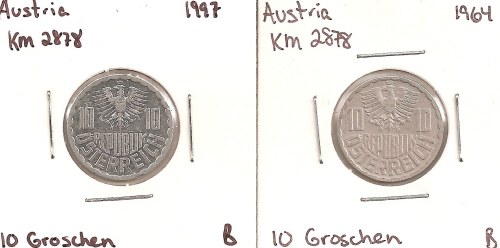
Here's the funny thing, the value of a '64 proof 10 Groschen is actually less than an UNC one. Since this coin is still in UNC condition I doubt anyone would swap it out.

As far as a side-by-side goes, I think my '97 non-proof Groschen looks more proof-like:

If-A-Proof-Coin-Loses-It's-Finish...

Oh well. Thanks for your replies guys!
Moderator
Learn More...
Sap's Avatar
Australia
16826 Posts
 Posted 11/19/2007  03:52 am  Show Profile   Bookmark this reply Add Sap to your friends list Get a Link to this Reply
As the numismatic dictionaries will all state, "proof" is a method of manufacture, not a condition or grade. A coin doesn't lose it's "proofness" by being removed from the wrapper or even by being spent and circulated.

Exactly how "proof" coins are made will depend on the process used at that mint at that time, but modern proofs are usually struck from specially prepared dies, using specially prepared blanks and handled with extra care to avoid mint damage. Often the press (a low-speed, high-pressure machine set aside for striking proof coins) will strike the coin twice, rather than the usual once.

Theoretically, you should be able to tell the difference, as the dies will be different. In practice, it may be impossible to tell them apart without expert knowledge of the series and/or a microscope.
Don't say "infinitely" when you mean "very"; otherwise, you'll have no word left when you want to talk about something really infinite. - C. S. Lewis
Edited by Sap
11/19/2007 04:01 am
  Previous TopicReplies: 5 / Views: 1,248Next Topic  

To participate in the forum you must log in or register.


Disclaimer: While a tremendous amount of effort goes into ensuring the accuracy of the information contained in this site, Coin Community assumes no liability for errors. Copyright 2005 - 2026 Coin Community Family- all rights reserved worldwide. Use of any images or content on this website without prior written permission of Coin Community or the original lender is strictly prohibited.
Contact Us  |  Advertise Here  |  Privacy Policy / Terms of Use

Coin Community Forum © 2005 - 2026 Coin Community Forums
It took 0.24 seconds to rattle this change. Forums