Coin Community Family of Web Sites Join Thousands of Coin, Bullion, & Money Collectors
Vancouvers #1 Coin and Paper Money Dealer Specializing in Modern Numismatics Coin, Banknote and Medal Collectors's Online Mall 300,000 items to help build your collection! Royal Canadian Mint products, Canadian, Polish, American, and world coins and banknotes. Royal Estate Auctions - $1 Coin AuctionsJoin Thousands of Coin, Bullion, & Money Collectors


Username:
Password:
Save Password
Forgot your Password?


This page may contain links that result in small commissions to keep this free site up and running.

Welcome Guest! Registering and/or logging in will remove the anchor (bottom) ads. It's Free!

1647 Sweden 4 Mark Queen Christina

To participate in the forum you must log in or register.
Author Previous TopicReplies: 6 / Views: 12,570Next Topic  
Pillar of the Community
Learn More...
t360's Avatar
United States
2703 Posts
 Posted 11/19/2007  8:42 pm Show Profile   Bookmark this topic Add t360 to your friends list Get a Link to this Message Number of Subscribers
1647-Sweden-4-Mark-Queen-Christina

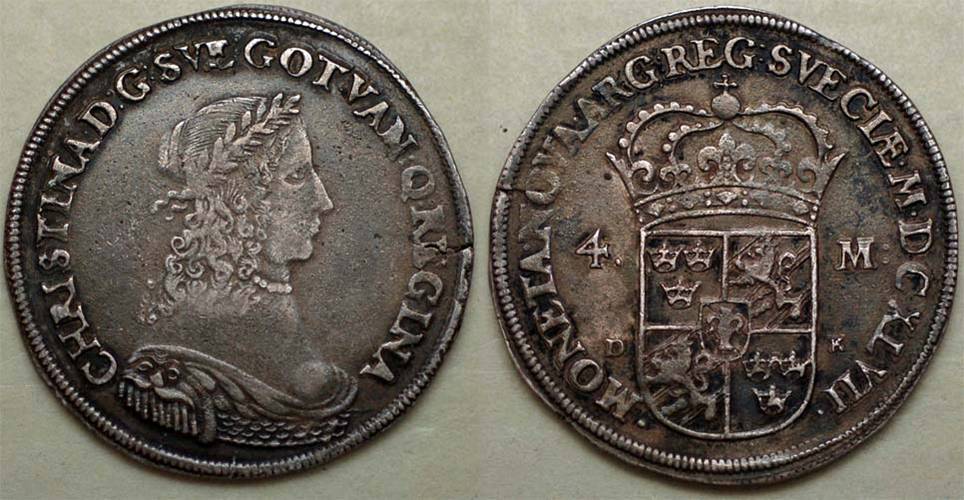
Today a dealer friend of mine offered me this 1647 (MDCXLVII) Swedish 4 Mark of Queen Christina, and I couldn't resist.
During Christina's reign, Fort Christina was established as part of New Sweden in present day Delaware.

1647-Sweden-4-Mark-Queen-Christina 1647-Sweden-4-Mark-Queen-Christina
Moderator
Learn More...
echizento's Avatar
United States
23731 Posts
 Posted 11/20/2007  01:30 am  Show Profile   Bookmark this reply Add echizento to your friends list Get a Link to this Reply
Very nice coin. I wasn't aware of New Sweden, thanks for the history lesson.
Pillar of the Community
Learn More...
t360's Avatar
United States
2703 Posts
 Posted 11/20/2007  08:39 am  Show Profile   Bookmark this reply Add t360 to your friends list Get a Link to this Reply

Yes for some reason we learned only about the British colonies in North America, and almost nothing about the Dutch, Swedish, French or Russians. Growing up in California, at least they did teach us about the Spanish missions and early California history.

1647-Sweden-4-Mark-Queen-Christina

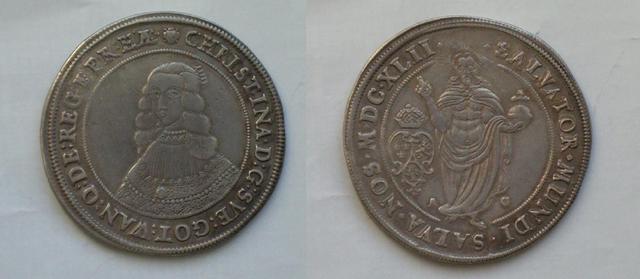
I also recently won this 1642 Christina riksdaler on tradera.com. I am still anxiously awaiting its arrival from Göteborg, Sweden.

Pillar of the Community
swamperbob's Avatar
United States
5362 Posts
 Posted 11/20/2007  3:28 pm  Show Profile   Bookmark this reply Add swamperbob to your friends list Get a Link to this Reply
I have never seen a Sweedish silver coin of this age. So I have a couple observations and questions:

1. The coin must have been made in one of three ways - an open sided screw press - by hand hammering - or possibly in a rocker or roller press based on the age. Does anyone know what technology was actually employed in Sweeden in 1647? There are elements I see here that are not compatible with all three methods.

2. Is my presumption that the coin is silver correct? What is the weight?

3. Can anyone confirm how the coin dies were made at this time? It looks engraved right down to the lettering in some cases, but in other instances it appears punched. The die steel seems soft and easily damaged based on the number and locations of die chips and the loss of fine detail.

The reason for these comments is based on my initial impression of the pictures. If this were a Spanish or English coin of the same date I would be VERY suspicious that it was actually a cast reproduction. But I do not know enough about the mint processes used to be certain.
Pillar of the Community
Learn More...
t360's Avatar
United States
2703 Posts
 Posted 11/28/2007  11:08 pm  Show Profile   Bookmark this reply Add t360 to your friends list Get a Link to this Reply
SwamperBob,

Thank you for your observations and questions. I now have the coin in hand and assembled some additional information with the help of Jurek at NumismaticStore.

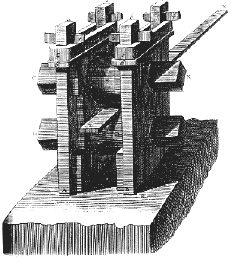
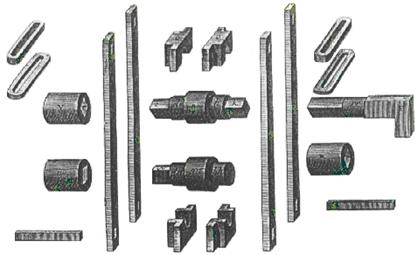
1. The 4 mark coin was struck on a Weimer press, which was based on the same technology as the roller-mill coining press.

"The coin rolling-mill was first conceived by Leonardo da Vinci and became popular in Europe around the mid-sixteenth century. This was the type of machine employed in the most of Europe mints to "roll" (not "strike") coins from 1586 through 1772 when screw-presses were finally installed. The rolling-mills (with smooth instead of engraved roller surfaces) continued to be used however to prepare the metal strips, and are similar to machines used in mints today for the same purpose."
1647-Sweden-4-Mark-Queen-Christina

2. The coin weighs 21.37g, the reference value from Krause KM#193 is 22.02g, 0.750 silver.

3. The coin does have some odd characteristics. However, it does not look like an obvious cast to me. Many of the letters do show doubling with some shift in position. The thinness of some of the letters appears to be a result of the double or triple impression with shift. The speckles in the fields look more like flan defects than casting bubbles. There is fine detail without granularity or extra metal in the devices. The wear on the face, curls and bust appears natural. The edge is plain without any seam and appears to have some normal wear consistent with the rest of the coin. I could be wrong, but it seems ok to me.

The only other coin I have see of this type is currently running on tradera. It is the same year but a different variety with a slightly different style portrait and a second ring of beads on the reverse. However the characteristics of the metal used is similar and this example shows very similar doubling in the legends and speckling in the fields.

1647-Sweden-4-Mark-Queen-Christina 1647-Sweden-4-Mark-Queen-Christina
Pillar of the Community
swamperbob's Avatar
United States
5362 Posts
 Posted 11/29/2007  10:42 am  Show Profile   Bookmark this reply Add swamperbob to your friends list Get a Link to this Reply
The roller press technology goes a long way to resolving the problems I see here. This type press actually induces stresses on the die parallel to the die surface that produces small surface fractures in the die metal adjacent to sharp features. Hence, the end result is the infilling of numbers and letters seen here. In older worn dies this could lead to distortions in the lettering which might account for the "engraved" look I see. Since each letter is stressed along a different axis depending upon where it is positioned on the die (relative to the direction of travel) then wear patterns would clearly cause the letters to assume different shapes after prolonged usage.

The pictures of the new coin show almost no wear and clearly point to a die manufactured with letter punches - not a hand engraved die.

The "doubling" effect or stretching effect which in some ways resembles Strike Doubling is also a feature commonly seen on rolled coins when there is a small amount of slippage between the roller die itself and the coin being produced. On the final picture, I see clear evidence of the coin being rolled through the die more than once, creating something close to a "double strike".

In Spain, England and the US - roller presses were used in counterfeiting operations for some time after the introduction of the screw press. Forgers also employed a compact version a "rocker" press because it was easier to hide than a screw press. So many of the features that would prove a coin to be real in one case can be evidence in another case that the coin is a forgery. That is why the question of HOW a real coin was made is so critical to spotting counterfeits.

Pillar of the Community
Learn More...
t360's Avatar
United States
2703 Posts
 Posted 12/10/2007  5:53 pm  Show Profile   Bookmark this reply Add t360 to your friends list Get a Link to this Reply
Thank you for your comments, swamperbob!

1647-Sweden-4-Mark-Queen-Christina

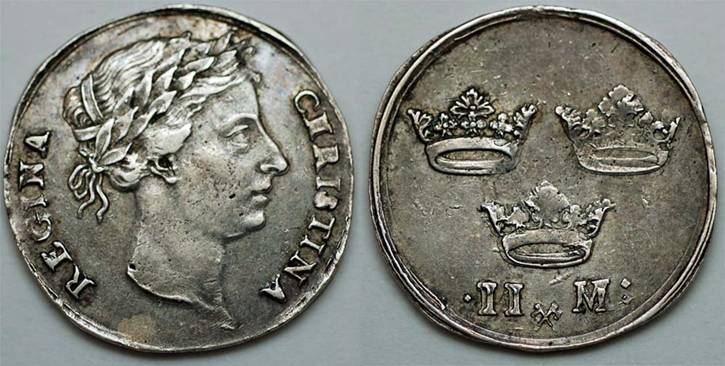
I just aquired this 2 Mark Christina, which will be on its way to me tomorrow.
  Previous TopicReplies: 6 / Views: 12,570Next Topic  

To participate in the forum you must log in or register.


Disclaimer: While a tremendous amount of effort goes into ensuring the accuracy of the information contained in this site, Coin Community assumes no liability for errors. Copyright 2005 - 2026 Coin Community Family- all rights reserved worldwide. Use of any images or content on this website without prior written permission of Coin Community or the original lender is strictly prohibited.
Contact Us  |  Advertise Here  |  Privacy Policy / Terms of Use

Coin Community Forum © 2005 - 2026 Coin Community Forums
It took 0.31 seconds to rattle this change. Forums