| Author |
 Replies: 12 / Views: 2,031 Replies: 12 / Views: 2,031 |
|
|
Pillar of the Community
United States
1804 Posts |
Thickness of a BU Ike dollar. When measured with calipers, is the RIM-REED (area) or the MIDDLE (area) of the coin thicker? Thanks to all *** Moved by Staff to a more appropriate forum. *** |
|
|
|
Pillar of the Community
Canada
4911 Posts |
im not sure what you mean but if I think I know what you mean then yes, the edge is higher to protect the design elements from ware.
Feel free to call me Will.
|
|
Bedrock of the Community
United States
12437 Posts |
The rim is always the thickest part of a coin, it helps protect the design elements from wear and also aids in the stackability of coins. However, there is no standard thickness for a rim since the thickness varies as a function of striking pressure(stronger strike= thicker rim).
|
|
Pillar of the Community
 United States
1804 Posts |
Quote:
Weak strikes are sometimes confused with grease strikes - coins that are struck through a heavy layer of compacted die fill. It's actually quite easy to tell the two errors apart.
A weak strike will show a poorly developed or absent design rim. A grease strike will show a very well-developed design rim.
A weak strike will retain some, most, or all of the planchet's original proto-rim. The proto-rim is erased in a grease strike.
A weak strike will retain the beveled rim/edge junction of the planchet. The bevel will be lost in a grease strike.
The edge will be weakly struck and relatively narrow in a weak strike. The edge will be tall and vertical in a grease strike.
Reeding will be weak or absent in a weak strike. Reeding will be very strong in a grease strike.
In a weak strike, extent and pattern of weakness will be essentially the same on both faces. Uneven weakness is a hallmark of most grease strikes. In line with the thickness nature of my education interest, I just grabbed this info off the net. Will edit this post to give credit to correct party ASAP. CREDIT TO ERROR-REF.COMLove my education in-on coins  edit by domain555 Edited by Domain555
04/03/2015 2:30 pm
|
|
Pillar of the Community
United States
1804 Posts |
Quote:
Collar installation errors Smooth edge instead of reeded edge (and vice versa)
Smooth edge instead of edge design (and vice versa) Reeded edge instead of edge design (and vice versa) Can anyone please show an example of a BU Eisenhower dollar, with no REEDS? Exstreem thanks for any thoughts, and PICs |
|
Bedrock of the Community
United States
12437 Posts |
Find a picture of a broadstruck Ike and you will have your example, that is the only way it could happen for that particular coin.
|
|
Pillar of the Community
921 Posts |
|
|
Pillar of the Community
921 Posts |
seems that pic of an ike with no reeds turns out to be a necklace holder type deal that I didn't read, just saw the pic...sry, my bad, but that error book is loaded with great info
|
|
Pillar of the Community
United States
1804 Posts |
Thank you aardspeed  Quote:
seems that pic of an ike with no reeds turns out to be a necklace holder type deal that I didn't read, just saw the pic...sry, my bad, but that error book is loaded with great info. It's a small world.  That is one of my Ikes. Six months ago, I had no idea what it was, until the heavy weights educated me here on CCF. A few times I have wanted to get a saw and cut the bezel off. But as of yet, I just look at it. |
|
Pillar of the Community
United States
1804 Posts |
|
|
Bedrock of the Community
United States
12437 Posts |
Well ok, a broadstrike is the only way it can happen on a standard Ike planchet |
|
Pillar of the Community
United States
1804 Posts |
Weak Strike or die Brake Quote:Occurs when there is insufficient pressure from the dies to leave a full impression on the planchet. This can occur for a variety of reasons but usually occurs when the power to the presses is turned off and the dies continue to strike coins with less and less pressure until coming to a stop. On such coins all the detail, including the reeding on clad coins should exhibit extreme weakness. If the coin is simply Struck Through Grease, some details may be strong and the edge reading will also be strong. 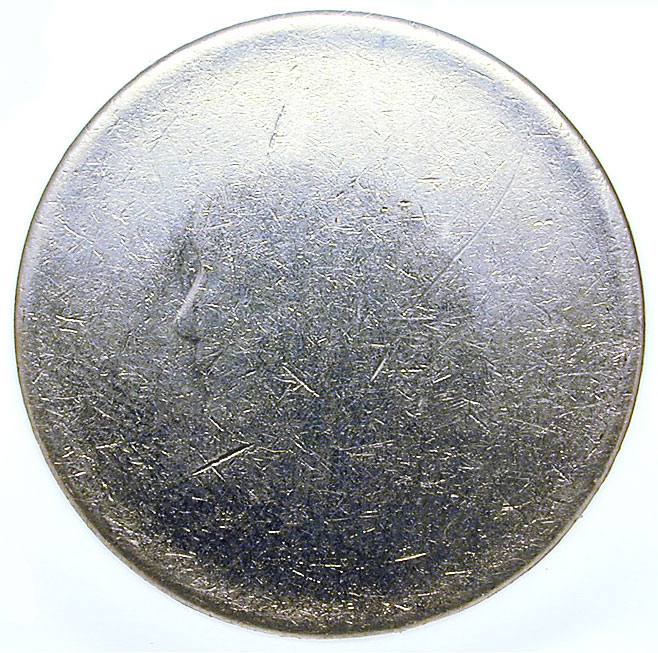 IMHO, if man (and or) a machine made it, there is a possibility of an error. And that does not count the time(s) when dirty nasty, dishonest crummy employees deliberately sabotage or destroy stuff. Maybe for future profit? |
|
Bedrock of the Community
Australia
21789 Posts |
In the mint, a coin's specification is the blank thickness to which it is rolled, it's diameter, and therefore the mass. Rim coin thickness is essential to determine the standard roll length for a given coin type. Coin diameter is determined by the collar dies. The minimum thickness of a '64 Kennedy half between field faces is about 2/3rds of the thickness of the rim. I remember measuring this with a small dome tipped calipers vernier screw gauge about a year ago. Edited by sel_69l
04/07/2015 10:13 am
|
| |
Replies: 12 / Views: 2,031 |
|










 Posted 04/03/2015 12:25 pm


