| Author |
 Replies: 16 / Views: 3,586 Replies: 16 / Views: 3,586 |
|
Pillar of the Community
United States
5318 Posts |
While this may be similar to a topic posted a week ago, there's one slight twist: I really did it this time! Not another false alarm, lol! After your helpful comments last time, I built a diagnostic tool in photoshop using verified LR and HR obverses, carefully noting the position of denticles to the "A", and a few more datapoints. Long and short of it, I would use this tool on auctions, pulling up the photo in this tool and carefully comparing the details. In addition to the "A" centered between denticles (the top counter apex actually), I found a few other diagnostics to prove/disprove question coins. So after about 10 hours of work, I found one. It's about MS-62--for $5. I thin I'm going to enjoy collecting Canadian!  I'll post the coin later sometime with a shot of my diagnostic tool. Edited by KurtS
12/11/2007 11:10 am
|
|
|
|
Pillar of the Community
Canada
965 Posts |
I really should learn to use Photoshop.  That's pretty cool how you did that. I'd certainly be interested in hearing more about how you've done this. (Not that I'm looking to compete with you on ebay, but that I wouldn't mind using it to check other coins for varieties.) |
|
Valued Member
Canada
187 Posts |
That's brilliant KurtS, congratulations. Of course now that the secret to your success is out, you may have a little competition from time to time...  |
|
Pillar of the Community
 United States
5318 Posts |
Thanks both of you! After my false alarm with the 5c "mule" and others, I owe it to members here with finding a way to really scrutinize these varieties. While my method works, I'm sure experienced people can just eyeball things. I think this particular coin escaped scrutiny because it was shot from an angle and the lighting on denticles was confusing. Because of that, I actually thought it was an HR, but something just wasn't right...so I compared it against a half-dozen hires photos of HR coins vs slabbed LR coins. It was fairly time consuming, but it paid off this time, and I learned a lot about this variety.  |
|
Valued Member
Canada
187 Posts |
When a few minutes can make the difference between a $15 coin and a $1700 coin, it's worth the extra time. I'd love to see a pic of your new find
|
|
Pillar of the Community
United States
5318 Posts |
In this case it was hours of work, lol. I just wasn't going to "trust my eyes" and make another unfounded claim. When the coin arrives, I'll post a good photo and a snapshot of the methods I used to determine the variety...open source for all! |
|
Pillar of the Community
United States
1571 Posts |
Very interesting reading , the above posts! Topher, I, have Photoshop 7.0, and Coop has tried to help me learn it, but I get lost so fast, that I have just about given up on it. I want to learn to make overlays, to check for differences, because I don't remember all the markers, and other details, not to mention KNOWING what to look for. So it would be nice to know how to use a tool like this. I can do these things, if someone SHOWS me how, but telling me is a waste of time, because I can't visualize what I should be doing I have a photographic memory, but anything I hear, just goes thru from one ear to the other, and is gone! Not having any central vision doesn't help any, either.
Any suggestions?
Dick
|
|
Pillar of the Community
Canada
965 Posts |
I'm the opposite, I can remember what to look for, but don't have the "tools" to do comparisons like this. I'd love to be able to take pictures of every 1985 cent I come across to look for pointed 5's, or take all of the 1977 nickels and sort them into varieties, etc. If I feel confident, then, maybe I'll use it to cherrypick coins off of ebay. |
|
Pillar of the Community
United States
5318 Posts |
Ok, here's a capture of my diagnostic tool, plus a few noted datapoints between the LR and HR versions: 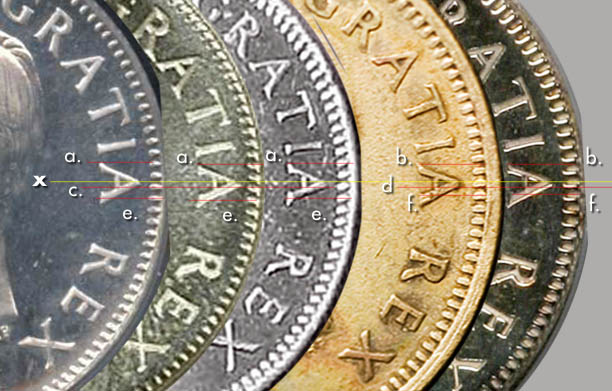 Firstly, in photoshop I imported several photos from verified/slabbed HR and LR coins. Then I scale and orient these examples so they're relatively consistent for easier comparison. What I found is that achieving exact angles and sizing between coins isn't critical if you compare the relationships between features of the same coin against one another. After studying about a dozen confirmed LR and HR coins, here are a few datapoints I've diagrammed above. Establishing a horizontal baseline (x), I compare the position of the inner "counter" apex (the upper inside space) of the last A in GRATIA to the position of adjacent denticles. I prefer to orient this horizontally because of my familiarity with left-to-right reading, but you might choose a vertical baseline aka "plumb line". Using the baseline x, you'll note upper vertices of the counter align either between the denticles in the case of the LR variety, or through the center of a denticle for HR varieties. However, with lower-resolution auction photos, I don't find one datapoint is adequate in differentiating between LR and HR. So here's a few more key points. You may need to expand this photo to see all the pertinent detail: a. For the LR variety, the left leg of the "A" orients close to the center of a denticle. b. Compare that to the HR variety, where the same feature lines up between denticles. c. For LR coins, the far right corner of the upper "A" counter aligns to the center of the denticle just clockwise from the "A" vertex d. Compare that to the HR variety, where the right corner of the same counter aligns to just between (clockwise) two denticles e. On LR coins, the denticle just below (CW) to the one nearest to "A" aligns to the center of the A's right "foot". f. While on HR coins, this denticle just CW from the A apex aligns to the inner corner of the A's right "foot". I'll note something I observed with denticles: sometimes there's a slight twist to denticles, which I attribute to the coining process. Sometimes these can be confusing, but you should go by where the denticle ends in the coin field. Seeing today is my birthday, this isn't a bad gift to myself Kurt Edited by KurtS
12/14/2007 02:56 am
|
|
Pillar of the Community
United States
1571 Posts |
I would like to clarify just what LR, and HR indicates. Does it mean High, and Low "R", and if so what does "R" imply? New Canadian collector.
Later: I was under the impression that the first "A" in GRATIA was the one to use. This post indicates the opposite. Nothe the opposite indications in the "tool, and the lower "A", are just opposite.
Thanks for any, and all info,
Dick
Edited by livingdinasaur
12/14/2007 1:55 pm
|
|
Pillar of the Community
United States
5318 Posts |
Hi, I believe that HR and LR denote "High Relief" and "Low Relief" which refer to the depth of George VI's portrait on the obverse and a few other die changes. Regarding the "correct" A to use, as far as I know...it's the second A in GRATIA. This is the diagnostic that Charlton's catalog uses, and the same is referred to at jandm.com, which have some excellent pictures of die varieties. That detail is proven when I compare certified LR coins to HR varieties. In any case, when one has high-resolution photos of the two varieties, they can develop their own diagnostics as they see fit. Edited by KurtS
12/14/2007 5:10 pm
|
|
Pillar of the Community
United States
1571 Posts |
KurtS, thanks for the info. I knew there was a place where the high, and low relief is pertinant, but didn't know wheere to apply it. I like the diagnostic "tool". It does the same as my projecting the image(s) on a large screen TV, and tracing the outline. Then it is just a case of observing, to tell which is which. That doesn't mean I won't try to learn top make overlays, because they will be much more accurate. As far as the relief, it would be best to have a "pair in hand", or at least a pair of good quality photos, side-by-side, to see the difference.
Dick
|
|
Pillar of the Community
United States
5318 Posts |
Dick,
Thanks...when my work slows down, I'll do a demo here on comparing images in photoshop. It sounds like you've found a good method too, and an important aspect of this is always our eyes. You know, I had dismissed this coin at first, but something wasn't right--proven later by the computer analysis. Instincts often tell us something computers can't.
|
|
Pillar of the Community
Canada
1487 Posts |
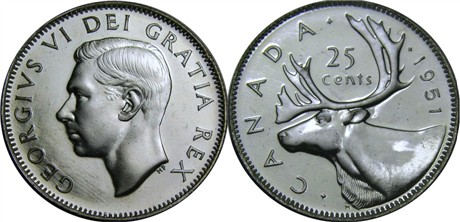
Here's a 1951 quarter I received this week as part of a set. Image:  DSCN4969b.jpg DSCN4969b.jpg43.5 KB |
|
Pillar of the Community
United States
5318 Posts |
|
|
Pillar of the Community
United States
1571 Posts |
KurtS, I read you 100%! My eyes are the reason that I have to resort to "diagnostic tools", among other things. It would be nice if some one could, or would make an overlay of the more common coins, to determone the marks, and if is indeed a clash, or other damage. The difference in one of your overlays, would be the way they are mad. In your case, the coin rotated, and in our case, it flips. The obverse and reverse are erect, on Canadian coins, while ours are 180 degrees out of sync, ie, the obv is erect, while the rev is upside down. Everyone knows this, but I thought it might be nice to remind folks like me, who are very new at this.
Dick
|
| |
Replies: 16 / Views: 3,586 |







 Posted 12/11/2007 11:10 am


 DSCN4969b.jpg


