| Author |
 Replies: 26 / Views: 3,228 Replies: 26 / Views: 3,228 |
|
|
|
Pillar of the Community
United States
1781 Posts |
Hi Mike, I've read your articles on this topic and they were well written and point on. I'm glad you find looking at an actual die helpful. I've been digging through many of my dies and finding interesting effects.
Ken
|
|
Pillar of the Community
United States
2752 Posts |
In one of my Coin World articles I basically concluded that Retained Cuds of the hammer die don't exist (or if they do, they're incredibly rare). For the anvil die, I agree with you completely that distinguishing a true Retained Cud from a still-attached die fragment is very difficult. Those with very slight vertical displacement or horizontal offset I suspect are still attached. Those with an extreme amount of vertical displacement or horizontal offset are probably detached. For those falling between these two extremes, who knows? But if they have the traditional diagnostics, I still call them Retained Cuds, for lack of an alterative. Error coin writer and researcher.
|
|
Moderator
 United States
23522 Posts |
Am I correct in assuming that Modern dies have nothing whatsoever sheathing the business end of the hammer die? That would be prima facie evidence of the virtual impossibility of a Retained Cud on one. Even if it were a retractable sheath only in place for the strike, the retraction should dislodge anything stuck. |
|
Pillar of the Community
United States
2752 Posts |
There is nothing to hold a Retained Cud in place on the hammer die. The collar can prevent loss of a Retained Cud on the anvil die. Error coin writer and researcher.
Edited by mikediamond
04/17/2015 9:54 pm
|
|
Moderator
United States
23522 Posts |
Thank you. I know how the Morgan & Orr presses worked, but nothing about the current Schuler equipment.
|
|
Pillar of the Community
United States
1781 Posts |
Mike, Generally, I agree that most Hammer Die Retained Cuds probably are not that at all in the strictest sense of the definition. However, I leave some wiggle room for Hammer Die Retained Cuds. A die can break from its face all the way down to its base (or nearly so)and be fully separated from the rest of the die. When that is the case, there is plenty of room to fasten some dies into place and hold both pieces in place. Much if it depends on the type of die style being used which can vary from Mint to Mint, press to press and era to era. Straight shank dies tend to break all the way down more often than a multifaceted Columbia style die for example. Die cracks and " Cud breaks" tend to end at the shoulder of the die on the Columbia style though it can go further. Shown is a straight shank where the die has split in two. This could have been held in place long enough to run off some what you could call split dies or Retained Cuds (a fully split die is really just a sub-classification for a Retained Cud ). Next is a Columbia style die showing how " Cud breaks" often end at the shoulder. Next is another. Next is a Columbia die with a crack extending from the face down the nose, shoulder and body to the foot where to abruptly turns left. A Columbia style die fastens into the die holder about a half-inch above the foot. If this die had cracked upward again and separated into two parts, the parts may have been retained in the holder long enough to strike some coins. Now, of course all this is speculation but there seems enough evidence for me to leave this wiggle room open - in particular for the Retained Cuds we sub-categorize as Split Dies. Ken 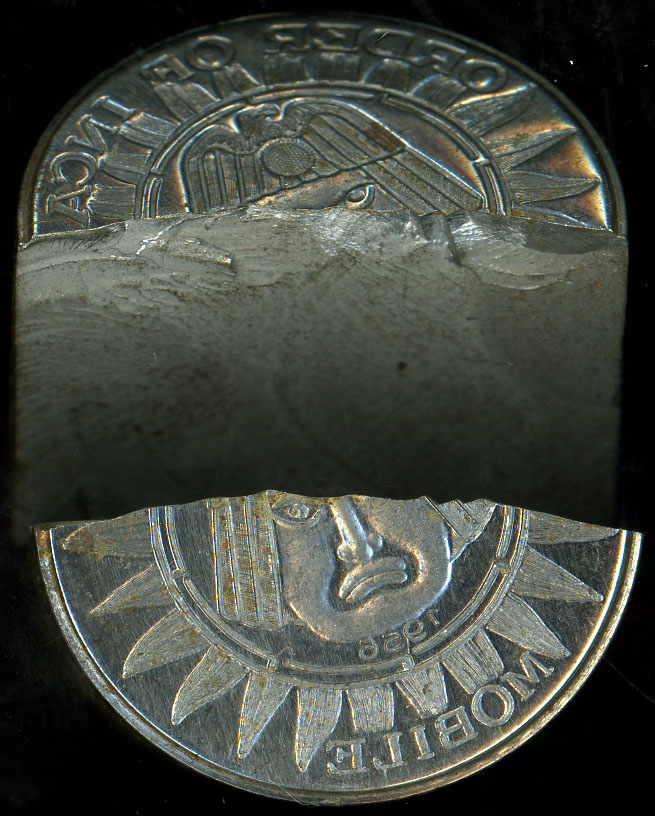 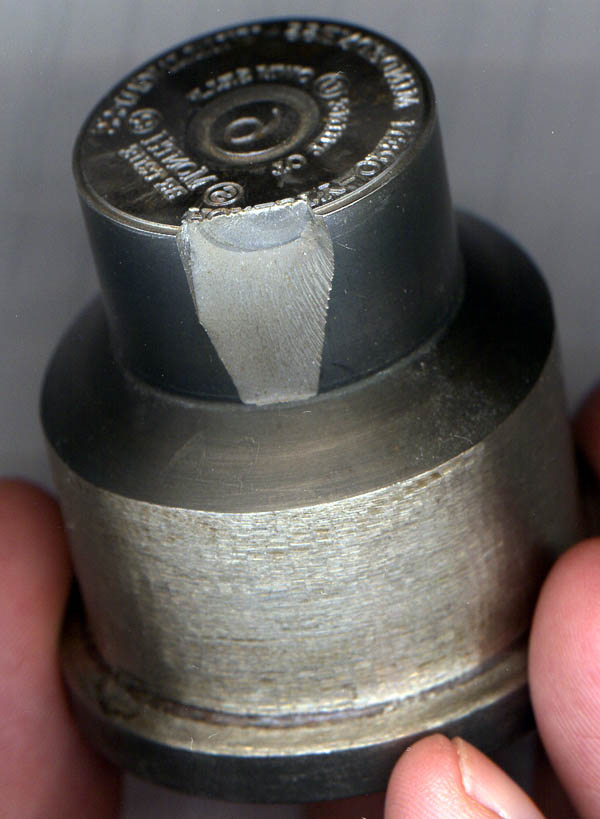 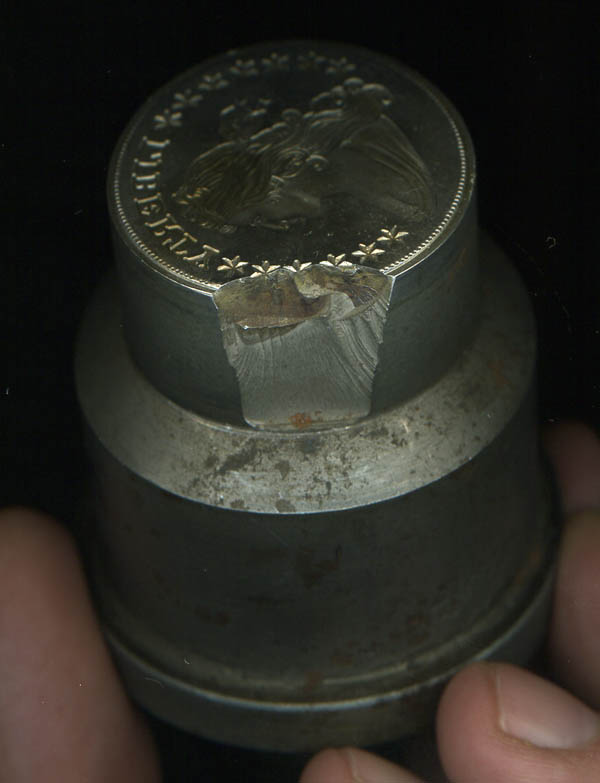 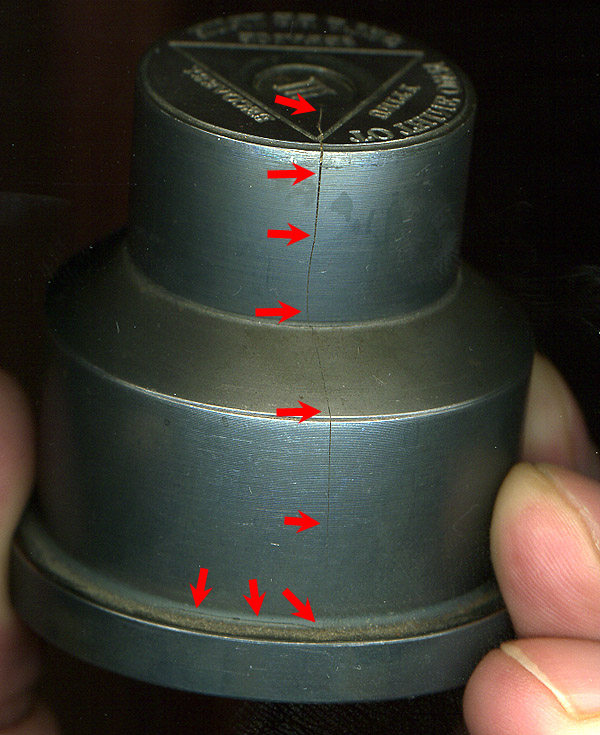 |
|
Pillar of the Community
 United States
740 Posts |
Those are some neat pictures of some messed up dies. Do you own these? The U.S. mint defaces dies before selling. Do you guys mind checking out this other Kennedy half I found. I had some doubts of it being a lamination but posted it as a lamination anyways then SsuperDdave's reply made me doubt it even further. The reason I doubt it is because of the way it's raised. The surface doesn't look like a die crack such as __/\__ but rather a step such as __/¯¯¯ In other words, the right half of the coin appears to be a very tiny bit higher than the left half of the coin, yet the shelf does not continue across the face. It does however travel partially up the neck and fade away, it's like it is leveled out over the higher devices. https://goccf.com/t/226696 |
|
Pillar of the Community
United States
2752 Posts |
Ken, your speculations concerning Retained Cuds of the hammer die are worth considering. However, most alleged Retained Cuds of the hammer die are relatively modest in size, making a break extending deep into the shaft (at least as far as the clamp/bolts) unlikely. I don't agree that a Retained Cud is the same thing as a split die. By definition, a Retained Cud is a piece of a die that has separated completely from the die neck, but is nevertheless held in place. On the coin it primarily exhibits vertical displacement and/or horizontal offset. By definition, a split die is a die that is still intact. On the coin it should primarily or exclusively show lateral spread. I will agree that many purported Retained Cuds are really rim-to-rim bi-level die cracks that are the result of surface cracking and subsurface deformation. In such cases the similarity to a split die is closer. Error coin writer and researcher.
Edited by mikediamond
04/18/2015 11:16 pm
|
|
Pillar of the Community
United States
1781 Posts |
Mike, We are in complete agreement with your comment on "most alleged Retained Cuds of the hammer die." That has always been my position. However, with all due respect, my definition of a Split Die is different than yours and I doubt that I'd ever conform to yours. If you took my Order Of Inca Mardi Gras die and fixed it into a die holder with the two pieces locked together long enough to strike a few coins -- they would be Split Die Strikes and they'd also be Retained Cuds (by my definition). I find it impossible to look at many of the Split Die Strikes listed and say whether or not they were fully split or splitting or at what point the full split occurred or if it occurred at all but to me either it is Split or it is Splitting. When it comes to the Retained Cuds we face a similar situation. Many of these varieties straddle the fence; nobody can say if they are or aren't fully split away from the die or not. Technically, they are either rim-2-rim die cracks or Retained Cuds. Some are no-brainers, but for many of these. who's to knows? So coming full circle, your are right, some coins generally defined as Split Dies are not fully split and as such not also not technically Retained Cuds. But some are in my opinion fully split. The problem is that if I am willing to accept the fact that some coins we categorize as Retained Cuds actually may not be (by the strictest of definitions) then I need to accept that some Split Dies (at least by the strictest definition, i.e., should be fully split in half) are not and are thus still a form of Retained Cud when you stretch the definition to that we use for Retained Cuds. It's an uneasy concession for me but I can't really prove which of the Splitting Die varieties are actually just Splitting, from those that are fully split so I'm willing to compromise here. This does not suggest you have to, it just means that I have and will undoubtedly continue to do so until somebody can define them differently with a more exacting and provable definition. Still, we're 99% on the same page here. Ken |
|
Pillar of the Community
United States
2752 Posts |
All your points are valid. But if I see a split die that fails to show any vertical displacement or horizontal offset (and most don't), I think it most likely that the die is still intact. Another interesting point is that purported Retained Cuds of the anvil die are much more common than purported Retained Cuds of the hammer die. That numerical imbalance might indicate that a significant number of these purported Retained Cuds are bona fide Retained Cuds. Error coin writer and researcher.
|
|
Pillar of the Community
United States
1781 Posts |
|
| |
Replies: 26 / Views: 3,228 |







 First Page


 Posted 04/17/2015 5:49 pm


