 Heritage Auctions
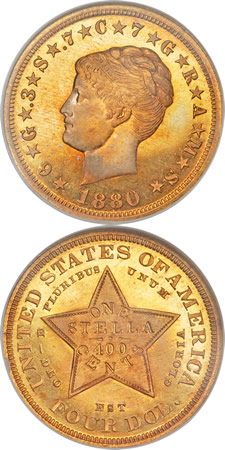
 - 1880 $4 Coiled Hair, Judd-1660, Pollock-1860, Low R.7, PR67 NGC. CAC. The 1880 Coiled Hair stella is, in no uncertain terms, an extraordinary issue and one of the great treasures in United States numismatics. It is the rarest date in a series renowned for remarkably low production totals across the board. In addition to the issue's fascinating history, this particular representative's outstanding preservation and corresponding high technical grade undoubtedly make it one of the most desirable and important stellas available to collectors. Most recently, a comparably graded example fetched over $2.5 million at auction in 2013, and we would not be surprised if the present coin realized a similar price.
John A. KassonIn some respects the origin of the four dollar gold stella parallels the personal history and interests of one of its originators, Congressman John A. Kasson (1822-1910). Born in Charlotte, Vermont, Kasson graduated from the University of Vermont at Burlington with a degree in law. After being admitted to the bar and practicing in St. Louis, Missouri, he moved to Des Moines, Iowa, where he served as chairman of the Republican state central committee from 1858 to 1860. Kasson was subsequently appointed by President Lincoln to serve as First Assistant Postmaster General under the direction of Montgomery Blair in 1861. In 1862, Kasson represented the United States at an international convention in Paris dedicated to the reform of international postal relations. He argued that postal systems varied too greatly by country, resulting in inefficient complexities, and thus needed to be regulated. In effect, he called for an international postal standard.
This necessity for international uniformity and standardization is exactly what Kasson had in mind in 1879 while serving as Envoy Extraordinary and Minister Plenipotentiary to Austria-Hungary. In that year, Kasson, with the aid of Dr. William Wheeler Hubbell, outlined a plan for the establishment of a four dollar metric gold coin (90% gold and silver composition, 10% copper) to be used for international trade. The stella, so-named after the pentagonal star gracing its reverse, would be easily exchangeable with the British sovereign, French 20 franc, Italian 20 lire, and Austrian 8 florin, among other foreign denominations. Kasson's suggestion was apparently well-received by members of the Committee on Coinage, Weights, and Measures -- at first. The limitations of the odd denomination, however, would become apparent in due time.
Producing the Coins: Charles E. Barber and George T. MorganCongressional approval for the proposed denomination heightened the rivalry between the American engraver
Charles E. Barber and English engraver George T. Morgan, suitably reflecting the international flavor of the four dollar coin. For years
Charles Barber, the son of Chief Engraver
William Barber (1807-1879), worked as an assistant engraver at the Philadelphia Mint with the expectation that one day he would succeed his father. However, in 1876 the Barber dynasty came under threat. In that year Mint Director H.R. Linderman hired Morgan, then working at the London Mint, to assist the overworked -- and in Charles' case, arguably underqualified -- Barbers. Morgan had an impressive pedigree and obvious talent. He quickly gained recognition for his artistic abilities, and in 1878 a slightly modified version of his Liberty and eagle design was chosen for the Bland dollar, widely known and collected today as the
Morgan dollar.
In 1879, after Congress approved Kasson and Hubbell's proposal for the four dollar international trade coin,
Charles Barber and George Morgan were asked to submit obverse designs for the new stellas. This is understandable given that
William Barber had recently died in August 1879, and both
Charles Barber and Morgan were being considered as possible replacements. Additionally, Mint officials' habitual desire for acquiring patterns likely influenced their decision to have both Barber and Morgan be involved in the production process. Unlike much of Barber's other work, his Flowing hair design was critically acclaimed, and it was adopted in the fall of 1879.
Mintage and PopulationA small number of four dollar stellas was struck using
Charles Barber's Flowing Hair design and distributed to Congressmen. Perhaps 425 Flowing Hair representatives were manufactured with the 1879 date. The exact mintage is unknown and could be as large as 725 coins according to Jeff Garrett and Ron Guth (2006). The coins were delivered on an as-needed basis: 25 coins in January 1880 (struck either in late 1879 or early 1880), 100 coins in March 1880, 150 coins in May 1880, and another 150 coins in November 1880. Furthermore, there is much confusion as to the existence of any so-called "original" coins made up of Hubbell's goloid composition. As of yet, only two examples with the Goloid composition have been scientifically tested.
Even less is known about the other issues in the series. USPatterns.com estimates that 12 to 15 1879 Coiled Hair stellas, 20 1880 Flowing Hair Stellas, and just 10 1880 Coiled Hair stellas are extant. It is probable that the production of the rare stella varieties was purely for numismatic purposes, but the actual circumstances of their production remain a mystery.
The 1880 Coiled Hair stella is the rarest of the four variants in the series. It was originally issued in three-coin sets along with a goloid dollar and metric dollar, both of which were also designed by Morgan. As mentioned above, only 10 (or fewer) examples are thought to exist from an original mintage that likely totaled between 10 and 20 pieces. Examples of the design were also struck in copper (Judd-1661) and aluminum (Judd-1662). Of the nine gold specimens that have been accounted for (see roster below), Akers notes that five examples exhibit frosted surfaces while the remaining four are brilliant. He explains:
"So this pattern, even more than J-1638 and J-1657, has an aura of mystery about it. If only ten pieces were struck, it is virtually certain that they were not struck at the same time because of the two different finishes. However, there does remain the possibility that the original ten were the frosted type and the brilliant specimens are from an additional quantity that was struck later in that year, or vice-versa."
For the time being, the documentation available to numismatic researchers is insufficient to either confirm or deny Akers' theory.
The 1880 Coiled Hair was the last of the four stella varieties to appear at auction. Its first appearance occurred in May 1906 as part of the Chapman Brothers' sale of the Harlan P. Smith Collection. Lot 1456 of that sale reads:
"1880 Stella or four dollars. The same design as the first Stella described in 1879. Head of Liberty with close plaited hair. Gold. Proof. Exceedingly rare; probably but two known in gold. See plate."
The lot realized $37, a strong price at the time. The second appearance of an 1880 Coiled Hair stella we have been able to trace was in B. Max Mehl's sale of the Albert Grinnell Collection, 37 years later. Mehl described lot 187 of that catalog as follows:
"1880 $4.00. Liberty head with coiled hair. A magnificent perfect brilliant proof with partly wire edge. Of excessive rarity. While according to mint records the number of specimens minted of this variety was about the same as that of the 1879 coiled hair and the 1880 flowing hair, but for some reason or other, there has been far fewer specimens of this coin offered in the past fifty years than that of any other variety. I do not recall whether or not I have ever offered at auction a complete set of these great coins and I do not recall having more than one, or two specimens at most, previously pass through my hands in my more than forty-two years of numismatic experience. I consider this coin as rare as almost any United States gold coin and it would not surprise me to see it reach the four-figure mark now. I do know that some of the greatest collections in this country do not possess this coin."
The price realized for this lot fell just short of Mehl's hoped-for four figures, at $850. Although we have no definitive evidence that the Grinnell coin is the present specimen, Mehl's description would fit this coin exactly, as far as it goes. This PR67 representative is the finest non-Cameo example at NGC and PCGS has failed to certify any coins finer than PR66 (1/15).
Denomination AbandonedIn the long run, the four dollar denomination had a few inherent flaws that lead to is demise. The stellas were more difficult to count than the larger double eagle coins for large transactions, and the four dollar denomination did not exactly match any of its European counterparts. Ultimately, the plan for an international gold coin was scrapped and the United States has still never struck a regular-issue coin intended for international exchange. As for the stellas, the series' low production totals and the denomination's fascinating history have made all variants widely sought-after for over a century, but none more so than the 1880 Coiled Hair coins.
Physical DescriptionThis magnificent Superb Gem exhibits fully detailed frosty design elements and impeccably preserved orange-gold surfaces with a few highlights of red and green. A partial wire rim shows in some areas. The deeply reflective fields display a few tiny lint marks near the border at star 7. The mysterious parallel striations always seen on coins of this denomination are clearly evident, causing present-day numismatists to theorize that they were struck on half eagle planchets that were filed down to the correct weight. Alternatively, the striations may have been caused in the drawing and rolling process. Eye appeal is terrific. As the finest-certified non-Cameo specimen in the population data this coin will be sought-after by pattern collectors and Registry Set enthusiasts alike. Housed in a former generation holder. Census: 1 in 67, 0 finer (2/15).
Roster of 1880 Coiled Hair Stellas
Delp Specimen. PR67 Cameo NGC. Winner Delp Collection (Stack's, 11/1972), lot 792, realized $35,000; Summer FPL (Stack's, 1997) offered as part of a four-piece set for $875,000; FUN Signature (Heritage, 1/2005), lot 30044, realized $977,500; Tacasyl Collection (Bonhams, 9/2013), lot 1011, realized $2,574,000.
DuPont Specimen. PR67 NGC. S. Hallock du Pont Collection (Sotheby's, 9/1982), lot 252, part of a four-piece set of stellas with the coins offered in individual lots, realized $102,300; Chicago Sale (Superior, 8/1991), lot 707, realized $440,000. The present coin.
Trompeter Specimen. Gem Brilliant Proof. Will Neil Collection (B. Max Mehl, 6/1947), lot 2605, sold as part of a set for $3,850; Grant Pierce; 1976
ANA (Stack's, 8/1976), lot 2920, sold as part of a set for $225,000; Western Collection (Stack's, 12/1981), lot 1139, realized $135,000; Ed Trompeter Collection (Superior, 2/1992), lot 136, realized $264,000; Orlando Sale (Superior, 8/1992), lot 599; 60th Anniversary Sale (Stack's, 10/1995), lot 1548, realized $308,000.
Eliasberg Specimen. PR65. Louis E. Eliasberg, Sr.; Louis E. Eliasberg, Jr.; United States Gold Coin Collection (Bowers and Ruddy, 10/1982), lot 319, realized $99,000; Holecek Family Trust (Stack's, 10/2000), lot 1625.
Memorable Specimen. PR64 NGC. Memorable Collection (Numismatic Gallery, 3/1948), lot 282; Public Auction Sale (Stack's, 3/1999), lot 136; Rarities Sale (Bowers and Merena, 1/2000), lot 352.
Kern Specimen. PR62 NGC. Golden Jubilee Sale (B. Max Mehl, 5/1950), lot 245, sold as part of a set for $4,100; Amon Carter, Sr.; Amon Carter, Jr.; Carter Family Collection (Stack's, 1/1984), lot 634, realized $72,250; Richmond Collection (David Lawrence, 7/2004), lot 1306; Santa Clara Sale (Superior, 7/2005), lot 425, realized $618,125; FUN Signature (Heritage, 1/2009), lot 4035, realized $575,000; Los Angeles Signature (Heritage, 7/2009), lot 1246, realized $546,250.
Davies Specimen. PR61 NGC. Davies-Niewoehner Collections (Paramount, 2/1975), lot 547, realized $67,500; Bowers and Ruddy Rare Coin Review #26, p. 64; FUN Signature (Heritage, 1/2000), lot 7519; Robert Swan & Rod Sweet Collections (Bowers and Merena, 3/2004), lot 2620.
Dallas Bank. Impaired Proof. Dallas Bank Collection (Sotheby's and Stack's, 10/2000), lot 363.
Lilly Specimen. PR64. Josiah K. Lilly; National Numismatic Collection at the Smithsonian Institution, grade per Garrett and Guth.
Additional AppearancesProof. H.P. Smith Collection (S.H. & H. Chapman, 5/1906), lot 1456, part of a three-piece Goloid set, with the coins offered in individual lots.
Proof. Dewitt Smith; sold to Virgil Brand in 1908, Brand Journal number 46965.
Proof. Edgar Adams; sold to Virgil Brand in 1911, Brand Journal number 57094.
Proof. F.C.C Boyd; sold to Virgil Brand in 1921, Brand Journal number 105730.
Proof. Albert A. Grinnell Collection (B. Max Mehl, 6/1943), lot 187; Fred E. Olsen Collection (B. Max Mehl, 11/1944), lot 621, part of a four-piece set of stellas with the coins offered in individual lots.
Proof. King Farouk; Palace Collections of Egypt (Sotheby's, 2/1954), lot 323, purchased by Baldwin.
Proof. Public Auction Sale (Kreisberg-Schulman, 2/1961), lot 1150, part of a four-piece set of stellas.
Proof. Golden Sale of the Century, Part II (Kreisberg-Schulman, 1/1963), lot 1940, part of a four-piece set of stellas, with the coins offered individually.










 Posted 04/24/2015 5:04 pm


