| Author |
 Replies: 14 / Views: 1,630 Replies: 14 / Views: 1,630 |
|
|
Valued Member
United States
356 Posts |
I saw a recent post where slabbing of a coin was not seen as ideal. I agree. However, I store my coins in plastic containers sealed, then put in my display case with non toxic silica. Occasionally a guest will ask to handle the coin; I know I have at times. Is that bad for the coins? I do not want to destroy history and ruin my coins by handling them, albeit it is rare. Thoughts?
|
|
|
|
Pillar of the Community
United States
7067 Posts |
Coins are meant to be handled...by clean, dry hands. Your guests have the right idea. I suspect this is fine.
|
|
Valued Member
United States
61 Posts |
My thoughts are if they've made it to you after 1500-2000 years, your hands probably won't do any damage
|
|
Moderator
 Australia
17005 Posts |
In one sense, ancient coins are more durable than modern coins. They survived being in circulation before being buried for over a thousand years, dug up again, and cleaned; there's not much you can do to it that's worse than that, without actually destroying or deliberately damaging it. They're usually quite solid, so they can put up with being tossed around and passed hand hand to hand much more than a modern coin would. There's also typically no "mint lustre" to have to worry about protecting.
In another sense they can be more fragile. Metal tends to become more brittle with age - a process known as "crystallization" - so a knock or drop that would make a modern coin just bounce, dent or deform could shatter an ancient one. I have a small silver hemiobol from Selinus that I'd taken out for display at a coin club meeting; it broke apart on me as I tried to put it back into the flip.
My recommendation: so long as the table, bench or whatever surface you've got underneath the coins is well padded (a big fluffy towel should suffice), go ahead and handle your coins, and let others handle them too. I'd even recommend not using gloves, as gloved hands are much more likely to drop things, especially for people not used to wearing them.
Don't say "infinitely" when you mean "very"; otherwise, you'll have no word left when you want to talk about something really infinite. - C. S. Lewis
|
|
Valued Member
United States
61 Posts |
I don't think slabbing is considered bad really, but people like to touch ancient coins just for the novelty.
slabbing and grading is a way to make sure you are buying what you think
|
|
Pillar of the Community
United Kingdom
3626 Posts |
Or in some cases, slabbing is a way to make you think you know what you are buying.
Caesar, handling ancients is absolutely fine. However, if your guest has just finished a bucket of KFC he should not mind if you asked him to wash his hands first!
|
|
Valued Member
 United States
356 Posts |
Thank you all for the feedback. The truth is most people I know are minimally interested. I do have some friends that express some interest. I make them take their shoes off when entering my home, so yes they will have clean hands if they do request to touch the coin. Thanks all!
|
|
Pillar of the Community
Australia
1006 Posts |
I believe that post would have been in my thread lol. Frankly I understand the arguments for raw coins however I just feel better having a higher value coin securely protected from sliding and cabinet friction as well as the definitive grade helps with cataloging. Plus NGC images to me are rather nice.
|
|
Pillar of the Community
United Kingdom
3626 Posts |
My better coins are in quadrum cases and are protected by foam. Loose coins are in trays that are covered in something like velvet (it's not real velvet).
|
|
Pillar of the Community
United States
7067 Posts |
Quote:
Or in some cases, slabbing is a way to make you think you know what you are buying. Exactly, Pish. Consider the following coin, listed in an e-auction by a major firm last October: 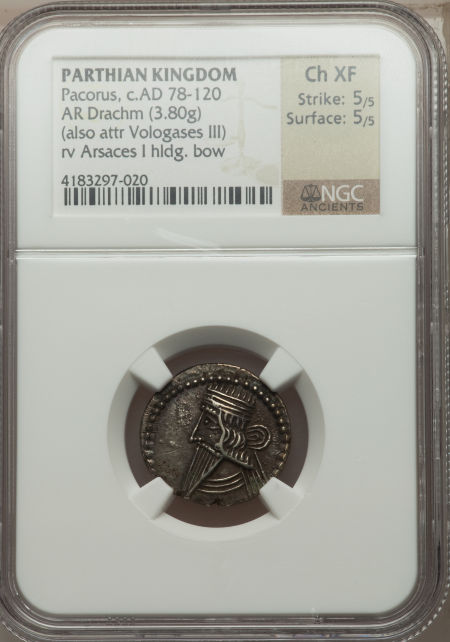 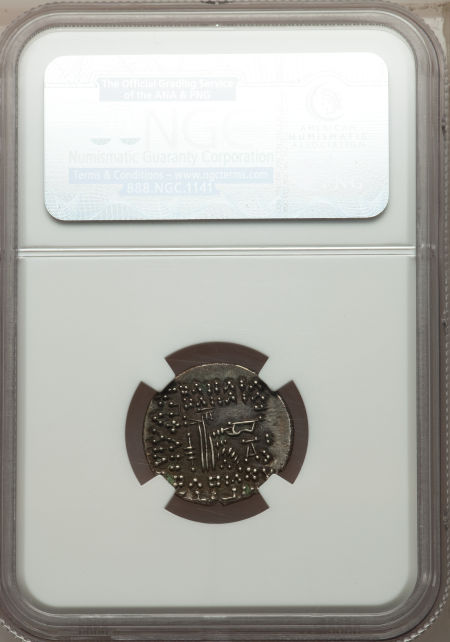 The NGC-slabbed coin was listed as a very common Sellwood 78 drachm (Vologases III, more recently reattributed as Pacorus). Prior to the closing of the auction, it was bringing in bids you would expect for that common type...$40, $50, or thereabouts. The thing is, this is not a Sellwood 78 but rather a much, much, much, rarer - and similar-looking - Sellwood 83 (Unknown King), easily worth more than $1,000. Here's one sold through CNG for $1,450: http://cngcoins.com/Coin.aspx?CoinID=224658I thought I had it made since early bidding indicated that no one knew what the coin really was. Unfortunately for me, on the last day of the auction (Oct 16th - alas, a date that will live in infamy for me), in the final minute for that lot, it became very clear that some other Parthian collector was hip to what the coin was. People watching live had to wonder about the crazy two individuals going at it, upping one another on bids, for what both NGC and the auction house listed as an extremely common type. The other bidder got it as I stopped bidding at a certain point, dashing my dreams of getting this rarity for the price of a common Sellwood 78. Long story, and off-topic (sorry, caesar77), but prompted by Pish's wise observation. Granted, NGC focuses on grading, not attribution. Still, that this one got past them AND the respected auction house, still amazes me... |
|
Valued Member
United States
61 Posts |
Good point and example there.
I'd reword my statement if I could.
|
|
Pillar of the Community
1121 Posts |
Edited by Topcat7
04/30/2015 12:45 am
|
|
Pillar of the Community
United Kingdom
856 Posts |
I echo most of the sentient here. My coins are modern. A mere 350+ years old. But they have survived this far being handled and I doubt a careful inspection by me or a friend will hurt.
Heck, one of my coins I tracked back to an auction in 1911, so it's been in collections longer than that. Probably being admired by the collector's friends after dinner and having cigar smoke and port fumes breathed over it!
Where I differ is on the TPGS side. I'm not much in favour of it myself. Partly because I store my coins raw, so it's a nuisance, though I admit that's personal preference.
But the main things are you still can't really see the edges of slabbed coins. And my experience is that attribution can be quite inaccurate and doesn't include the specialist cataloguing numbers used by most collectors of the series I specialise in.
But my main gripe is that I consider the collector provenance for my coins important. Here in the UK, it's not unusual to receive a coin with the 'tickets' (little paper disks with details of the coin) from earlier collections. But in all instances I know where a coin has been slabbed the ticket has been discarded or lost.
I also know of at least one instance where the tell-tale red wax that used to be used to make casts of coins for photography in the first part of the last century was carefully removed by the TPGS. Thus removing an opportunity to confirm the coin had been illustrated in an auction catalogue during a particular period and the possibility of tracing its provenance (and confirming authenticity). I'd have minded less if the TPGS in question hadn't used this vandalism as advertising for its 'conservation' service!!
.
|
|
Pillar of the Community
United States
7067 Posts |
Quote:
Sold $50 You're right, TC, that that's another misattributed Parthian, but that particular mistake doesn't have the cost implications of the example I cited (since it's not Sellwood's Unknown King). The coin you link to was erroneously sold as a Mithradates V (Sellwood 82), but is in fact a Volo III/Pacorus. So even though misidentified, it's still only worth about what it sold for ($50). If it had been an Unknown King, the buyer would have made an immediate profit of more than a thousand dollars... Edited by Kamnaskires
04/30/2015 09:36 am
|
|
Pillar of the Community
1121 Posts |
Thanks, Bob.
I suspected that it was 'misattributed' but because of my total lack of knowledge of the Parthian Period, I was going for the 'Unknown King' and the 'profit'.
Thanks for the information. One day when I have exhausted the Roman Empire, I may turn to the Parthian. They have interesting 'depictions' on their coins.
|
| |
Replies: 14 / Views: 1,630 |
|







 Posted 04/28/2015 9:18 pm





