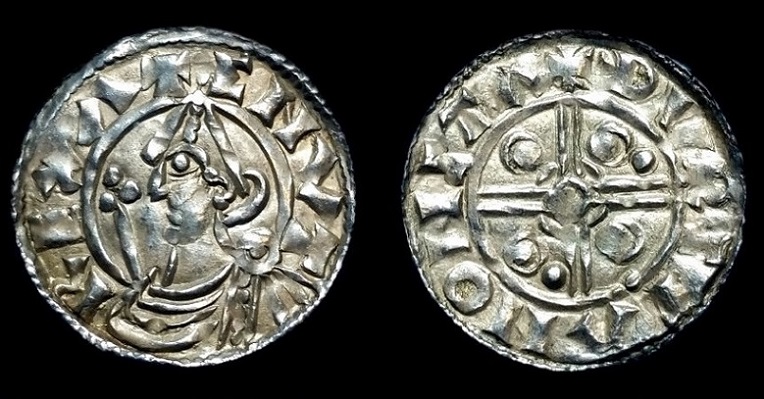
I am a sucker for European medieval coins, especially western European, so I had to have this coin at the price it was at. The style is rather crude and the strike isn't the best but the condition itself is nearly flawless. This actually happens to be my first post-Carolingian medieval French coin, after the split of the Frankish Empire into the kingdoms of West and East Francia, which later developed into France and Germany, respectively.
This coin was struck by Count Herbert of Maine (a region in northern France). I think this coin, not being struck in the name of the king at the time (Robert II of the Capetians), is a testament to the feudal, decentralized nature of France at the time, when many local counts and dukes pretty much had free reign to do what they pleased as long as they recognized the king.
Herbert's date of birth is not recorded but he was the son of the previous Count of Maine, Hugh III, and succeeded his father in 1017. Herbert often participated in the various wars between counts at this time, solidifying his reputation as a great warrior, and he earned his nickname "Wakedog" from his conflicts with the Angevins.
One of Herbert's biggest enemies was Avesgaud, Bishop of Le Mans. They often fought one another and during the course of their conflict Avesgaud excommunicated Herbert. Shortly after the excommunication was lifted and peace was established between them, but this hardly lasted, and later one of Avesgaud's castles was besieged and destroyed.
Herbert also personally fought against his former feudal lord and the Count of Anjou, Fulk III Nerra, who was able to capture Herbert through deception and consequently take over the County of Maine. Herbert was released after much humiliation at the hands of Count Fulk and only given back some of his former lands.
Herbert died in 1035.
(I couldn't find anything else about him online unfortunately)
Herbert I, Count of Maine, Kingdom of FranceAR denier
Obv: +COMES CENOMANIS ("Count of Maine"), monogram of Herbert within circle
Rev: +SIGNVM DEI VIVI ("sign of the living God"), cross with pellets and letters in corners, all within circle
Mint: Le Mans (struck 1017-1035 AD)
Ref: B., 170; P.A., 1548; Legros, 568; D., 398

Europe circa 1000 AD:

County of Maine:

These soldiers aren't French but here's how they more-or-less would have looked like:











 Posted 04/29/2015 2:39 pm