| Author |
 Replies: 10 / Views: 1,813 Replies: 10 / Views: 1,813 |
|
|
Pillar of the Community
United States
1781 Posts |
I posted this under Australian errors as it related to a topic there but it may be of interest here too ... Not all indents of the configuration you show are from Elliptical Clips. Some are from Shear Clip Tabs. 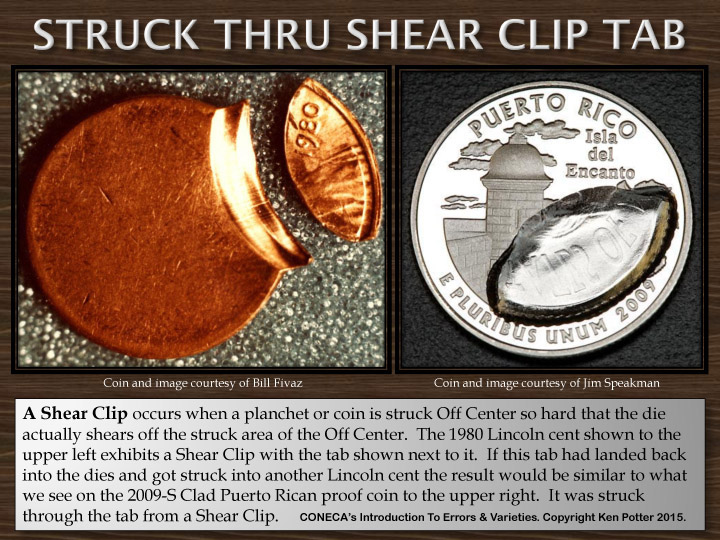 Edited by koinpro
05/02/2015 4:49 pm
|
|
|
|
Bedrock of the Community
United States
62064 Posts |
That does look interesting. But is that incuse into the coin on the Porto Rico coin? It seems it would have to be as it is mirrored and if it were struck into the coin and it remained it would be not mirrored and have the new design on this area. This subject might be covered in this thread Of Mike Diamond's : Stiff collar strike: http://www.error-ref.com/stiff-collar-strike/ |
|
Pillar of the Community
 United States
1781 Posts |
Coop,
You are correct. What is on the PR coin is the indent from a struck tab. The "Tab" is gone.
|
|
Pillar of the Community
United States
4809 Posts |
Cool!  |
|
Pillar of the Community
United States
2752 Posts |
A brockage from a struck tab of the kind illustrated by the 1980 cent would be unlikely to show a strong impression of the design rim and reeding. It could be another kind of strike clip, one generated by an off-center planchet being sheared in two between the hammer die and a stiff, unyielding collar. Or this could be a brockage from an elliptical clip planchet that had settled against the collar for its initial strike.
There are many kinds of strike clips ("shear clips"), representing a number of different etiologies.
By the way, although recent business strikes are struck with inverted dies, most proofs are still struck with the conventional die setup of obverse die as hammer die. That's what I'm assuming was the case with this proof quarter
Error coin writer and researcher.
Edited by mikediamond
05/04/2015 10:19 am
|
|
Pillar of the Community
United States
1781 Posts |
Mike, the cent is shown for illustrative purposes. An elliptical clip planchet even getting into the press room where proofs are made is highly unlikely.
What would make you feel that a brockage from a struck tab of the kind illustrated by the 1980 cent would be unlikely to show a strong impression of the design rim and reeding (assuming the coin had reeding -- which we know it didn't). I see no reason for there not to be a similar effect if Fivaz's "tab" was struck into another cent. I would have to assume his coin was the result of a stiff collar.
Edited by koinpro
05/05/2015 01:01 am
|
|
Pillar of the Community
United States
2752 Posts |
Fivaz' cent, and others like it, are not caused by a stiff collar. This type of strike clip is simply the result of the coin metal being stretched to the breaking point. Instead of being sheared off, the tab (or tongue, as I refer to it) is pinched off. Off-center, uniface strikes, whether pinched off or not, generally do not show a design rim on the die-struck face and definitely do not show reeding.
Error coin writer and researcher.
|
|
Pillar of the Community
United States
1781 Posts |
Mike, I'm going to have to disagree. I see no evidence that Fivaz's "tab" would not have had reeding if it was a reeded coin. I also see no difference in what the end result is between a tab sheared off with the aid of a stiff collar or otherwise. In this discussion I see the question of a stiff collar as being moot-- the result is the same and without actually being there and video taping and playing it back in slow motion we will never know if a stiff collar was involved or not. As I see it, an elliptical planchet making it all the way into the press room where proof coins are struck is highly unlikely. This leaves us with a very high likelihood of a struck through tab. It is during the striking process where this would most likely occur since it is all automated for the cents through dollars.
Edited by koinpro
05/05/2015 01:04 am
|
|
Pillar of the Community
United States
2752 Posts |
Ken, I've already indicated that a strike clip produced as the result of a stiff collar will show a strong design rim and may show well-developed reeding. I was simply objecting to the idea of the brockage-maker being derived from the snapped-off tab of an off-center, uniface strike, like the 1980 cent. You might not be interested in the distinctions between the several types of strike clips, but I think they're important. There's a big difference between a coin that is torn apart by vertical shear forces, one torn apart by horizontal shear forces, and one torn apart by tensile forces. These differences are important enough that I plan to devote a future Collector's Clearinghouse column to them.
Error coin writer and researcher.
Edited by mikediamond
05/05/2015 12:38 pm
|
|
Pillar of the Community
United States
3644 Posts |
Following these debate/discussions leave me realizing how much more I have to learn yet-especially on this particular subject-very interesting thanks!
Edited by Slamnbass
05/05/2015 12:40 pm
|
|
Pillar of the Community
United States
1781 Posts |
Mike, I'm not discounting the fact that the actions are somewhat different, just pointing out that the image of the cent is used for illustrative purposes to show viewers what a Shear Clip & Tab is. Many don't know what one is. When used in this context, the idiosyncrasies you point out only seem to cloud the issue in my opinion.
Edited by koinpro
05/05/2015 1:50 pm
|
| |
Replies: 10 / Views: 1,813 |
|







 Posted 05/02/2015 6:09 pm





