| Author |
 Replies: 89 / Views: 32,771 Replies: 89 / Views: 32,771 |
|
|
|
Moderator
 Australia
17006 Posts |
Quote:
The liquid around the buff is turning blue? Haha this is weird. It's not "weird", it's chemistry. The acetic acid reacts with the metal, partially dissolving it. The resultant acetate salts are coloured. Copper acetate is blue; nickel acetate is green. Cupronickel (made of 75% copper, 25% nickel) gives a mostly-blue solution. Don't say "infinitely" when you mean "very"; otherwise, you'll have no word left when you want to talk about something really infinite. - C. S. Lewis
|
|
Pillar of the Community
 United States
6478 Posts |
Very interesting info. Thank you.
|
|
Pillar of the Community
United States
4963 Posts |
After reading this thread a few hours ago, I searched through 2 rolls of buffs for dateless ones, to find 2 in the second roll. One has lots of patina and an S mintmark, the mintmark area on the other is worn smooth. The MM-less one, based on ribbon and hair detail, seems to be a 1920 (thanks, carnold774), but I'll try anyway. Not 100% sure. Will post before pics in the morning, when I find a cord to connect my phone. Hopefully I can pull some dates off.
|
|
Pillar of the Community
United States
4963 Posts |
Anyway, how does this process pull dates off? I would assume that the date digit area is less dense, being less compressed during striking, and corrodes in the acid more easily. Is this correct?
|
|
Bedrock of the Community
Australia
21792 Posts |
Just thinkin'.......
The numerals in the date area have less compressed metal than the area next to them.
Could the variation in metal compression be revealed by UV or polarized light, to show up variations in metallic crystal structure?
Could X-Ray testing be used, as with identifying metal flaws in aircraft components?
|
|
Pillar of the Community
United States
4963 Posts |
OK, I found the cord, so here are the before pics. I just put the coins in. By the way, I meant to say that one had a D MM, not S (the one on the right). 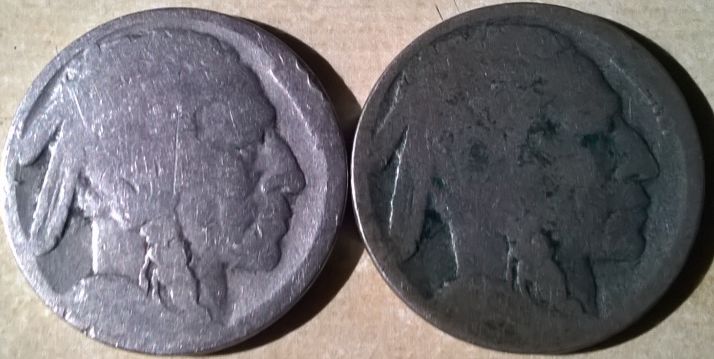 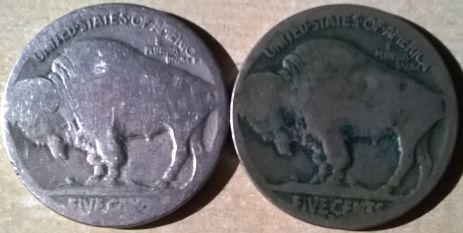 Edited by Numisma
05/17/2015 1:47 pm
|
|
Pillar of the Community
United States
6478 Posts |
It either says 1915 or 1913 on my coin.
|
|
Pillar of the Community
 United States
5828 Posts |
Post the pics here and the members more familiar with worn buff dates can tell. But make sure that you take the pic at the right angle so we can see the date lol
|
|
Pillar of the Community
United States
4963 Posts |
My 2 have been in for about 8 hours now and still no dates, just a few bubbles on one coin.  |
|
Valued Member
United States
415 Posts |
Yeah, telling the difference between a 13 and a 15 on an acid dated buff can be tricky at times. Definitely post a pic though and we should be able to help you out.
|
|
Pillar of the Community
United States
6478 Posts |
Ok. Let me take it out of the acid.
|
|
Pillar of the Community
United States
6478 Posts |
More acid? 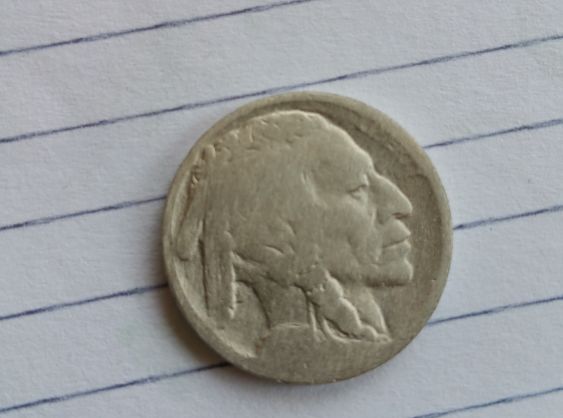 |
|
Valued Member
United States
415 Posts |
I can't tell if that pic needs to be taken at a better angle under better lighting, or if it needs more acid. It's REALLY hard to photograph an acid-dated buff and be able to clearly see the date. I have had the best results by placing the coin pretty much directly under the light source and taking the picture at an angle instead holding the camera right over it.
If I had to fashion a guess from that pic I'd say 1913, but it's just too hard to tell for sure. Try to snap a few more pics in the manner I suggested and see if one comes out a bit better.
|
|
Moderator
Australia
17006 Posts |
Quote:
Anyway, how does this process pull dates off? I would assume that the date digit area is less dense, being less compressed during striking, and corrodes in the acid more easily. Is this correct? It's a little more complicated than that. We're talking here about the chemistry of acid-metal reactions combining with the physics of the microstructure of a piece of metallic alloy that has been struck between dies. Here's my take on what happens. When a coin is struck, the metal "flows" in a generally outwards direction, following the shape of the die as it presses down. This aligns and stretches the crystals within the metal in that direction of flow. If the flow encounters an obstacle (such as a valley in the die the metal has to flow down into) the crystals follow the contours of the valley. A "valley" in a die, of course, creates a raised feature (such as the date numerals) on the coin itself. This means that, on a worn coin, in the areas where the transition between the field and the numeral used to be, the crystals are not aligned in the same direction as they are elsewhere on the coin. It is this different crystal alignment that reacts slightly faster to the acid. Thus, after acid-treatment, the transition zone becomes an etched pit between the two flat areas - which remain at the same height as each other. It is only the corrosion pit in between the two zones that causes the date to stand out. Perhaps this picture helps explains it.  I have seen this exact same effect happen on silver coins. I was recently attempting to re-tone a silver coin where one side had been ground completely flat. I assumed all trace of the old coin would have been erased, but I found that on exposure to hydrogen sulfide gas, the now-vanished design of the coin re-appeared in outline as a toning pattern, like the ghost of the old coin coming back to haunt me. One could, in theory, use this same technique to reveal a date on a worn silver coin, except you'd need to strip away the "natural" toning first, and then you'd have to protect the re-toned surface from further toning. Don't say "infinitely" when you mean "very"; otherwise, you'll have no word left when you want to talk about something really infinite. - C. S. Lewis
|
|
Pillar of the Community
United States
6478 Posts |
My dad just left with his camera phone so I won't be able to take pics for a while. I might see him tomorrow or Tuesday.
|
| |
Replies: 89 / Views: 32,771 |





 First Page
 Previous Page


 Posted 05/17/2015 12:45 am





