| Author |
 Replies: 10 / Views: 2,056 Replies: 10 / Views: 2,056 |
|
|
Pillar of the Community
Netherlands
847 Posts |
Hello all, Ive got these 2 coins which were determined as on the small note you can see with the picture. I am not good in determine chinese coins. SO I was wondering if someone can confirm these descriptions... And if these are fairly common or rare types? They are only struck on one side.. 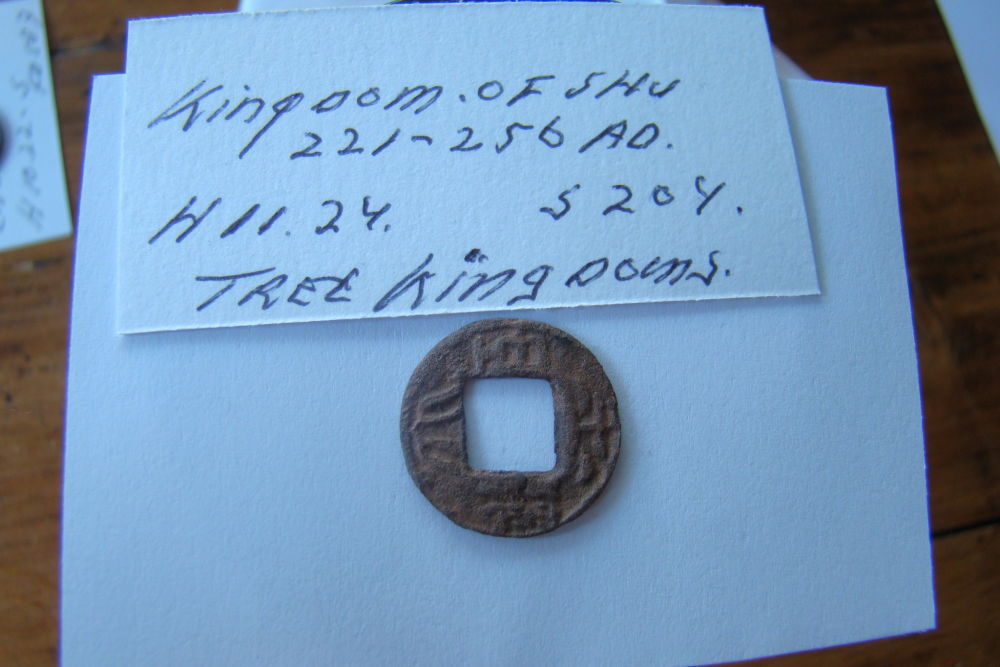 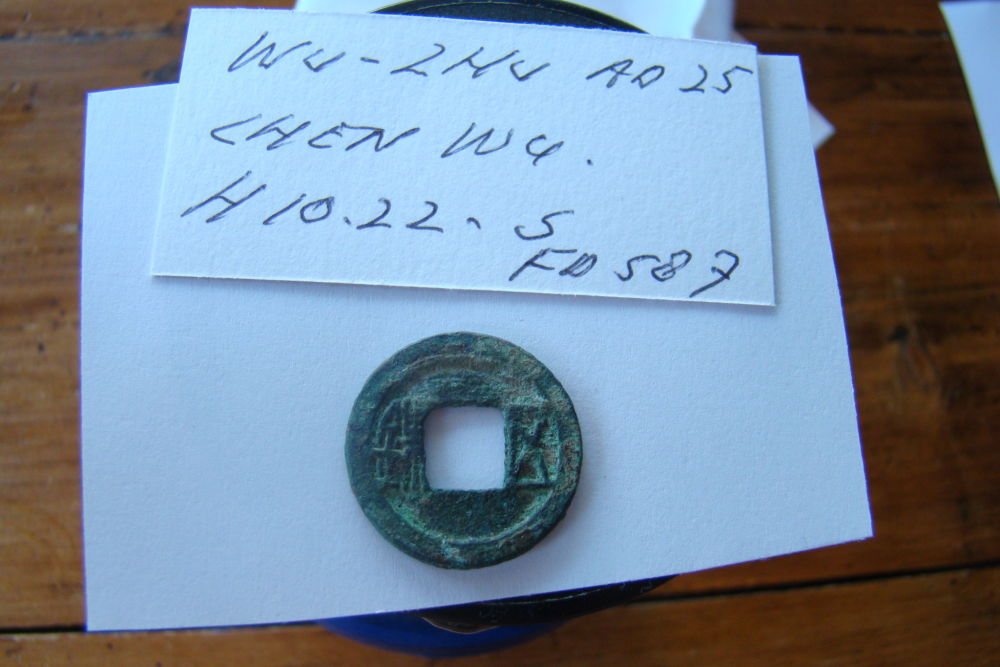 |
|
|
|
Moderator
 Australia
17006 Posts |
The top one seems correctly described to me. "H 11.24" is the number in the Hartill catalogue, which does not give specific values but a rarity scale and rough value guide. This coin is given a rarity value of 11 (where 1 is unique and 16 is super-abundant), rating it as "common" with an approximate value of $25 back in 2005 when the catalogue came out.
The second coin "H 10.22-5" indicates to me that the writer of the ID card was unable to attribute it to a specific type (either 10.22, 10.23, 10.24 or 10.25). It looks more like a 10.24 or 10.25 to me; the two are best differentiated by weight (10.24 weighs more than 3.7 grams, 10.25 weighs less). 10.25 is the most common (rating 14) while 10.24 is rated at 13, making it a $5 to $10 price coin.
Don't say "infinitely" when you mean "very"; otherwise, you'll have no word left when you want to talk about something really infinite. - C. S. Lewis
|
|
Pillar of the Community
 Netherlands
847 Posts |
amazing how you can determine these coins so fast!
Does it take along time if you are beginner in Chinese coins to learn how to determine them? Just with images?
|
|
Moderator
Australia
17006 Posts |
Well, I wouldn't have been able to ID them anywhere nearly as fast, if you hadn't already supplied the catalogue numbers.  As for IDing Chinese coins generally, it's just like any other coin series: I try to know enough general information about the series to know roughly where I need to go to look for further information. The Hartill catalogue is good in having pictures and clear descriptions that help differentiate the major types, and most of the minor varieties, so once you know roughly which period you should be looking at, playing match-the-pictures is relatively easy. The Jen katalogue put out by Krause is more user-friendly for beginners - or at least it would be, if there were fewer errors in it. Still, I find the guide in the back of Jen very handy as a one-stop-shop to search for the inscriptions on coins. Don't say "infinitely" when you mean "very"; otherwise, you'll have no word left when you want to talk about something really infinite. - C. S. Lewis
|
|
Pillar of the Community
Canada
695 Posts |
|
|
Pillar of the Community
Netherlands
847 Posts |
Thanks for this information. I have to see alot of them to know the comparisement between different periods. I have the krause from the past 400 years. But they are all just to much lookalike each other. And everything older then that I wouldn't find
|
|
Pillar of the Community
United States
6370 Posts |
The first one is a Tai Ping Bai Qien, cast by Emperor Fei of the Wu Dynasty from 256-257 AD. Is is a cash coin whose inscription states that this coin had a value of 100, likely 100 Wu Zhus. This was common during this period because of high inflation brought about by economic and political turmoil and fudiciary coinage. The most interesting thing about this coin is that the words "Tai Ping" refer to the reign title of the emperor (a common practice to have a lucky or auspicious title to accompany one's reign), and this coin is regarded as the first to do so. The practice of putting the reign title on the coinage First became consistently used at the beginning of the Northern Song Dynasty in 960 AD.
The second coin is indeed a Wu Zhu, but it is one of the last if not the last officially produced by a central governing authourity. This variety of Wu Zhu is usually attributed to the Sui Dynasty (589-618 AD), but other argue that is was cast under the Northern Wei in the sixth century AD). The fabric of the coin (the style of the rim in comparison to the characters) is the first to have a wide, flat rim the same height as the characters (like I said in your other thread), that became characteristic of most cast cash coins from thereafter. Because of this, I believe that the coin style had to be issued from a central authority (Sui dynasty unified China in 589 AD) that had great influence in the style of their coinage. The fabric seen on this Wu Zhu was used by the Tang Dynasty (who formed from the Sui in 618) in their Kai Yuan Tong Bao coinage.
|
|
Pillar of the Community
United States
6370 Posts |
The first one is worth about $50 while the second is worth about $5.
|
|
Pillar of the Community
Netherlands
847 Posts |
Dear sir,
I like the information you give about the coins very much! Really interesting about the iron coin and the history behind these 2 coins. I appreciate that!
Maybe a stupid question but all these coins with holes in it are from iron or copper. I can't find any that is in silver or gold. So these metals were or scarce? Or they used in some other kind of money instead of coins with holes. I know that the syncee bars are from silver but more from an later period.
|
|
Pillar of the Community
United States
6370 Posts |
Silver cash was never made for circulation. Very few of very few types (Kai Yuan Tong Baos is the only on to come to mind right now) were cast in silver or gold specifically for the imperial family and the highest-ranking government officials in commemoration for some important event, usually the birth of a son. There are silver and gold ingots that were traded as coins in ancient times (with a VERY large purchasing power), but these are obscenely rare and 90+% of all genuine examples are in Chinese museums.
|
|
Moderator
Australia
17006 Posts |
The Chinese and Greco-Western coinage systems were invented at almost the same time, but developed completely separately in almost every respect - including method of manufacture (cast versus struck) and metals used (precious versus base).
China did, of course, trade heavily in precious metals - but it never truly entered the monetary system in any form resembling "coinage". The merchant-made "sycee" and similar ingots were as close as they came. Chinese cash coins are exclusively brass/copper/bronze, or iron, or (in Southeast Asia) zinc or tin. Some extremely rare gold and silver cash coins have been found dating from the Kai Yuan period (Tang Dynasty), apparently genuinely made from the same moulds as normal bronze cash coins, but these seem to have been produced purely as "palace coins", novelties for giving away as imperial gifts, rather than as a normal component of the monetary system.
Don't say "infinitely" when you mean "very"; otherwise, you'll have no word left when you want to talk about something really infinite. - C. S. Lewis
|
| |
Replies: 10 / Views: 2,056 |
|










 Posted 06/07/2015 08:09 am


