| Author |
 Replies: 10 / Views: 1,207 Replies: 10 / Views: 1,207 |
|
|
New Member
United States
41 Posts |
Hi, I was looking at another post from this site about homestead quarter errors. A user had uploaded several different what could be errors or varieties, but got no comments back on this one. The one I have in mind is where there are die chips on the husks that cause leaves to look "bold" seen here (the picture shows the right-mid of the rev. --rotate it 90 degrees to the left to make it look normal): 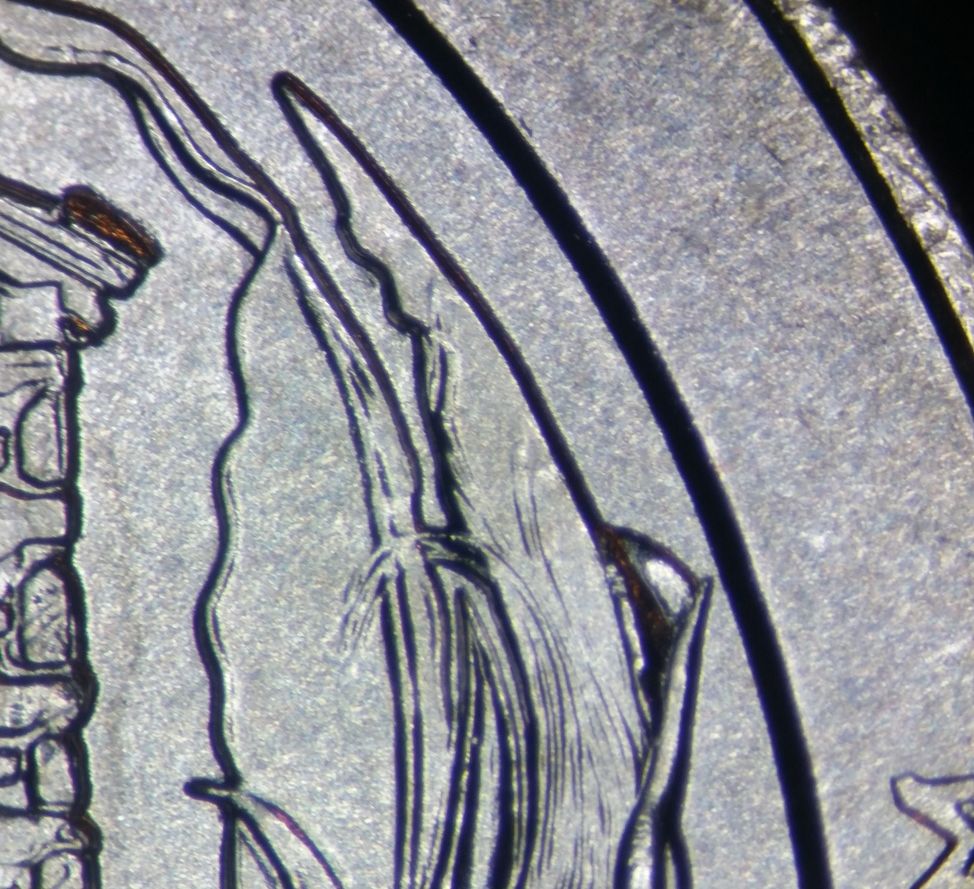 It looks fairly minor to me, but what do you guys think? Just an explanation on the above would be great but... if someone could briefly (or not, I don't care) explain the difference between a variety and an error, that would be great! I take it a variety doesn't NEED to be an error (it could come from large/small date change like in 1982 1 cent), but if it is an error, is it one that occurs frequently enough so that it can't be given "error" status (low occurrence rate yields high price, etc.), but it is still uncommon enough and the feature is non-negligible, so they have to make a distinction? |
|
|
|
Moderator
 United States
56855 Posts |
The quick answer to error or variety:Error is a one off and variety has many. John1  |
|
New Member
 United States
41 Posts |
Hi, thanks! Wouldn't that mean, though, that something like the 1955 true doubled die is not an error, as there are few true ones, but more than just one? Oh well... maybe it's just a literal variation, and that variation could be an error or a smaller date or a higher weight or a silver clad one (Bicentennial quarter for those last two). In any case, do you, or anyone else know about how common these "Bold husks" are? I bought three rolls and didn't get a single pump reflection and got one questionable window DDR...but I did get a good number of these, most of them being more pronounced than the image I borrowed. I also got (a few) very bizarre varieties within the cabin structure walls. Not just the being wispy, but having one wisp go from one side to the cabin, through the window, out the window, and go to the other side, for instance. I haven't heard much about those either. Thanks for your tip |
|
New Member
United States
41 Posts |
Oh, did you mean that within a certain coin: if there is just one error to look for (1955 doubled die), then that is an error, whereas, in the Homestead quarter there are many errors to look for, so those errors are called varieties? That would make a lot of sense
|
|
Moderator
United States
56855 Posts |
Edited by John1
06/20/2015 07:51 am
|
|
Pillar of the Community
 United States
5828 Posts |
|
|
New Member
United States
41 Posts |
Ah, so an error would just be something like a clipped planchet or something like that, which doesn't occur (pretty much) more often in one year of one denomination more than any other?
Anyone know about the prevalence of the bold husks, too, by the way?
Thanks!
|
|
Bedrock of the Community
United States
62064 Posts |
See if this helps?  The question gets asked a lot and I though I would put the answer on the image. I know that some don't agree with my thinking, but I'm a variety purist. 3Edited by coop
06/20/2015 6:06 pm
|
|
Pillar of the Community
United States
2775 Posts |
Coop - I'm amazed how quick you come up with these explanations and illustrations. Helpful info that gets shared time and time again.
I'm a rookie and sure not an editor. The last sentence under Other Die Events. You say "were on a new die when first used."
I may be reading wrong, but should it read "were not on a new die when first used."
Just a thought, Thanks, Doug.
|
|
New Member
United States
41 Posts |
It seems to me a variety is a minting anomaly that occurs as a result of malfunctioning of, or on, the die itself (it is a direct result of the die that was in place), whereas an error is any minting anomaly that occurs as a result of the malfunctioning of the strike (it would have occurred, in theory, regardless of whatever die was in place).
It seems coin events would be any minting anomaly that occurs as a result of a properly functioning, yet or deteriorated or deteriorating die (it is the indirect result of the die that was in place -- due to too much function, not malfunction).
I hope I understood your take pretty well. The last sentence is confusing, though.
I don't think you need to say "were not", but I believe you want 'as' to mean 'because', so you need a comma before it.
I think it should read (I am trying to keep most of your own words), "They are not the results of one time events, nor are they varieties, as the (anomalies/defects/abnormalities) are due to (degradation/deterioration/exhaustion) of the die from the time of its first use.
I like the explanation a lot, though! Yes it did help, thank you!
Edited by JayCameron
06/20/2015 5:51 pm
|
|
Bedrock of the Community
United States
62064 Posts |
Fixed it. Thanks for pointing that out.
|
| |
Replies: 10 / Views: 1,207 |
|










 Posted 06/20/2015 07:18 am


