Quote:
On October 29, 2007, collector Michael Tremonti created a lot of excitement in the coin market by announcing that he had discovered a 1969-S Doubled Die Obverse cent in an unsearched roll of Lincoln cents. The coin he found was in high mint state condition. This coin was immediately submitted to PCGS in a Brinks Armored truck, where it was assigned a grade of MS64 Red by PCGS. This same coin sold on January 09, 2008 at public auction for a record-breaking price of $126,500. Remarkable, Tremonti found a second example which is probably the PCGS MS63 Red graded example that sold in a Heritage Auction on March 27, 2009 for $86,250.
Part of this passage is incorrect. The correction and some details which have never been told are as follows.
Mike Tremonti of Michigan found an example in an unsearched roll of 1969-S cents on October 3, 2007. He purchased the roll along with a lot of other rolls that had been sold to Abbott's Coins of Birmingham, Michigan.
This is the ONLY specimen he ever found.I authenticated it as genuine and sent it to PCGS for certification via Brinks Armored truck (if I remember correctly, that cost $200 alone).
The Brinks pick-up was almost a disaster as I was given the all-clear for the pick-up by the New York office and on the morning of the pick-up I was told what time to meet the driver at my credit union in Warren, Michigan.
As it turns out, Brinks drivers are not supposed to wait around anywhere nor are they supposed to meet private individuals.
So when the driver arrived at my credit union 45 minutes early and learned that he was not picking up directly from a business or the credit union, he called my cell phone and started reading me the riot act and almost left without picking up the coin. I managed to talk him down, rightly blaming the misunderstanding on the NY office.
Contrary to what PCGS states, Tremonti only found one 1969-S doubled die.
Two additional specimens, (often reported as just one, as only one was reported upon by me in my
Coin World article and only one was initially certified), where found by a fellow by the name of Bowman (first name withheld to maintain his anonymity) of Michigan in December of 2007 in Birmingham Coin & Jewelry, a shop just two blocks away from the shop where Tremonti found his.
Both of Bowman's coins were eventually graded MS63 -- though I would not have graded on of them higher than MS62. One was certified by PCGS and if I remember correctly, the other was certified by NGC, the later coin possibly crossed over to PCGS at a later date.
The discovery of the later two varieties drove the price of the 1969-S cents down a bit for a time as many insiders then knew that three specimens had been found in Michigan within less than three months of each other. Speculation suggested that there may have been more to be found -- which never occurred.
So how did three of the coins end up in two different coin shops located just blocks from one another? My understanding is that an elderly fellow that was selling off rolls was hoping to get more for them than he was paid for the first batch and decided to try the second shop.
Nobody knows if he actually did get more or if he still has more rolls. There is a presumption that he sold off all his rolls but who knows.
In regard to the 1969-S doubled die cents being in later die states, the interesting part is that all I have seen (four in hand so far) are in the same die state. All appear to show extremely sharp doubling consistent with an EDS. What does throw one off is the amount of die degradation present around the date. When I look at IN GOD WE TRUST I see an essentially EDS coin with hints of die flow lines just starting to appear -- what we might see after just a few thousand or less strikes -- but when I look at the date I see fields that seem to suggest MDS or later.
This presents an enigma but I'm going to crawl out on a limb and suggest that all the 1969-S cents are in EDS struck from a die that was unevenly hardened with some premature die fatigue occurring around the date.
With that said, I have only seen four of these coins in hand but I can say that all four were all of then same die state as each other.
I have seen photos of others but photos taken to enhance a coin often do not capture details such as the die degradation of the fields around the date which gets blasted out by the lighting.
.................... Click Images To Enlarge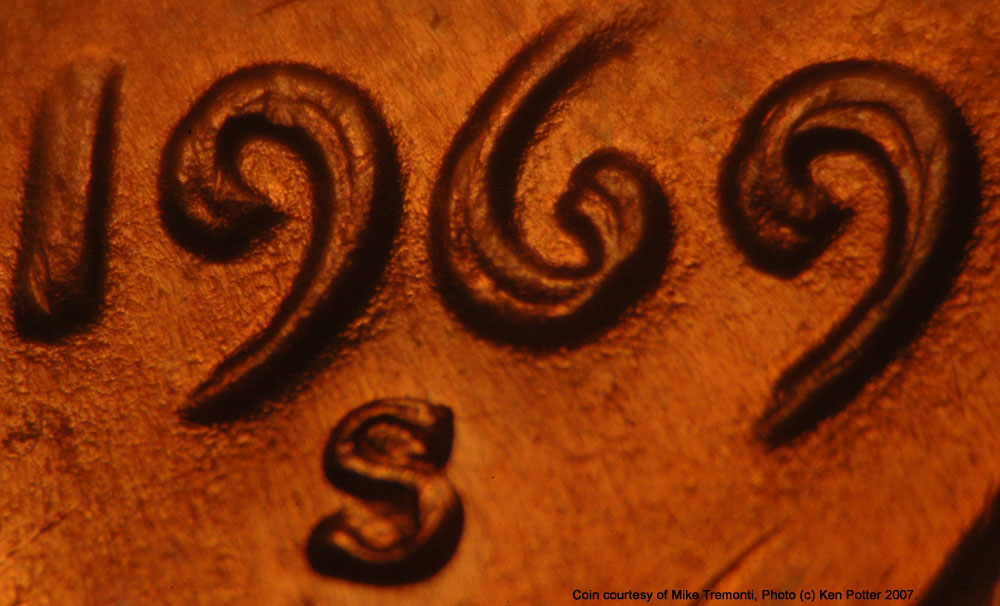
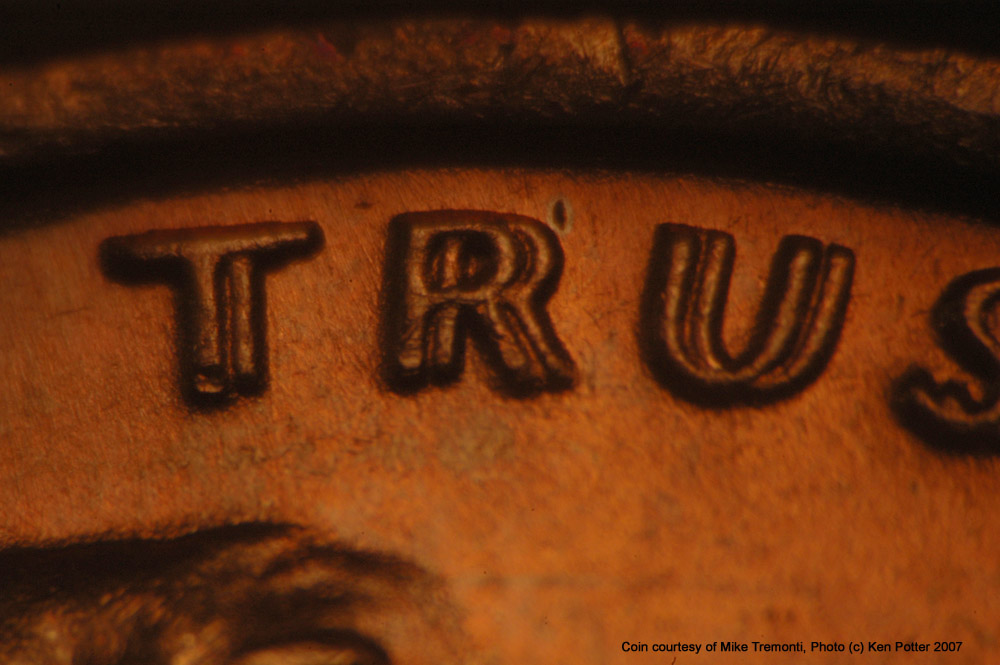 Below is the article I wrote for Coin World on the Tremonti specimen:
1969-S Doubled Die Found In BU Roll
by Ken Potter
Special To
Coin WorldOctober 10, 2007
Michael Tremonti of Michigan has just gone down in numismatic history as being one of a very small number of collectors to find a major 1969-S Doubled Die Obverse #1 cent! The variety continues to elude collectors with just 38 examples certified between the three major grading services that publish population reports.
Tremonti, who enjoys searching rolls of Lincoln cents for errors and varieties, said he has a way of buying more rolls than he has the time to search through. He tends to accumulate and then search as time permits. So on October 3 when he found some spare time, he sat down and began searching rolls looking for varieties. He figured it'd be just like any other day of searching, finding a few Repunched Mintmarks and maybe some typical doubled dies. He had no idea that he was about to hit pay dirt in a very big way within the very first roll of cents that he picked up.
Upon opening the first of two uncirculated rolls of 1969-S cents that was in his pile, he searched through over more than half the roll finding exactly what he has found so many times before in rolls of 1969-Ss - nothing except examples of
Strike Doubling. He then flipped over the final 15 or 20 coins heads-up and immediately spotted what he knew had to be a 1969-S doubled die. He was able to spot it with the naked eye and said he knew it was a very valuable coin but didn't know how much its current value was. He then decided to call me knowing that I write a column for
Coin World on the subject of die varieties and was local. He figured he might be able to get some idea of value and maybe coax me out of the office long enough to examine his coin.
Having never met, I unaware of his level of expertise, so I just assumed that his find was one of the exceedingly common examples of
Strike Doubling found on this date. This date (along with the 1968-S and 1970-S cents) is the most notorious for this form of doubling damage occurring on Lincoln cents. I advised him of this but he shrugged it of as not being what he found. As I talked to him further he seemed to be knowledgeable with the subject. It seemed that for once there was a possibility that one of the folks making the common claim of finding a 1969-S doubled die cent might have actually hit the mark. As it turned out he lived just a few miles from where I am employed so I decided to meet with him to confirm his find after work the next day. Even though he sounded like he knew what he was talking about I was still prepared to pop my glass over an example of
Strike Doubling. To my surprise, what I beheld was a beautiful brilliant uncirculated example of the1969-S doubled die!
The 1969-S doubled die cent has an interesting history in that when it was discovered in 1970, examples sent into the US Treasury Department for verification were consequently declared counterfeits and confiscated. In the meantime several respected hobby representatives continued to insist that they were genuine based on where they were found and on the diagnostics exhibited on the coins. As it turned out, the counterfeits were actually dated 1969 (with no mintmark) and were produced to defraud collectors by a small group of misguided collectors. According to John Wexler in his cover story in the February 28,1981 issue of Error-Variety News, (where he shows excellent images of the counterfeit 1969 doubled die provided by Alan Herbert) Roy Gray and Mort Goodman received prison sentences for their involvement in the counterfeiting scheme. Later when the government reversed their position at least some of the genuine San Francisco issue doubled dies were returned to collectors.
Discovery of the variety was originally reported on the front page of the July 8, 1970 issue of
Coin World as being submitted independently by Cecil Moorhouse and Bill Hudson. According to Walter Breen in his Complete Encyclopedia of U.S. and Colonial Coins: "Moorhouse's coin came 6/16/70 in a lot of 5 rolls from the San Francisco Federal Reserve Bank via the Belmont branch of Bank of America. Secret Service Agents seized it in the mistaken belief that it was one of the Goodman counterfeits, but later returned it as genuine."
Of the grading services that publish population reports, ANACS of Austin Texas shows they have graded seven 1969-S doubled die obverse #1 cents ranging from XF to AU-58, Numismatic Guaranty Corporation of Sarasota, FL has graded nine examples ranging from AU-53 to two in mint state both grading MS-61 Brown; while Professional Coin Grading Service of Newport Beach, CA has graded 22 pieces ranging from VF to MS-64 with only one of seven mint state grades being classified as a full red example. There have undoubtedly been some crossovers, i.e., where the same coin has been graded by more than one of the three services sited in an attempt to get a coin upgraded or due to personal preferences in one service over another. Thus, the actual number of graded pieces is undoubtedly less than 38. Allowing for an admittedly arbitrary crossover rate of 20% would mean that only about 30 pieces have actually been graded.
In sharp contrast even when we restrict ourselves to just PCGS report we see that 2,658 1955 doubled dies, 2,733 1972 doubled dies and 10,911 1995 doubled die cents (all DDO#1) have been graded.
Prices for the 1969-S doubled die in uncirculated grades as found on the online PCGS Price Guide range from $40,000 for a PCGS graded MS-60 Brown to $100,000 for a PCGS graded MS-64 Red. The guide does not offer pricing information on lower grades nor is it necessarily applicable to coins graded by other services.
Sam Lukes of Sam Lukes Rare Coins of Visalia, CA, who tracks prices on rare die varieties like this one provided records of known sales since 2004. The following prices include the 15% buyer's fee where it applies:
MS-62 BN (PCGS) March 27, 2004 (Heritage Auctions)...$43,700.00 (Live phone bid)
MS-64 RB (PCGS) January 15, 2005 (Heritage Auctions)...$36,800.00 (Live floor bid)*
MS-61 BN (PCGS) May 7, 2005 (Heritage Auctions)...$39,100.00 (
ebay Bidder)
EF-45 (PCGS) Private sale earlier this year (2007) $22,000.00
MS-64 RB (PCGS August, 2007 (Bowers and Merena Auctions)...$85,100.00
* Within a few months of this sale, the same coin was sold privately for $75,000.00 to a collector.
Tremonti dabbled in coins off and on during his youth but never got serious about them until six years ago when he decided to collect Lincoln cents by date and variety. This led to him searching for varieties in BU rolls of Lincoln cents, which became an obsession. He is no stranger to finding major varieties! In just under a year Tremonti has found three of the most major doubled dies known on the
Lincoln Cent including a 1955 doubled die obverse #1 and a 1972 doubled die obverse #1. I will feature these later two coins in my column next week.
Hub doubling, or what collectors commonly refer to as a doubled die, is possible due to a phenomenon known as work hardening. This causes the metal of the face of a die to become too hard and too brittle to allow a complete image to be sunk into the die in one operation without causing it to crack or shatter (during the multiple hubbing process). As a result, several impressions or hubbings are required to produce a die when using this process. (The United States Mint largely replaced the multiple hubbing process in recent years by the more modern "single squeeze" restrained hubbing process). Between each hubbing the die is removed from the press and annealed (softened) thus allowing for another impression without shattering the die. If for some reason a partially finished die is reinstalled into a press for strengthening and the hub and die is improperly indexed, resulting in a misalignment of images, or if the hub varies in design from the one(s) used for earlier impressions -- hub doubling will result. In this case of the 1969-S doubled die obverse #1 we have what it referred to as a Class 1 Rotated Hub doubled die. This class or doubling occurs when there is a rotational misalignment between images. As can be seen in the images shown here the final overlying image is rotated counter clockwise in relation to the earlier underlying image. The direction of spread on hub doubling is defined as the direction you must more from the underlying images to the usually stronger overlying image. Thus, this variety is defined as a Class 1 Rotated Hub with CCW doubling.
If there is any kind of lesson to be learned here it's to never overlook the obvious. Don't assume that just because everybody knows about a certain variety that every roll or bag of that date has been searched. Rare die varieties are still there to be found if you take the time to look!
I'd like to thank Mike Story and Don Reid, promoters of the Redford Township Monthly Coin Show in Redford, Michigan, for providing a courtesy bourse table for me to photograph this coin.
Here is the CW article I wrote on one of the Bowman specimens:Another 1969-S Doubled Die Found In Michigan
by Ken Potter
Special To
Coin World1/9/2008
Another 1969-S hub doubled die
Lincoln Cent has been found in Michigan! The find comes right on the heels of a specimen located by Michigander, Michael Tremonti who found one in an uncirculated roll of the cents on October 3, 2007.
The finder of the newest example, who preferred to remain anonymous and was close-mouthed about any details as to exactly when and where it was found, would only say that he cherrypicked it from an uncirculated roll of 1969-S cents after seeing the story on the Tremonti find in the October 29, 2007 issue of
Coin World. By phone he claimed that he had found a 1969-S doubled die cent that he wanted me to examine, saying it was exactly like the one pictured in the
Coin World article. As with Tromonti, I initially had my doubts that it was actually a doubled die because
Strike Doubling is exceedingly common for the year and erroneous reports on doubled die finds this date are frequent. However, just like with Tromonti, the more he went into detail the more plausible the story seemed. I agreed to meet with him at my post office later in the day if he was willing to make the drive. Upon meeting him, what I beheld was the second brilliant uncirculated example of a 1969-S doubled die found in Michigan within just a few months of the first! I grade the coin MS-62 to MS-63 Red.
This latest find is interesting in that it exhibits characteristics that are counter to conventional wisdom frequently offered by specialists who suggest that if the Mintmark is strongly doubled that it is not (or probably is not) the doubled die but an example of
Strike Doubling. They point out the
Strike Doubling is extremely common for the date and that it often effects both the date and Mintmark while hub doubling does not effect the Mintmark since the Mintmark was punched into the die during a subsequent operation after the die was hubbed and was not repunched and thus, normal.
Strike Doubling (or what others may refer to as
Machine Doubling,
Mechanical Doubling or die bounce) is a form of essentially worthless doubling that plagues the San Francisco issued cents of 1968-1971 and occurs within a split second after the strike and/or during ejection from the press.
This latest 1969-S doubled die not only boasts very strong hub doubling but it also displays
Strike Doubling on the Mintmark, 96 of date TY of LIBERTY and bridge of Lincoln's nose. The first 9 of date actually shows strong tripling due to this combination of effects while tripling on the 6, TY and nose is to lesser degree. This suggests that some folks may have been misled by wrong advice and may need to look over their 1969-S cents again. Ignore whether or not the Mintmark is doubled and concentrate on the doubling on the rest of the coin. Is it raised and rounded as shown in the photos here or flat and shelf-like as seen on the Mintmark? If it is raised and rounded and is identical to what is seen on this coin then authentication is strongly recommended. Collectors are urged to check their 1969-S cents more closely as it is possible that more could be found even though grading service population reports suggest that there are probably fewer than 25 specimens currently known. David Lange, in his Complete Guide To Lincoln Cents states: "Quite rare, no more than 15-20 examples have turned up, this despite the thorough searching of all variety enthusiasts. Given such a small survival rate, it's doubtful that more than 100 could have been released, if even that many."
The 1969-S doubled die cent has an interesting history in that when it was discovered in 1970, examples sent into the US Treasury Department for verification were consequently declared counterfeits and confiscated. In the meantime several respected hobby representatives continued to insist that they were genuine based on where they were found and on the diagnostics exhibited on the coins. As it turned out, the counterfeits were actually dated 1969 (with no mintmark) and were produced to defraud collectors by a small group of misguided collectors. According to John Wexler in his cover story in the February 28,1981 issue of Error-Variety News, (where he shows excellent images of the counterfeit 1969 doubled die provided by Alan Herbert) Roy Gray and Mort Goodman received prison sentences for their involvement in the counterfeiting scheme. Later when the government reversed their position at least some of the genuine San Francisco issue doubled dies were returned to collectors.
Discovery of the variety was originally reported on the front page of the July 8, 1970 issue of
Coin World as being submitted independently by Cecil Moorhouse and Bill Hudson. According to Walter Breen in his Complete Encyclopedia of U.S. and Colonial Coins: "Moorhouse's coin came 6/16/70 in a lot of 5 rolls from the San Francisco Federal Reserve Bank via the Belmont branch of Bank of America. Secret Service Agents seized it in the mistaken belief that it was one of the Goodman counterfeits, but later returned it as genuine."
Prices for the 1969-S doubled die in uncirculated grades as found on the online Professional Coin Grading Service Price Guide range from $40,000 for a PCGS graded MS-60 Brown to $100,000 for a PCGS graded MS-64 Red. The guide does not offer pricing information on lower grades nor is it necessarily applicable to coins graded by other services. A PCGS MS-64 RB sold by Bowers and Merena Auctions in August 2007 brought in $85,100.00 including the buyer's fee. The Tremonti specimen, which grades PCGS-64 Red and is tied for the finest known is currently up for auction by Heritage Auctions being held at the FUN show on January 10 with current online bids exceeding $125,000.00
Hub doubling, or what collectors commonly refer to as a doubled die, is possible due to a phenomenon known as work hardening. This causes the metal of the face of a die to become too hard and too brittle to allow a complete image to be sunk into the die in one operation without causing it to crack or shatter (during the multiple hubbing process). As a result, several impressions or hubbings are required to produce a die when using this process. (The United States Mint largely replaced the multiple hubbing process in recent years by the more modern "single squeeze" restrained hubbing process). Between each hubbing the die is removed from the press and annealed (softened) thus allowing for another impression without shattering the die. If for some reason a partially finished die is reinstalled into a press for strengthening and the hub and die is improperly indexed, resulting in a misalignment of images, or if the hub varies in design from the one(s) used for earlier impressions -- hub doubling will result.
In this case of the 1969-S doubled die obverse #1 we have what it referred to as a Class 1 Rotated Hub doubled die. This class or doubling occurs when there is a rotational misalignment between images. As can be seen in the images shown here the final overlying image is rotated counter clockwise in relation to the earlier underlying image. The direction of spread on hub doubling is defined as the direction you must more from the underlying images to the usually stronger overlying image. Thus, this variety is defined as a Class 1 Rotated Hub with CCW doubling.








 First Page


 Posted 06/30/2015 08:21 am


